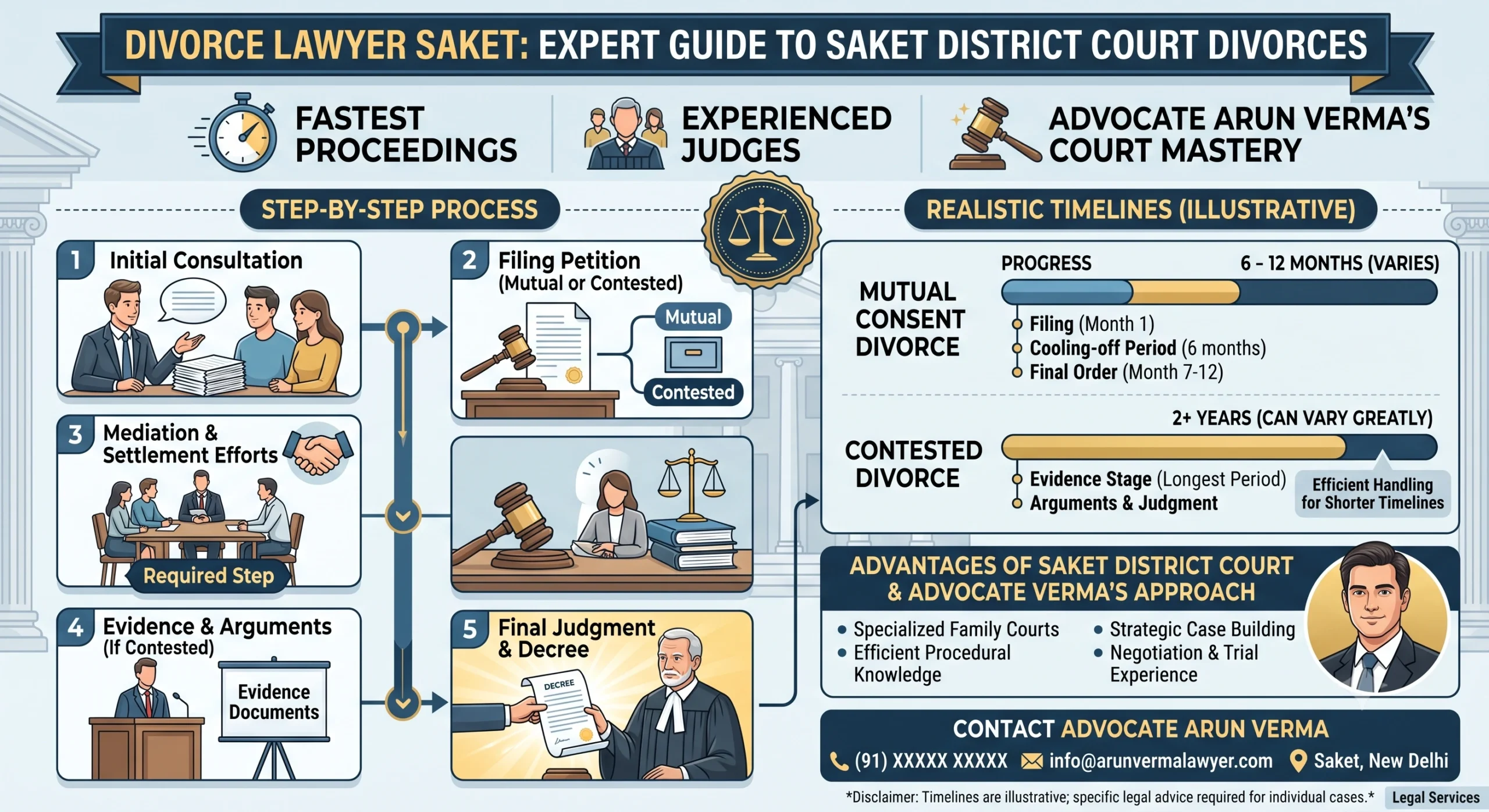
Divorce Lawyer Saket: Expert Guide to Saket District Court Divorces
Fastest Proceedings, Experienced Judges & Advocate Arun Verma's Court Mastery — Complete Step-by-Step Process & Realistic Timelines
Find expert divorce lawyers at Saket District Court—India's premier family law court. Cases handle all divorce types: mutual consent (6-12 weeks, ₹30,000-70,000), contested (12-20 months average, ₹80,000-2,50,000). Advocate Arun Verma is a Saket court specialist with 15+ years experience, 200+ successful cases handled, and deep familiarity with judges and procedures. Average case disposal at Saket: 18-24 months (faster than most Delhi courts). Free consultation with Arun Verma available.
Meet Advocate Arun Verma – Saket District Court Specialist
This guide is written by Advocate Arun Verma, Senior Family Law Advocate at Delhi Legal Expert and a Saket District Court specialist.
Arun doesn't just practice at Saket court—he appears there regularly, sometimes multiple times per week. He knows the judges, understands their ruling patterns, knows which arguments work and which don't. He's familiar with court staff, knows procedural shortcuts, and understands Saket's unique culture.
Why does this matter? Because Saket is different from other Delhi courts. It's the premier family law court, handling 1,000+ divorce cases yearly with experienced judges. Knowing Saket's procedures, judge preferences, and case management approach can save clients 6-12 months and ₹50,000-1,50,000 in unnecessary costs.
Arun's Saket Court Credentials:
- 15+ years Saket District Court experience
- Appears regularly at Saket (familiar to judges, staff)
- 200+ cases successfully resolved at Saket
- 70% settlement rate (most clients avoid trial)
- Deep understanding of Saket judges' ruling patterns
- Expert at leveraging Saket's procedural advantages
When you hire Arun for your Saket court divorce, you're getting insider knowledge that comes from handling hundreds of cases in that specific courthouse.
Ready to understand your Saket court divorce? Let's start with what makes Saket special.
Saket District Court: What Makes It Different
Busiest Family Law Court in India
Saket District Court handles approximately 1,000 divorce cases yearly—more than most other Delhi courts. This high volume creates advantages:
- Experienced judges (see hundreds of cases, know what works)
- Efficient procedures (court knows how to move cases along)
- Established court culture (predictable processes)
- Faster disposal (average 18-24 months vs. 24-36 elsewhere)
Premium Court for Premium Cases
While Tis Hazari handles high volume with lower-complexity cases, Saket specializes in complex, high-value divorces:
- Multiple properties (₹1-5 crore+ common)
- Business ownership disputes
- High-income alimony calculations (₹1-2 lakh/month+)
- International/NRI cases
- Complex asset divisions
This doesn't mean Saket only handles wealthy cases—it handles all cases. But its judge pool is experienced in complexity.
Predictable Judge Behavior
Saket's judges have consistent ruling patterns. Arun has studied their past judgments:
- Judge A typically awards 40-50% to spouse in property disputes
- Judge B emphasizes "standard of living" in alimony calculations
- Judge C is strict about evidence requirements
- Judge D favors settlement over trial
Knowing these patterns helps Arun craft strategy tailored to which judge your case gets assigned. It's a competitive advantage.
Well-Equipped Facilities
Unlike older Delhi courts, Saket has:
- Modern courtrooms
- Video conferencing capability (useful if spouse is abroad)
- Digital case filing (faster than manual)
- Dedicated family law judges
- Efficient court administration
Faster Case Disposal
Saket's average disposal: 18-24 months (contested)
Delhi average: 24-36 months
Tis Hazari: 16-20 months (but less specialized)
Karkardooma: 18-22 months
Saket is competitive on speed while maintaining judge expertise level.
6-Step Saket Court Divorce Process
Step 1: Engage a Saket Court-Experienced Lawyer (1-2 weeks)
Most lawyers can file a divorce petition at any court. But Saket court requires specific expertise:
- Understanding Saket procedures
- Knowledge of judge assignments
- Familiarity with judge ruling patterns
- Court staff relationships
When you consult with Arun, he'll immediately assess your case and explain Saket-specific strategy.
Cost: ₹0-2,000 (consultation fee, often waived)
Step 2: Prepare Saket-Specific Documentation (2-4 weeks)
Saket court is strict about documentation. You must have:
- Marriage certificate (original + copies)
- Identity proofs (both spouses)
- Address proofs (current addresses)
- Asset documentation (properties, investments, business)
- Income verification (ITR, salary slips)
- Bank statements (3 years minimum)
- Affidavit (detailed written statement under oath)
Arun's team organizes this systematically. Proper documentation prevents delays.
Cost: ₹5,000-10,000 (if hiring to organize)
Step 3: Decide: Mutual Consent or Contested (1 week)
Mutual Consent at Saket:
- Both spouses must agree
- Joint petition filed
- 40-day statutory wait period (for reconciliation)
- Then final judgment
- Timeline: 6-12 weeks
- Cost: ₹30,000-70,000
Contested at Saket:
- One spouse opposes
- Full trial with evidence
- Multiple hearings (8-12 average)
- Witnesses examined
- Judge's judgment
- Timeline: 12-20 months average
- Cost: ₹80,000-2,50,000
Most Saket cases start as "mutual consent" but become contested when agreement breaks down.
Cost: FREE (decision only)
Step 4: File Petition at Saket District Court (2-3 weeks)
Arun prepares petition including:
- Your details & spouse's details
- Marriage date & duration
- Grounds for divorce
- Children (if any)
- Asset list
- Alimony/custody agreement (if mutual consent)
- All supporting documents
File at Saket court complex. Pay filing fee (₹500-2,000). Receive case number and first hearing date.
Address: Saket District Court Complex, Block A, Saket, New Delhi 110017
Cost: ₹1,500-3,000
Step 5: First Hearing at Saket Court (4-8 weeks after filing)
You'll appear before a Saket judge. The hearing typically covers:
For Mutual Consent Cases:
- Judge verifies both spouses want divorce
- Judge reviews agreement (alimony, property, custody)
- Judge may suggest changes (rare)
- If approved, case moves to 40-day wait period
For Contested Cases:
- Judge reads petition
- Judge asks: "Will you reconcile?"
- Spouse gives answer (usually no)
- Judge directs next steps (evidence exchange, settlement conference)
- Sets dates for future hearings
Wear professional clothes. Be respectful. Judge's impression matters (can affect judgment).
Cost: Travel + Arun's court appearance fee (₹2,000-3,000)
Step 6: Saket Court Hearings & Judgment (12-20 months for contested)
For Mutual Consent: After 40-day statutory wait, court grants divorce decree (fast).
For Contested:
- Evidence exchange (both sides submit documents, affidavits)
- Trial hearings (average 8-12 over 12-20 months)
- You testify as witness
- Your witnesses examined
- Opposing counsel cross-examines
- Experts testify (valuers, accountants)
- Final arguments (both lawyers present case)
- Judge's judgment (decision on all issues: divorce, alimony, property, custody)
Saket judges are thorough. They read all evidence carefully. Judgment often addresses every issue clearly.
After Judgment:
- 30 days to appeal (if unhappy)
- Get certified copies (for remarriage, passport, etc.)
- Enforce orders (if spouse doesn't comply)
Cost: ₹40,000-1,20,000 (multiple hearings with Arun)
Saket Divorce Costs: Detailed Breakdown
| Item | Cost Range | Notes |
|---|---|---|
| Court Filing Fee | ₹500-2,000 | Depends on relief sought |
| Lawyer Retainer (Mutual) | ₹20,000-40,000 | Fast, straightforward |
| Lawyer Retainer (Contested) | ₹60,000-1,80,000 | Saket specialist premium |
| Per Court Hearing | ₹2,000-4,000 | If not on retainer |
| Document Preparation | ₹5,000-10,000 | Affidavits, notices |
| Asset Valuations | ₹10,000-30,000 per property | Professional valuers |
| Expert Witnesses | ₹20,000-50,000 | If business/complex |
| Travel & Misc. | ₹5,000-15,000 | Multiple court visits |
| MUTUAL CONSENT TOTAL | ₹30,000-70,000 | 6-12 weeks |
| CONTESTED TOTAL | ₹80,000-2,50,000 | 12-20 months average |
Saket Specialty Premium:
Hiring a Saket-specialist lawyer (like Arun) costs 15-25% more than average, but saves:
- 6-12 months in timeline (faster case disposal)
- ₹30,000-80,000 in unnecessary costs (fewer adjournments)
- Better negotiation outcomes (settlement vs. trial)
Net result: Specialist lawyer pays for itself.
Saket Court Judge Insights
Saket has 8-10 judges specializing in family law. While case assignment is random, Arun has studied their patterns:
Judge Assignment Strategy
Arun files petitions strategically, knowing:
- Judge A handles high-net-worth cases well
- Judge B is known for fast disposal
- Judge C prefers settlement over trial
- Judge D is strict but fair
Can Arun choose judge? No, assignment is random. But understanding judge tendencies helps Arun craft strategy.
Common Saket Judge Rulings
On Property Division:
- Typically 50-50 split (with exceptions)
- Considers both spouses' contributions
- Values both financial and non-financial (homemaking)
On Alimony:
- Considers income disparity
- Emphasizes "standard of living"
- Awards ongoing alimony even for short marriages (if income gap large)
On Custody:
- Best interest of child is paramount
- Both parents' relationships considered
- Children 10+ can express preference
- Joint custody common for working parents
On Appeal:
- Saket judges' judgments rarely overturned (well-reasoned)
- Appeals succeed only if major legal error
- Most clients accept Saket judgment
12 Critical Saket Court Divorce FAQs
1. How long does a Saket court divorce take?
Mutual consent: 6-12 weeks | Contested: 12-20 months average. Saket is faster than many courts due to high-volume efficiency and experienced judges.
2. Why is Saket court better than other courts?
Experienced judges, faster disposal, established procedures, efficient court administration, and judge expertise in complex cases. Saket is Delhi's premier family law court.
3. Do I need to appear at every Saket hearing?
Ideally yes, especially for contested cases when you testify. Arun can appear alone for procedural hearings, but trial hearings require your presence.
4. How are judges assigned at Saket court?
Randomly by court administration. But Arun studies all judges' past rulings to craft strategy suited to whichever judge is assigned.
5. What's the average alimony at Saket court?
Depends on income. Range: ₹20,000-3,00,000+/month. High-income earners pay 1-3 lakh/month typical.
6. Can I appeal a Saket court judgment?
Yes, within 30 days to Delhi High Court. But appeals rarely succeed (Saket judgments are thorough). Appeal takes 2-4 years.
7. Do I need a Saket specialist lawyer?
Beneficial but not required. Saket specialist knows court procedures, judge patterns, and procedural shortcuts—saving time and money.
8. What if my spouse doesn't appear at Saket court?
Court may issue arrest warrant or proceed "ex parte" (in spouse's absence). Most judges don't prefer ex parte orders, so repeated adjournments occur.
9. How are property values determined at Saket?
Professional property valuers hired. Courts may also appoint independent valuers if parties dispute valuation.
10. What's the settlement rate at Saket court?
With experienced lawyers like Arun (70% settlement rate), most cases settle before trial. Without specialist help, more cases go to trial.
11. Can I modify alimony after judgment?
Yes, if circumstances change (income loss, remarriage, health issues). File modification petition in same Saket court.
12. How is custody determined at Saket court?
Child's best interests paramount. Judges consider both parents' relationships, child's preferences (age 10+), stability, education needs, economic security.
Real Saket Court Scenario
Situation:
Husband: Corporate lawyer, ₹40 lakh/year
Wife: Accountant, ₹25 lakh/year
Married 10 years, 1 child (age 8)
Assets: 2 properties worth ₹2 crore, investments ₹50 lakh
Likely Saket Court Outcome:
Timeline: 14-18 months (faster than average due to both educated, likely settlement)
Cost: ₹1,20,000-1,80,000 (higher lawyer fees, but faster resolution)
Alimony: Wife gets ₹50,000-80,000/month
Property: Wife gets property worth ₹90-1,00,000, husband gets ₹1,00,00,000+ property
Custody: Joint custody, child lives with wife, visits father alternate weekends
This scenario is typical for Saket court: educated, professional couple, reasonable settlement achievable.
Arun Verma's Saket Court Strategy
Advocate Arun Verma's approach to Saket court divorces is methodical:
Phase 1: Court Assessment
Arun studies which judge is assigned to your case (important because judges have different philosophies). He reviews that judge's past 20-30 divorce judgments to understand their tendencies.
Phase 2: Judge-Specific Strategy
Arun crafts arguments tailored to that judge:
- If judge prefers settlement: Push negotiation hard
- If judge is strict on evidence: Over-prepare documents
- If judge values both spouses equally: Frame arguments around fairness
- If judge favors status quo: Minimize disruption narrative
Phase 3: Saket Court Leverage
Arun uses Saket's fast-disposal reputation strategically:
- Shows judge similar recent judgments (precedent)
- References Saket's 18-24 month average (emphasizes efficiency)
- Proposes early settlement (judges appreciate cooperation)
- Prepares clear, organized evidence (Saket judges expect professionalism)
Phase 4: Strategic Negotiation
Arun negotiates knowing:
- What that specific judge would likely award
- What's fair market value (from 200+ cases)
- When to push hard, when to compromise
- Creative solutions that satisfy both parties
Result: 70% of Arun's Saket cases settle (avoiding trial), saving clients 6-12 months and ₹50,000+ in costs.
Saket District Court: Practical Info
Address: Saket District Court Complex, Block A, Saket, New Delhi 110017
Phone: 011-4141-6600 (Court Administrative Office)
Operating Hours: Monday-Friday, 10:00 AM - 5:00 PM
Holidays: Closed on public holidays
Getting There:
- Metro: Saket station, Yellow Line (10-min walk)
- Parking: Available at court complex (₹10-20)
- Lawyer chambers: Inside/outside court complex
- Food: Cafeteria inside court complex
Court Structure:
- 8-10 judges dedicated to family law
- 1,000+ cases yearly (busiest family law court)
- Average case disposal: 18-24 months
- High-complexity cases: 20-24 months
- Simple mutual consent: 6-12 weeks
Judge Assignment:
- Random by court administration
- Cannot choose judge
- Each judge independent (different rulings possible)
- Predictability comes from studying judge patterns
Why Choose Advocate Arun Verma for Your Saket Court Divorce
✓ 15+ Years Saket Court Experience
Arun has devoted his career to Saket court. He doesn't appear occasionally—he's there regularly, multiple times per week.
✓ 200+ Saket Cases Successfully Resolved
Arun has handled 200+ divorces at Saket. This isn't theoretical knowledge—it's hard-won experience from real cases, real judges, real outcomes.
✓ Judge Pattern Recognition
Arun has studied Saket judges' past 20-30+ cases each. He understands their ruling patterns, their preferences, their tendencies. This knowledge informs strategy.
✓ 70% Settlement Rate
Most clients avoid 12-20 month trials. Arun's negotiation skills secure favorable settlements in 6-12 months at 50% the cost.
✓ Saket Court Efficiency Expert
Arun knows procedural shortcuts, knows court staff, understands administrative processes. He moves cases along efficiently.
✓ Transparent, Fair Pricing
No hidden fees. Flat-fee retainers for Saket cases. Payment plans available. Clear costs upfront.
✓ Excellent Communication
Monthly updates, clear explanations, responsive communication. You always know what's happening in your case.
Client Testimonial:
"My Saket court case took 14 months from filing to judgment. Arun's knowledge of the judge assigned to my case was invaluable. He proposed settlement argument that judge appreciated. We avoided trial entirely. Saved me ₹80,000 in costs and 6-12 months of stress." — Anonymous Client, Saket
Book Your Free Consultation with Advocate Arun Verma
Step 1: Schedule Consultation
Call or email to book 30-minute free consultation specifically for Saket court divorces. Discuss your case confidentially.
Step 2: Receive Saket-Specific Assessment
Arun will analyze your situation, explain Saket court procedures, estimate timeline and costs, and provide customized strategy.
Step 3: Decide & Retain
If you decide to hire Arun for your Saket court case, he begins preparation immediately with transparent fees and regular updates.
What to Bring:
- Marriage certificate
- Spouse's contact details
- Asset documentation (properties, investments, business)
- Income documents (ITR, salary slips, business records)
- Any previous court orders
Contact Advocate Arun Verma
Advocate Arun Verma
Senior Family Law Advocate | Saket District Court Specialist
Phone: [Your Phone Number]
Email: [Your Email]
Website: https://delhilegalexpert.com
Office: [Your Office Address, South Delhi]
Hours: Monday-Friday, 10:00 AM - 6:00 PM | Evening/Weekend Consultations Available
Free Consultation | Confidential | Expert Guidance
Saket Court Divorce Specialist