Matrimonial Lawyer in Delhi: How to Choose the Right Divorce & Family Law Advocate
Quick Answer
A matrimonial lawyer in Delhi aids in divorce, mutual consent divorce, contested matrimonial cases, maintenance, alimony, child custody, visitation, settlement negotiation, and associated family law matters. No one really has a “best” lawyer for each and every case. It comes down to the lawyer’s experience handling your case type, knowledge of which court in Delhi you need, clear communication of strategy and cost, and the willingness to provide honest insights as opposed to guarantees.
Key Takeaways
- Choose a lawyer based on matrimonial-law experience relevant to your case, not only on a “best” or “top” label.
- Mutual consent divorce and contested divorce require different skills: settlement drafting and procedural efficiency in one, and evidence and trial experience in the other.
- Jurisdiction should be checked before filing. Under Section 19 of the Hindu Marriage Act, 1955, the appropriate court can depend on factors including where the marriage took place, where the respondent resides, and where the spouses last lived together; additional rules can apply depending on the facts and applicable law.
- Matrimonial disputes may also involve maintenance, custody, property-related questions, domestic-violence proceedings, or other connected litigation. These issues should be considered together when developing a legal strategy.
- There is no universal Delhi divorce lawyer fee. Ask whether the quoted professional fee includes drafting, appearances, applications, mediation, evidence, and connected proceedings.
- For Hindu marriages, Section 13B of the Hindu Marriage Act provides for divorce by mutual consent where its statutory requirements are satisfied. The six-month period in Section 13B(2) is not an automatic absolute bar in every case; courts have discretion to consider waiver in appropriate circumstances.
- A lawyer can explain legal options and risks, but no responsible advocate can guarantee a divorce, custody order, maintenance amount, or particular court outcome.
What Does a Matrimonial Lawyer in Delhi Do?
A matrimonial lawyer is an advocate who provides advice and represents clients with matters related to marriage, separation and family disputes.
Depending on the case, the work may include:
- Mutual consent divorce
- Contested divorce
- Judicial separation
- Annulment or nullity proceedings
- Maintenance and alimony
- Child custody and visitation
- Guardianship-related proceedings
- Matrimonial property and settlement issues
- Domestic-violence-related proceedings
- Matrimonial mediation and settlement
- Appeals and other connected proceedings
- Advice concerning related criminal or civil proceedings
The applicable law is based on the marriage and the facts. For instance, if a marriage falls within the jurisdiction of the Hindu Marriage Act, 1955, the provisions of that Act shall apply to such a marriage; but if it does not fall within the provisions of the Hindu Marriage Act, 1955, then it may be governed by different Acts of Parliament or by personal law.
For that reason, looking for a matrimonial lawyer in Delhi is not one thing to find a person who can “file a divorce.” The question, which is much more important, is whether the advocate has an understanding of the legal framework and dispute that would apply to you in your given situation.
When Do You Need a Divorce or Matrimonial Lawyer?
You may benefit from legal advice before filing anything, particularly if there is disagreement about the marriage, finances, children, or previous proceedings.
You may want a lawyer before filing when:
- Your spouse does not agree to divorce.
- There are allegations of cruelty, adultery, desertion, or other legally relevant grounds.
- You and your spouse agree to separate but need help drafting a settlement.
- There are children, and you need to address custody, visitation, or expenses.
- Maintenance or permanent financial support is disputed.
- Property, jewelry, stridhan, loans, or other financial issues are part of the separation.
- A domestic-violence, police, or other legal proceeding is already pending.
- You are an NRI or one spouse lives outside Delhi or India.
- You are unsure which court has jurisdiction.
- Your spouse has already filed a case against you.
You do not necessarily need to begin with litigation. In some situations, an initial consultation can clarify whether negotiation, mediation, mutual consent proceedings, or contested litigation is appropriate.
What Does a Divorce Lawyer Actually Do?
A good matrimonial advocate’s work goes beyond appearing on hearing dates.
1. Understands the facts
The lawyer needs to know the chronology of the relationship and the legal events surrounding it.
Useful information includes:
- Date and place of marriage
- Current addresses of both spouses
- Previous matrimonial residence
- Date of separation
- Children and their ages
- Income and major financial obligations
- Existing court cases or complaints
- Important correspondence or evidence
- Any settlement discussions
- Your immediate legal objective
2. Identifies the applicable law
Different marriages and disputes can fall under different legal frameworks. The lawyer should explain which statute or combination of laws applies rather than assuming that every divorce follows the same procedure.
3. Checks jurisdiction
Jurisdiction can affect where the petition should be presented.
For proceedings under the Hindu Marriage Act, Section 19 contains several jurisdictional bases, including the place where the marriage was solemnised, where the respondent resides, and where the parties last resided together, subject to the statutory wording and applicable facts. The provision also contains a specific rule concerning the wife’s residence in certain circumstances.
This is one reason a Delhi address alone does not automatically mean that every matrimonial case can be filed in any Delhi court.
4. Develops a case strategy
The strategy can be very different depending on whether the matter is:
- Mutual consent
- Negotiated but not yet settled
- Contested
- Primarily a custody dispute
- Primarily a maintenance dispute
- A dispute involving multiple connected proceedings
5. Drafts and reviews legal documents
This may include petitions, replies, applications, affidavits, settlement documents and other pleadings.
6. Negotiates settlement
Where appropriate, the advocate may negotiate issues such as:
- Maintenance or alimony
- Child custody
- Visitation
- Children’s education and expenses
- Return of belongings or stridhan
- Property-related arrangements
- Withdrawal or resolution of connected proceedings
7. Represents the client in court
Depending on the case, representation may involve procedural hearings, interim applications, evidence, cross-examination, arguments, mediation, and appellate proceedings.
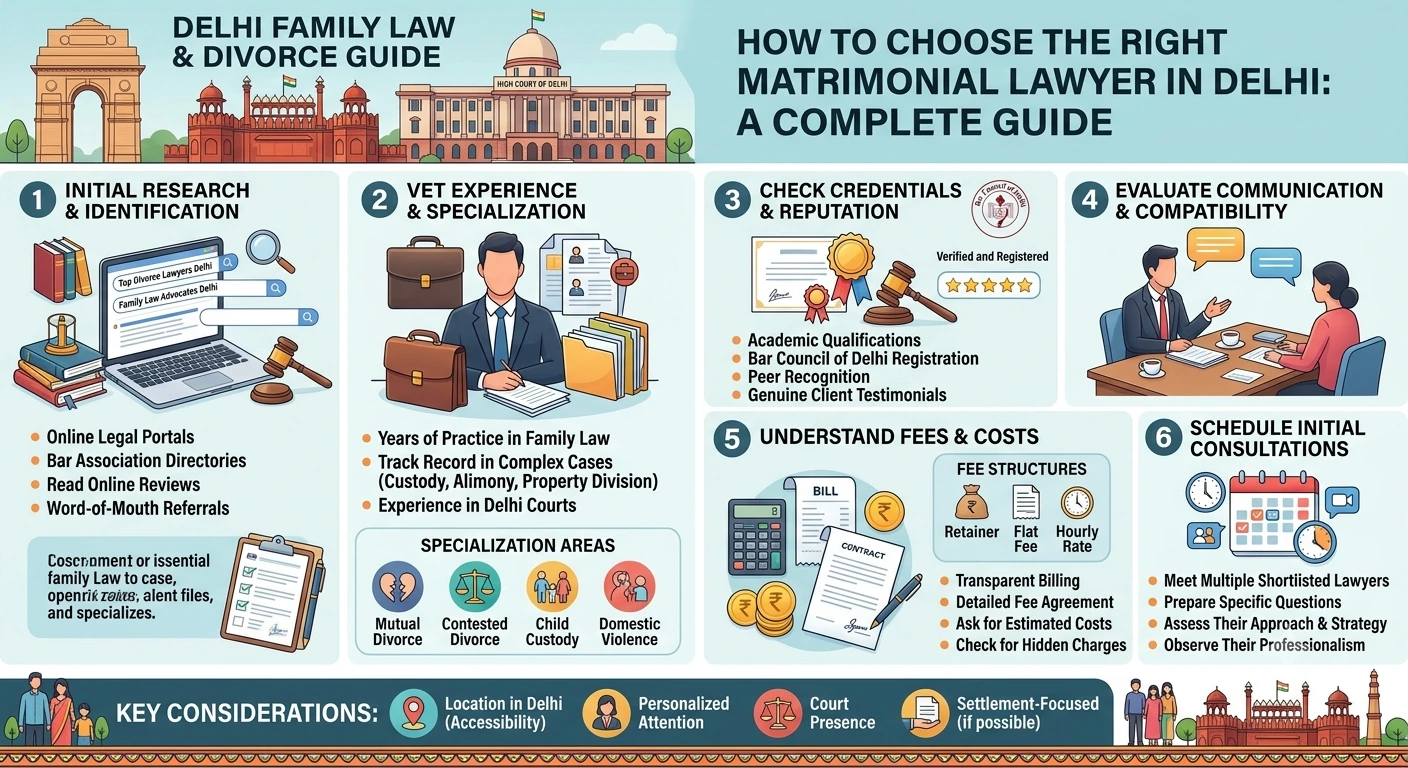
How Do I Choose a Divorce or Matrimonial Lawyer in Delhi?
No such list of “best matrimonial lawyers in Delhi” is there as there is no objectivity about it. While directory rankings and website claims and online reviews might help give a starting point, they should not be a substitute for professional verification and a discussion of an actual case.
Use this framework instead.
1. Check relevant matrimonial-law experience
It’s not always the right guy for the job, and a lawyer specializing in property is not necessarily the best choice for a complex divorce case. Likewise, a lawyer who becomes very familiar with negotiating a mutual consent case may not be the one to handle a case where a lot of evidence is to be introduced and a great deal of cross-examination is to be conducted.
2. Match the lawyer to your case type
Ask questions such as:
- Do you regularly handle mutual consent divorces?
- Do you conduct contested matrimonial trials?
- Have you handled custody disputes?
- Do you advise on maintenance and alimony?
- Do you handle matrimonial mediation?
- Do you deal with connected domestic-violence or criminal proceedings where relevant?
- Are appeals or Delhi High Court proceedings part of your practice?
3. Ask about court experience
Delhi has several courts of district and family courts. The official website of the Delhi District Courts offers details regarding districts, court services, case status, e-filing of courts, and links to Delhi Family Courts.
The question is not just this, that, or the other: Is a lawyer’s office in Delhi? Inquire if the advocate is frequently appearing in court that your case involves.
4. Evaluate communication
A good consultation should leave you with a clearer understanding of:
- Your possible legal routes
- The major risks
- Documents required
- Likely procedural stages
- Settlement possibilities
- Immediate next steps
- The proposed fee structure
Be cautious if basic questions are avoided or if you are pressured to sign an engagement immediately.
5. Look for fee transparency
Before engagement, ask:
- Is the consultation separately charged?
- Is drafting included?
- Are court appearances included?
- Are interim applications extra?
- Is mediation included?
- Are evidence and cross-examination charged separately?
- Are appeals a separate engagement?
- What happens if the case settles early?
6. Ask who will actually handle the case
This is often overlooked.
If you meet a senior advocate, ask:
“Who will draft my pleadings, attend routine hearings and argue the important applications?”
A large office may have several advocates working on a matter. That is not inherently good or bad, but you should know the arrangement before engaging the firm.
7. Avoid guaranteed-outcome claims
Be cautious about statements such as:
- “100% divorce guaranteed”
- “Guaranteed custody”
- “We will finish the case in one month”
- “The judge will definitely grant maintenance”
- “Your spouse cannot do anything”
- “We guarantee a favourable judgment”
Court outcomes depend on facts, evidence, law and judicial determination. A responsible lawyer should explain possibilities rather than guarantee results.
Which Type of Matrimonial Lawyer Is Suitable for Your Case?
| Your situation | Look for experience in |
|---|---|
| Both spouses agree to divorce | Mutual consent divorce and settlement drafting |
| Spouse disputes the divorce | Contested matrimonial litigation |
| Financial support is disputed | Maintenance and alimony proceedings |
| Children are involved | Custody, visitation and child-related litigation |
| Property or assets are disputed | Matrimonial settlement and property-related issues |
| Domestic violence allegations are involved | Matrimonial + relevant protective/criminal proceedings |
| One spouse lives outside Delhi | Jurisdiction and cross-border/NRI matrimonial issues |
| Existing cases are pending | Coordinated matrimonial litigation strategy |
| Settlement appears possible | Mediation and negotiated settlement |
Mutual Consent vs Contested Divorce
The distinction is important when choosing a lawyer.
| Factor | Mutual Consent Divorce | Contested Divorce |
|---|---|---|
| Agreement | Both spouses agree to seek divorce and settle applicable terms | One or both parties dispute divorce or related issues |
| Main focus | Consent terms, settlement and statutory procedure | Grounds, pleadings, evidence and adjudication |
| Lawyer’s role | Drafting, settlement review, procedural guidance and court representation | Case preparation, pleadings, evidence, cross-examination and arguments |
| Settlement | Usually central to the process | May occur before or during litigation |
| Evidence | Generally less dispute-focused | Often a major part of the case |
| Timeline | Can be shorter, but depends on statutory requirements and court process | Can be considerably longer depending on complexity and pendency |
| Suitable lawyer | Strong settlement and matrimonial-procedure experience | Strong matrimonial litigation and trial experience |
For Hindu marriages, Section 13B of the Hindu Marriage Act addresses divorce by mutual consent. It requires the statutory conditions to be satisfied, including the requirement concerning separation stated in Section 13B(1).
What Is the Difference Between Mutual Consent and Contested Divorce?
Mutual consent divorce is a type that is based on both spouses agreeing to the divorce and making the necessary agreement on the issues.
A contested divorce is one in which there is a dispute that needs to be resolved by the court by either of the parties. This may include pleadings, evidence, cross-examination, and arguments and will depend on the particular circumstances of the case.
Before making it too far on the road to the long, drawn-out contested case, a lawyer should consider whether a real negotiated settlement is feasible at all or whether the separation should be allowed to proceed into such a case.
Which Court Handles Divorce Matters in Delhi?
Applicability of the law and the jurisdictional facts will determine the appropriate court. Section 19 of the Hindu Marriage Act (HMA) lays out multiple possibilities for jurisdiction in a petition. These include the location of the marriage, the respondent’s home, and the last place of the parties’ joint residence, subject to statutory requirements.
District Establishments and Family Courts are the parts of the judicial system in Delhi. The Delhi District courts are also located in various places, including Tis Hazari, Karkardooma, Saket, Rohini, and Patiala House, which are identified in an official document of the district court of Delhi, and the court system separately provides access to Delhi Family Courts and its services.
Why should jurisdiction be checked before filing?
Because filing in the wrong forum can create avoidable procedural complications.
During your first consultation, give the lawyer:
- Marriage location
- Current residence of both spouses
- Previous matrimonial residence
- Date and place of separation
- Any existing court cases
- Whether either party lives outside India
The advocate can then assess the appropriate jurisdiction under the law applicable to your marriage.
How Much Does a Matrimonial Lawyer Charge in Delhi?
There is no single statutory professional fee for matrimonial lawyers in Delhi.
A lawyer’s professional fee may depend on:
- Type of case
- Complexity
- Mutual or contested proceedings
- Number and nature of applications
- Court appearances
- Evidence and cross-examination
- Custody disputes
- Maintenance proceedings
- Mediation and settlement work
- Appeals or connected proceedings
- Advocate’s experience and professional practice
For that reason, online fee figures should be treated cautiously. A low advertised figure may cover only part of the work.
What should you ask about fees?
| Fee Component | What to Ask |
|---|---|
| Consultation | Is it separately charged? |
| Petition drafting | Is drafting included in the quoted fee? |
| Filing | Are filing-related expenses separate? |
| Court appearances | Per hearing, stage-based or package? |
| Interim applications | Included or separately billed? |
| Maintenance proceedings | Separate engagement or included? |
| Custody proceedings | Included or separately charged? |
| Evidence | Is evidence-stage work separately billed? |
| Cross-examination | Included in the trial fee? |
| Mediation | Is mediation representation included? |
| Settlement drafting | Included? |
| Appeals | Separate professional engagement? |
| Connected cases | Separate fee structure? |
The objective should be clarity, not simply finding the lowest quotation.
Documents to Take to Your First Consultation
You do not necessarily need every document before speaking to a lawyer. However, organised records can make the consultation much more productive.
Basic documents
- Marriage certificate, if available
- Identity documents
- Current address proof
- Details of previous matrimonial residence
- Passport details where relevant
- Children’s birth certificates, if applicable
Case-related documents
Bring copies of:
- Existing petitions
- Court notices
- Orders
- Complaints
- FIRs or other police documents, where relevant
- Mediation records
- Previous legal notices
- Settlement proposals
Financial information
Where maintenance, alimony or settlement is relevant, organise:
- Salary or income records
- Bank statements where appropriate
- Tax-related documents
- Loan statements
- Major asset information
- Relevant financial liabilities
- Children’s educational or medical expenses
Evidence in contested matters
Depending on the dispute, potentially relevant material may include:
- Emails
- Messages
- Letters
- Photographs
- Medical records
- Financial records
- Witness information
- Relevant official documents
Do not delete potentially relevant evidence simply because you think it is embarrassing or unimportant. Instead, discuss it confidentially with your lawyer and ask what should be preserved and how.
Questions to Ask Before Hiring a Matrimonial Lawyer
Take this checklist to your consultation:
- What law applies to my marriage?
- Which court is likely to have jurisdiction?
- Is mutual consent realistically possible?
- If not, what legal route should I consider?
- What are the strongest and weakest parts of my position?
- What evidence should I preserve?
- Are maintenance or custody issues likely to arise?
- What settlement terms should I consider before filing?
- Who will personally handle my important hearings?
- What work is included in your professional fee?
- What additional expenses should I expect?
- What could make the matter take longer?
- What are the realistic risks?
- Is mediation appropriate?
- What should I avoid doing while the dispute is pending?
A useful lawyer should be comfortable discussing weaknesses as well as strengths.
Red Flags When Choosing a Divorce Lawyer in Delhi
Consider obtaining a second opinion if a prospective lawyer:
- Guarantees a particular result
- Promises an exact court timeline without qualification
- Claims to be “No. 1” without objective evidence
- Refuses to explain the fee structure
- Cannot clearly identify the applicable legal framework
- Encourages unnecessary litigation without discussing alternatives
- Makes promises based on supposed personal influence over a judge
- Cannot explain who will actually conduct the case
- Pressures you to sign immediately
- Discourages reasonable questions about documents, jurisdiction, or strategy
A strong lawyer does not need exaggerated claims to demonstrate competence.
How Long Can Divorce Proceedings Take in Delhi?
No such thing as a definitive timeline for divorce.
As settlement discussions may proceed more quickly than litigated proceedings, and a mutual consent divorce may be simpler to proceed, the length of the process will depend on the statutory requirements, court scheduling, continued consent of the parties, and settlement terms and whether there is any applicable waiting period that can be waived.
Issues that are disputed can take a lot longer, as they may require pleadings, interim applications, evidence, cross-examination, arguments and possible appeals.
What can affect the timeline?
- Whether the divorce is mutual or contested
- Whether jurisdiction is disputed
- Whether the respondent has been served
- Number of applications
- Court availability and scheduling
- Settlement negotiations
- Evidence required
- Custody disputes
- Maintenance proceedings
- Connected criminal or civil proceedings
- Appeals or transfer proceedings
A lawyer may provide a practical assessment after reviewing the facts, but a responsible estimate should not be presented as a guarantee.
Is Mutual Divorce Faster Than Contested Divorce?
Typically, mutual consent cases are less complicated than contested divorce, but there is no set timeframe for these cases to resolve.
Section 13B lays down a procedure for the mutual consent divorce for Hindu marriages. The second motion may be made, subject to the statutory scheme, within a period of six months of the petition’s presentation and eighteen months at most. Not less than 6 months after presentation of the petition, not more than 18 months at most, a second motion may be made, subject to the statutory scheme.
In Amardeep Singh v. Harveen Kaur, the Supreme Court had held that the six-month period under Section 13B(2) is not an inflexible mandatory period and that the period may be waived in an appropriate case.
Subsequent Supreme Court rulings have also warned against the interpretation of conditions in Amardeep Singh as a checklist. What actually happened does still count, and the waiver is not a conclusion but something to be considered by the judge.
Can the Six-Month Period Be Waived?
It may be waived in an appropriate case but does not need to be waived.
However, the Supreme Court in the case of Amardeep Singh v. Harveen Kaur appreciated judicial discretion in cases where reconciliation is not feasible and after six months, there was no useful purpose served.
A lawyer considering a waiver application should examine factors such as:
- How long the parties have been separated
- Whether reconciliation efforts have failed
- Whether the parties have genuinely settled relevant disputes
- Whether financial issues have been resolved
- Whether custody and child-related issues have been addressed
- Whether further waiting would serve a meaningful purpose
The current legal position should be checked against the latest applicable Supreme Court and High Court decisions before filing.
Child Custody Considerations in a Divorce Case
Divorce and child-related issues should not be treated as completely separate strategic questions.
Where children are involved, discuss:
- Physical custody
- Interim custody
- Visitation or parenting time
- Schooling
- Medical expenses
- Education expenses
- Travel arrangements
- Communication with the child
- Relocation
- Decision-making responsibilities
- Long-term financial support
Under the Hindu Marriage Act, Section 26 specifically addresses custody, maintenance and education of minor children in proceedings under the Act.
The court’s decision is fact-specific. A lawyer cannot responsibly guarantee that either parent will receive a particular custody arrangement.
Maintenance and Alimony
Financial support can arise at different stages and under different legal provisions.
For marriages governed by the Hindu Marriage Act:
- Section 24 concerns maintenance pendente lite and expenses of proceedings.
- Section 25 concerns permanent alimony and maintenance.
- Section 26 addresses custody, maintenance and education of minor children.
Other statutes and legal remedies may also be relevant depending on the parties and facts.
There is no universal formula that guarantees a particular maintenance amount. Income, financial circumstances, responsibilities, standard of living, children’s needs and other relevant factors can affect the legal analysis.
This is another reason why a matrimonial lawyer should review the financial facts rather than quoting a guaranteed figure during a first phone call.
Mediation and Settlement in Delhi Matrimonial Cases
Mediation may be helpful when both parties are ready to negotiate a mutually agreeable solution.
The information on the official Delhi District Courts website allows you to access information about the Delhi Mediation Centre and Delhi Family Courts. The Delhi court system also provides information on the procedure and services of the Family Court.
Parties can resolve their issues through mediation:
- Divorce by consent
- Maintenance
- Custody
- Visitation
- Children’s expenses
- Property arrangements
- Return of belongings
- Withdrawal or resolution of connected proceedings
Mediation is not appropriate for every dispute. A lawyer should explain both the potential benefits and any risks before recommending settlement.
Practical Insights From Matrimonial Practice in Delhi
This section is intended as general professional guidance and should not be presented as a personal case history unless verified by the reviewing advocate.
Prepare a chronology before your consultation
A two-page timeline can be more useful than a large pile of unorganised documents.
Include:
- Marriage date
- Important changes in the relationship
- Birth of children
- Date of separation
- Major disputes
- Police or court proceedings
- Settlement discussions
- Current living arrangements
This helps the lawyer identify legally relevant events quickly.
Separate facts from assumptions
Clients often arrive with conclusions such as “my spouse has committed cruelty” or “I am automatically entitled to half the property.”
The better approach is to explain exactly what happened and allow the lawyer to identify the legal significance.
Settle the important issues before calling a matter “mutual”
A couple may agree that they want a divorce but still disagree about:
- Alimony
- Child custody
- Visitation
- School fees
- Property
- Loans
- Jewellery
- Return of documents
- Pending proceedings
A lawyer should help identify these issues before the parties assume that a complete mutual settlement already exists.
Preserve documents early
Messages, financial records, court papers and official documents may become important later. Preserve relevant material lawfully and avoid altering or fabricating evidence.
Do not confuse legal advice with a guaranteed result
A good consultation should answer:
What can I legally do?
It cannot honestly promise:
Exactly what will the judge decide.
That distinction is especially important in matrimonial litigation because both factual and judicial variables can affect the outcome.
Why Consider Delhi Legal Expert?
Delhi Legal Expert’s matrimonial-law service page
Delhi Legal Expert’s current service page positions the practice around divorce, matrimonial disputes, child custody, maintenance, domestic violence and related family-law matters, with stated coverage of Delhi courts.
For a prospective client, the useful question is not simply whether a firm describes itself as the “best.” Instead, ask whether the service offered matches your case.
A consultation should ideally help you understand:
- Which legal framework may apply
- Whether Delhi has jurisdiction
- Whether mutual consent is realistic
- What documents should be preserved
- Whether maintenance or custody issues need early attention
- Whether mediation could be useful
- What the proposed professional-fee structure covers
- What the next procedural step should be
Any claims concerning individual advocates’ credentials, enrolment, years of practice, case volume, awards or results should be independently verified before publication.
Need Clarity About Your Divorce Case in Delhi?
If you are considering hiring a matrimonial lawyer in Delhi, an initial legal consultation can help turn a broad concern into a clearer action plan.
Before engaging an advocate, try to leave the consultation knowing:
- What legal options are available?
- Which court or jurisdiction may be relevant?
- What documents and evidence should be preserved?
- Are settlement or mediation options realistic?
- What issues involving maintenance, custody or property need attention?
- What will the lawyer’s professional fee cover?
- What should happen next?
Contact Delhi Legal Expert for matrimonial-law assistance
No consultation can guarantee the outcome of a case, but a properly informed discussion can help you make a more considered decision about the next legal step.
Frequently Asked Questions
Who is the best matrimonial lawyer in Delhi?
No one has a “one size fits all” solution regarding who the best matrimonial lawyer is for them and their situation. A better way is to compare the advocates regarding their specialization in matrimonial laws, experience in similar cases, practice in Delhi courts, communication, transparency in fees and settlement, or trial experience in the case. While online ratings or “best” labels can provide a good starting point, professional verification should not be assumed.
How do I choose a good divorce lawyer in Delhi?
First, consider your type of case, such as a mutual consent divorce, contested divorce, custody, maintenance, or any other type of matrimonial dispute. Then inquire of any new attorneys you speak with about past experience with similar cases, jurisdiction, appearances in court, who will be working on your case, fees, and realistic risk. Don’t accept someone who promises a specific outcome or timeline.
How much does a divorce lawyer charge in Delhi?
The professional fee is not standard. Charges may vary depending on the nature and complexity of the case, preparation, court appearances, interim applications, evidence, mediation, custody/maintenance actions, and appeals. Look for a written contract detailing what is covered and what will be an extra fee before entering into an agreement.
Which lawyer is suitable for a mutual consent divorce?
Select a lawyer that routinely deals with mutual consent divorces and drafting of settlement agreements. The lawyer should be familiar with the statutory provisions, assist in determining what financial and child-related issues are not resolved, confirm jurisdiction, and clarify the first and second motion procedure. The Hindu Marriage Act 1955 contains the mutual-consent provisions for Hindu marriages in Section 13B.
Which lawyer is suitable for a contested divorce?
If it is contested, seek a representative who has tried cases and has some experience in matrimonial litigation. Inquire of experience in pleadings, interim applications, evidence, cross-examination, and arguments in similar cases. If there are any existing coordinated criminal, domestic violence, or financial proceedings, inquire if the attorney can coordinate the litigation strategy.
Do I need a Delhi-based divorce lawyer?
Not necessarily. The key question is whether the advocate has the authority and expertise to appear before the court and whether they have substantive experience in the same jurisdiction and legal area in which they seek to appear. In a matrimonial case, however, a Delhi court, whether a family court or a district court, will be of practical value to an individual who has regular access to it.
Which court handles my divorce in Delhi?
The answer will be based on the law applicable and facts as to jurisdiction. Under the Hindu Marriage Act, Section 19 provides for several jurisdiction bases, such as the place of marriage, the residence of the respondent, and the last residence of the parties, subject to the provision of the statute.
What documents should I take to a divorce lawyer?
Bring marriage papers, identity and address papers, paperwork regarding the present and past matrimonial home, paperwork regarding the children (if any), existing court papers, paperwork of legal notices and significant financial records. If there are any issues in dispute, keep relevant communications, medical records and other evidence and have the lawyer explain what they think needs to be kept.
Can the six-month period for mutual divorce be waived?
Yes, a court could have discretion in deciding to waive the 6-month wait required by Section 13B(2) of the Hindu Marriage Act under “appropriate circumstances.” The Supreme Court has affirmed this principle in Amardeep Singh v. Harveen Kaur. Waiver is not a right that is automatic, and facts and current case law should be taken into account.
How long can divorce proceedings take in Delhi?
There is no set timeframe. The process for mutual consent cases may be simpler than contested litigation, and the contested cases may be longer due to pleadings, evidence, hearings, and other applications. The length of time may also be impacted by court scheduling, settlement, jurisdiction issues, and related proceedings.
Can custody and divorce issues be dealt with together?
They may occur in the same matrimonial law proceedings as long as the law allows, but the exact way of the proceeding is dependent on the case and the law. In proceedings under the Hindu Marriage Act, Section 26 discusses the custody, maintenance, and education of minor children.
Can a lawyer guarantee the outcome of my divorce case?
No responsible lawyer should guarantee a particular judicial outcome. An advocate can be a good source of information on the law, evidence, procedures, and possible pitfalls, but final judgment rests with the court. Look out for guarantees of divorce, custody rights, maintenance awards, or court-ordered schedules.
Author and Legal Review
Written by: Delhi Legal Expert Editorial Team
Legally reviewed by: [REAL ADVOCATE NAME — VERIFY AND INSERT BEFORE PUBLICATION]
Practice area: Matrimonial & Family Law
Last reviewed: 28 August 2026
Editorial note: The legal reviewer should be a real, independently verified advocate. Do not publish an advocate’s name, Bar Council enrolment details, years of practice, awards, case results or other professional credentials unless verified from reliable sources.
This article provides general legal information for readers researching matrimonial law in Delhi. It is not a substitute for advice based on the specific facts and documents of an individual case. Laws, procedures and judicial interpretations can change, so important legal decisions should be checked against current legislation and applicable court decisions.
Authoritative Legal Sources
India Code — Hindu Marriage Act, 1955
India Code is the Government of India’s official legislative information resource. The Hindu Marriage Act includes provisions concerning divorce, mutual consent, jurisdiction, maintenance, custody and related matrimonial matters.
India Code — Hindu Marriage Act, 1955
Supreme Court of India
The Supreme Court’s official website provides judgments, orders and other authoritative court information.
Supreme Court of India
Delhi High Court
The official Delhi High Court website provides judgments, orders, cause lists, e-filing and other court services.
Delhi High Court
Delhi District Courts
The official Delhi District Courts portal provides information about district courts, Family Courts, e-filing, case status and related court services.
Delhi District Courts
Amardeep Singh v. Harveen Kaur
The Supreme Court’s decision is important when discussing the discretionary waiver of the six-month period under Section 13B(2) of the Hindu Marriage Act.
Supreme Court judgment — Amardeep Singh v. Harveen Kaur
Final Thoughts
Choosing a matrimonial lawyer in Delhi should be based on fit, not slogans.
The most useful questions are straightforward: Does the lawyer handle cases like yours? Do they understand the relevant Delhi jurisdiction? Can they explain the strengths and weaknesses of your position? Are fees and responsibilities clear? Do they know when settlement may be better than litigation? And, if the case becomes contested, do they have the litigation skills required?
A thoughtful first consultation should leave you with a clearer legal position, a realistic understanding of your options and a defined next step.
That is a more reliable way to choose legal representation than simply searching for the lawyer described online as the “best” or “top” matrimonial lawyer in Delhi.