What Is a Bail Application and How Does It Work in Delhi?
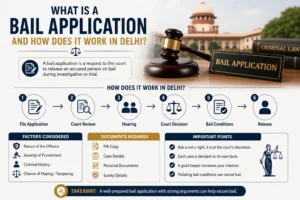
A bail application is a formal legal petition filed before a court requesting the release of an arrested or about-to-be-arrested person from custody, subject to conditions set by the court. In Delhi, bail applications are filed before magistrate courts, sessions courts, or the Delhi High Court depending on the nature of the offence and the stage of the case. The bail application must be supported by a lawyer who argues why bail should be granted.
Bail is not automatic in most criminal cases in India. For non-bailable offences — which include most serious crimes like fraud, assault, NDPS drug offences, and cybercrime — the accused must apply for a bail application before a court, and the court exercises discretion. The quality of the bail application and the advocacy at the hearing directly affects whether bail is granted or rejected.
Why Bail Matters — The Stakes of Every Bail Application
- Every day in custody before trial is a day lost — to family, employment, health, and dignity
- A rejected bail application at the magistrate court can be challenged before the Sessions Court or Delhi High Court
- The grounds argued in the first bail application set the tone for all subsequent applications
- A poorly drafted bail application — or one with factual errors — gives prosecutors ammunition to oppose all future bail attempts
- Bail conditions (surety amount, travel restrictions, court appearance requirements) are negotiable — a skilled advocate can secure reasonable conditions
What Are the Types of Bail in Delhi?
There are five types of bail recognised under Indian criminal law — regular bail for those already arrested, anticipatory bail to prevent an expected arrest, interim bail as temporary protection while the main bail application is heard, default bail when police fail to file a chargesheet within the statutory deadline, and statutory bail available under specific special laws. Each applies at a different stage and before a different court.
| Bail Type | When to Apply | Which Court | Legal Provision | Key Condition |
|---|---|---|---|---|
| Regular bail (bailable) | After arrest | Police station or Magistrate | S.479 BNSS (S.436 CrPC) | Right — cannot be refused |
| Regular bail (non-bailable) | After arrest | Magistrate or Sessions Court | S.480/483 BNSS (S.437/439 CrPC) | Court’s discretion |
| Anticipatory bail | Before arrest | Sessions Court or High Court | S.482 BNSS (S.438 CrPC) | Expected arrest, fear of false case |
| Interim bail | During bail hearing | Same court hearing bail application | Court discretion | Temporary — pending final order |
| Default bail | 60 or 90 days in custody without chargesheet | Magistrate Court | S.187 BNSS (S.167(2) CrPC) | Indefeasible right — cannot be refused |
| Medical bail | On medical grounds | Any court | Court discretion | Serious illness, hospitalisation |
Note: CrPC section references are given alongside BNSS sections as courts continue to apply both during the transition period following the Bharatiya Nagarik Suraksha Sanhita (BNSS) coming into force in July 2024.
What Is Regular Bail and How Do You Apply for It in Delhi?
Regular bail is applied for after a person has been arrested. For bailable offences, regular bail is a right and must be granted at the police station itself. For non-bailable offences, the arrested person must file a bail application before a magistrate or sessions court. In Delhi, the bail application is filed before the duty magistrate at the relevant district court — Tis Hazari, Saket, Rohini, Karkardooma, Patiala House, or Dwarka — within 24 hours of arrest.
Factors courts consider for regular bail in Delhi:
- Nature and gravity of the offence — More serious charges face stricter scrutiny
- Prior criminal record — First-time offenders are generally viewed more favourably
- Risk of flight — Local ties, family, employment, and roots in Delhi reduce flight risk
- Risk of tampering with evidence — Courts deny regular bail if witnesses or evidence may be interfered with
- Likelihood of the accused appearing for trial — Regular court attendance history matters
- Health and age — Elderly, seriously ill, or juvenile accused are given consideration
- Stage of trial — Regular bail is easier to obtain when the chargesheet has not yet been filed
What Is Anticipatory Bail and When Should You Apply?
Anticipatory bail is pre-arrest bail — filed before an arrest takes place when a person apprehends they may be arrested on a criminal charge, often based on a filed FIR or reliable information. In Delhi, anticipatory bail is filed before the Sessions Court or the Delhi High Court. If granted, the accused is directed to present themselves for arrest but is released on bail immediately upon arrest. Anticipatory bail is the most effective protection against arbitrary detention.
Apply for anticipatory bail immediately if:
- ✅ An FIR has been filed against you in any Delhi police station
- ✅ You have received police summons or notice to appear for questioning
- ✅ You have reliable information that a complaint is being filed against you
- ✅ You are involved in a matrimonial dispute with 498A or domestic violence allegations
- ✅ You are a business person facing allegations of financial fraud, cheque bounce, or conspiracy
- ✅ You are an NRI who has returned to India and faces an old FIR
Do not wait for the arrest warrant. Once an arrest warrant is issued or police arrive at your door, it is too late for anticipatory bail.
| Factor | Sessions Court | Delhi High Court |
|---|---|---|
| Jurisdiction | Cases triable in district courts | Cases triable in Sessions Court or HC; appellate jurisdiction |
| Processing time | 3 – 10 days typically | 7 – 21 days typically |
| Cost | Lower | Higher |
| When preferred | First anticipatory bail application; routine FIR cases | Sessions Court rejected or refused; serious offences |
| Appeal route | High Court | Supreme Court |
What Is Default Bail and Why Is It Important?
Default bail — also called statutory bail or compulsive bail — is an indefeasible right of the accused when the police fail to file a chargesheet within the statutory deadline: 60 days for offences punishable with less than 10 years, and 90 days for offences punishable with 10 years or more (including death). If the chargesheet is not filed within this window, the accused must file a default bail application immediately — any delay forfeits this right.
Default bail is one of the most overlooked rights in Indian criminal law. Many accused persons — and even some lawyers — miss the filing deadline, allowing the police to file the chargesheet on the 60th or 90th day and extinguish the default bail right.
Critical rule: The default bail application must be filed before the police file the chargesheet. If the chargesheet arrives even one day before your bail application, the right is lost.
Step-by-Step Process to File a Bail Application in Delhi
Filing a bail application in Delhi involves six steps — assessing the type of bail needed, preparing the application with supporting documents, engaging an advocate, filing at the correct court, attending the hearing, and fulfilling bail conditions after grant. The entire process for urgent regular bail can be completed in 24 to 48 hours.
Step 1 — Assess the Type of Bail Application and the Correct Court
- Already arrested → Magistrate court for regular bail (within 24 hours of arrest)
- Not yet arrested, FIR filed → Sessions Court for anticipatory bail (file immediately)
- Sessions Court denied → Delhi High Court for anticipatory bail
- 60/90 days without chargesheet → Magistrate court for default bail (file on the exact deadline date)
Step 2 — Engage a Criminal Advocate Immediately
Do not attempt to file a bail application without an advocate. The bail hearing is an adversarial proceeding — the public prosecutor will oppose bail, present the FIR, and argue against release. Your advocate must counter these arguments in real time. For urgent matters, contact Delhi Legal Expert immediately at +91 8130789810. We accept urgent criminal consultation calls and can appear at morning bail hearings in Delhi courts the same day.
Step 3 — Prepare the Bail Application and Supporting Documents
- ☐ Copy of the FIR (if available)
- ☐ Arrest memo (if already arrested)
- ☐ Identity proof of the accused (Aadhaar, PAN, passport)
- ☐ Proof of local ties — residential address proof, property documents, employment proof
- ☐ Character affidavits from family members or employers
- ☐ Medical documents (if bail on health grounds)
- ☐ Previous bail orders (if this is a subsequent bail application)
- ☐ Surety details — Surety’s Aadhaar, address proof, and proof of assets
Step 4 — File the Bail Application at the Correct Delhi Court
| Bail Type | Filing Court | Delhi Court Location |
|---|---|---|
| Regular bail (North/NW Delhi) | Tis Hazari District Court | Tis Hazari, Delhi 110054 |
| Regular bail (South Delhi) | Saket District Court | Saket, New Delhi 110017 |
| Regular bail (East Delhi) | Karkardooma District Court | Karkardooma, Delhi 110032 |
| Regular bail (West/SW Delhi) | Dwarka District Court | Sector 10, Dwarka, Delhi 110075 |
| Regular bail (Central Delhi) | Patiala House Courts | Tilak Marg, New Delhi 110001 |
| Regular bail (Rohini / NW) | Rohini District Court | Rohini Sector 14, Delhi 110085 |
| Anticipatory bail / FIR quashing | Delhi High Court | Sher Shah Road, New Delhi 110003 |
Step 5 — Attend the Bail Application Hearing
At the hearing, your advocate will present the bail application and argue the legal grounds, counter the public prosecutor’s opposition, cite relevant Supreme Court and High Court precedents, propose reasonable bail conditions, and address any specific concerns the judge raises about flight risk or evidence tampering. The judge will consider the FIR allegations, the accused’s prior record, local ties, conduct since the FIR was filed, and whether the investigation is complete or ongoing.
Step 6 — Comply With Bail Conditions After Bail Application Is Granted
- Personal bond — A self-undertaking of a specified amount (forfeited if bail is jumped)
- Surety — One or two persons who guarantee the accused’s court appearance, backed by their assets
- Address not to be changed without court permission
- Passport to be deposited with the court (common in cases involving travel risk)
- Regular court appearances on all scheduled dates
- No contact with complainant or witnesses
Violation of any bail condition leads to immediate cancellation of bail and arrest.
How Much Does a Bail Application Cost in Delhi?
Bail application costs in Delhi depend on the type of bail, the court, and the advocate’s experience. Regular bail applications before magistrate courts cost ₹5,000 to ₹25,000 in advocate fees. Anticipatory bail at the Sessions Court costs ₹15,000 to ₹75,000. Delhi High Court anticipatory bail applications cost ₹30,000 to ₹2,00,000 or more for senior advocates. Court fees and stamp duties are nominal — typically ₹200 to ₹2,000.
| Bail Type | Court | Junior Advocate | Mid-Level Advocate | Senior Advocate |
|---|---|---|---|---|
| Regular bail | Magistrate court | ₹5,000 – ₹10,000 | ₹10,000 – ₹25,000 | ₹25,000 – ₹60,000 |
| Regular bail | Sessions Court | ₹10,000 – ₹20,000 | ₹20,000 – ₹50,000 | ₹50,000 – ₹1,00,000 |
| Anticipatory bail | Sessions Court | ₹15,000 – ₹25,000 | ₹25,000 – ₹75,000 | ₹75,000 – ₹2,00,000 |
| Anticipatory bail | Delhi High Court | ₹25,000 – ₹50,000 | ₹50,000 – ₹1,50,000 | ₹1,00,000 – ₹5,00,000 |
| Default bail | Magistrate court | ₹5,000 – ₹15,000 | ₹15,000 – ₹35,000 | ₹35,000 – ₹75,000 |
| Bail cancellation opposition | Any court | ₹8,000 – ₹20,000 | ₹20,000 – ₹60,000 | ₹60,000 – ₹2,00,000 |
| Court fees and stamp duty | All courts | ₹200 – ₹2,000 | ₹200 – ₹2,000 | ₹200 – ₹2,000 |
How Long Does a Bail Application Take in Delhi?
A regular bail application after arrest in Delhi is typically heard within 24 to 72 hours of filing. Anticipatory bail applications before the Sessions Court are usually heard within 3 to 10 days. Delhi High Court anticipatory bail applications take 7 to 21 days for the first hearing. Default bail must be applied for on the exact day the statutory deadline expires and can be argued urgently the same day.
| Bail Type | Time to First Hearing | Time to Order (if urgent) |
|---|---|---|
| Regular bail (magistrate) | Same day or next day | 1 – 3 days |
| Regular bail (Sessions Court) | 2 – 5 days | 3 – 7 days |
| Anticipatory bail (Sessions Court) | 3 – 10 days | 7 – 14 days |
| Anticipatory bail (Delhi HC) | 7 – 21 days | 14 – 30 days |
| Default bail | Same day (urgent mention) | Same day or next day |
| Interim bail (pending main hearing) | Same as main bail application | Same day as filing |
What Are the Most Common Reasons a Bail Application Is Rejected in Delhi?
The most common reasons a bail application is rejected are the serious nature of the offence, a prior criminal record, risk of the accused tampering with evidence or intimidating witnesses, insufficient surety or proof of local ties, and a poorly drafted bail application that fails to address the prosecution’s specific objections. A rejected bail application can be challenged — but a strong first application is always better than a weak one followed by an appeal.
- ❌ Serious offence with high punishment — Courts are stricter on bail applications for offences carrying 10+ years
- ❌ Prior conviction or bail violations — Any history of jumping bail or prior convictions weakens the bail application severely
- ❌ Ongoing investigation — Courts are reluctant to grant bail when evidence collection is still in progress
- ❌ Risk of witness intimidation — Common in domestic violence, fraud, or organised crime cases
- ❌ Insufficient local ties — No permanent address, no family in Delhi, or employment instability
- ❌ Poorly argued bail application — Advocate who does not address the prosecution’s objections proactively
- ❌ Multiple previous bail rejections — Each rejection raises the bar for the next bail application; first impression matters
How Delhi Legal Expert Handles Bail Applications in Delhi
At Delhi Legal Expert, we understand that when someone is arrested — or when an arrest is imminent — every hour counts. Our criminal advocates are available for urgent bail application consultations and appear daily across all Delhi magistrate courts, Sessions Courts, and the Delhi High Court.
- ⚡ Same-day urgent consultations — Call +91 8130789810 and speak to a criminal advocate immediately for bail application emergencies
- ✍️ Precisely drafted bail applications — Every bail application addresses the prosecution’s likely objections before they are raised in court
- 🏛️ Court appearances at all Delhi courts — Tis Hazari, Saket, Rohini, Karkardooma, Patiala House, Dwarka, Sessions Courts, and Delhi High Court
- 📋 Default bail tracking — We monitor your case timeline and file the default bail application on the exact day the statutory deadline expires
- 🔄 Anticipatory bail before arrest — Proactive filing the moment an FIR is reported or police contact is made
- 📞 Family communication — We keep families informed throughout the bail application process, answering every question clearly
- ⚖️ Bail condition negotiation — We argue for the most reasonable bail conditions possible, minimising surety amounts and avoiding unnecessary travel restrictions
📞 Call or WhatsApp for urgent bail matters: +91 8130789810 | 🌐 Visit: delhilegalexpert.com | 🕐 Mon–Sat 10am–10pm | Sun 10am–5pm
FAQ: Bail Application in Delhi
What is the difference between regular bail and anticipatory bail in Delhi? Regular bail is applied for after arrest — it secures the release of a person already in custody. Anticipatory bail is applied for before arrest — it protects a person who apprehends they will be arrested on a criminal charge. Regular bail applications are filed before the magistrate or sessions court. Anticipatory bail applications are filed before the Sessions Court or Delhi High Court. If an FIR has been filed against you and you are still free, apply for anticipatory bail immediately.
Can a bail application be granted on the same day in Delhi? Yes — in urgent cases, a regular bail application after arrest can be argued and granted on the same day of filing, particularly at magistrate courts where duty magistrates hear urgent bail matters throughout the day. Default bail can also be argued and granted the same day. For any bail application emergency in Delhi, call Delhi Legal Expert at +91 8130789810 — we appear at morning, afternoon, and urgent board hearings.
What is default bail and who is entitled to it? Default bail — also called compulsory bail or Section 167(2) bail (now Section 187 BNSS) — is an indefeasible right of the accused when police fail to file a chargesheet within 60 days (for offences with less than 10 years punishment) or 90 days (for offences with 10 years or more, including death penalty). The default bail application must be filed before the chargesheet is filed. If the chargesheet arrives first, the default bail right is permanently lost.
What surety is needed for a bail application in Delhi and can it be reduced? Surety requirements vary by case and court. Magistrate courts typically require one or two local sureties with proof of identity, address, and assets. Your advocate can argue for lower surety amounts or cash security in place of property sureties. Courts can also accept personal recognisance (PR bond) in suitable cases, releasing the accused on their own undertaking without a third-party surety.
What happens if a bail application is rejected by the magistrate court in Delhi? If the magistrate court rejects the bail application, the accused can immediately file a fresh application before the Sessions Court under Section 483 BNSS (formerly Section 439 CrPC). If the Sessions Court also rejects the bail application, it can be taken to the Delhi High Court. If the High Court rejects, a Special Leave Petition (SLP) can be filed before the Supreme Court. Each higher court independently considers the application — rejection at a lower court does not bind the higher court.
Can bail be cancelled after a bail application is granted in Delhi? Yes. Bail can be cancelled if the accused violates bail conditions, if new evidence substantially strengthens the prosecution case, or if the accused is misusing the liberty granted. The prosecution or complainant can apply for bail cancellation. Strict compliance with all bail conditions is essential to avoid cancellation of the bail application order.
Does having a criminal lawyer significantly improve bail application chances in Delhi? Yes — significantly. Courts expect structured, legally grounded arguments. The public prosecutor always appears with preparation. A skilled bail advocate anticipates the prosecution’s objections, cites relevant Supreme Court and Delhi HC precedents, and proposes acceptable bail conditions — all within a 15 to 30 minute bail application hearing. The quality of the advocate directly affects the outcome.
Conclusion: Act Quickly on Every Bail Application in Delhi
Bail is not just about freedom — it is about your ability to participate in your own defence, maintain your employment, and support your family while your case proceeds. In Delhi’s courts, bail application decisions happen fast — and the quality of your bail application and advocacy at that first hearing sets the tone for everything that follows.
Whether you need a regular bail application after an arrest, anticipatory bail before one, or default bail because the police missed their chargesheet deadline — act immediately. Every day matters.
Next steps:
- Identify your bail type — regular bail, anticipatory bail, or default bail
- Locate the correct Delhi court for your bail application
- Call Delhi Legal Expert at +91 8130789810 right now — we handle urgent bail applications across all Delhi courts the same day
Contact Delhi Legal Expert at delhilegalexpert.com — experienced criminal advocates handling bail applications in Delhi across all courts since 2010. Available for urgent matters.
What Does a Property Dispute Lawyer in Delhi Do?
Direct Answer: A property dispute lawyer in Delhi handles all legal matters involving ownership, possession, transfer, and partition of immovable property — including title disputes, family partition suits, illegal possession and encroachment, tenant eviction, NRI property matters, and fraud involving forged sale deeds. They file and argue cases before civil courts, revenue courts, and the Delhi High Court, and apply for injunctions to protect property during litigation.
Property disputes are among the most common, most complex, and most emotionally charged legal battles in Delhi. Whether it is a family fight over ancestral land, a fraudulent sale deed, a builder who has not delivered possession, or a tenant who refuses to vacate — the right property dispute lawyer in Delhi can mean the difference between winning your case and losing property you have held for decades.
Why Property Disputes in Delhi Are Particularly Complex
- Delhi’s rapid urbanisation has created overlapping ownership claims on thousands of properties
- Multiple laws apply simultaneously — Transfer of Property Act, Delhi Rent Control Act, Hindu Succession Act, Registration Act, and Specific Relief Act
- Revenue records (jamabandi, mutation) and registered documents often conflict
- Family property disputes involve both civil law and personal law
- NRI property matters add international dimensions and Power of Attorney complications
- Fraudulent sale deeds and forged documents are increasingly common in Delhi’s property market
What Are the Main Types of Property Disputes in Delhi?
Direct Answer: The main types of property disputes in Delhi are title disputes (who legally owns the property), partition suits (dividing jointly owned or ancestral property among co-owners), illegal possession and encroachment (someone occupying your property without right), landlord-tenant and eviction disputes, NRI property matters, builder-buyer disputes, and will and succession conflicts over inherited property. Each requires a different legal approach and a different court.
| Type of Dispute | Legal Action Required | Court/Forum |
|---|---|---|
| Title dispute / ownership dispute | Declaration suit | Civil Court / Delhi HC |
| Partition suit for joint property | Partition suit | Civil Court |
| Illegal possession / encroachment | Possession suit + injunction | Civil Court |
| Tenant eviction (old tenancies) | Eviction petition | Rent Controller |
| Tenant eviction (new tenancies) | Civil suit for possession | Civil Court |
| NRI property (illegal transfer) | Declaration + injunction | Civil Court / Delhi HC |
| Builder-buyer dispute | Specific performance / RERA | RERA / Consumer Forum / Civil Court |
| Will dispute / probate | Probate petition / contest | District Court (Probate Division) |
| Forged sale deed / fraud | Criminal complaint + civil suit | Police + Civil Court |
| Ancestral property dispute share | Partition + injunction | Civil Court |
| Boundary / encroachment | Mandatory injunction + survey | Civil Court |
What Is a Title Dispute and How Is It Resolved in Delhi?
Direct Answer: A title dispute arises when two or more parties claim ownership of the same property — through competing sale deeds, inheritance claims, disputed gift deeds, or forged documents. In Delhi, title disputes are resolved through a declaration suit filed in civil court, where the court examines all ownership documents, revenue records, and evidence to determine who holds the valid legal title. The party with the clearest documented chain of ownership typically wins.
How to Strengthen Your Title Dispute Case:
- Maintain an unbroken chain of ownership documents from the earliest sale deed to the present
- Ensure the property is mutated in your name in Delhi revenue records (mutation certificate)
- Pay property tax regularly — receipts in your name are strong evidence of possession and ownership
- Register all sale deeds, gift deeds, and partition deeds — unregistered documents carry less weight
- If you suspect forgery, file a police complaint under IPC Section 420 (cheating) and 467 (forgery of valuable security) alongside the civil suit
Common causes of title disputes in Delhi:
- Multiple sales of the same property by the original owner
- Forged Power of Attorney used to sell property without the owner’s knowledge
- Unregistered or disputed wills that conflict with registered sale deeds
- Ancestral property sold by one co-heir without others’ consent
- Property in DDA or government housing schemes with irregular allotment chains
What Is a Partition Suit and How Does It Work in Delhi?
Direct Answer: A partition suit is a civil case filed when co-owners of a property — typically family members inheriting ancestral property — cannot agree on how to divide it among themselves. The court either orders physical division of the property or, where physical division is not practical, a court-supervised sale with proceeds distributed among all co-owners according to their legal shares. Partition suits are among the most common property cases filed in Delhi civil courts.
File a partition suit when:
- ✅ You are a legal heir with a share in ancestral or jointly owned property
- ✅ Other co-owners are refusing to divide the property or are occupying more than their share
- ✅ One co-owner is trying to sell the entire property without your consent
- ✅ The property generates rental income that is not being shared equally
- ✅ You want your share formalised and documented to prevent future property disputes
What Happens in a Partition Suit:
- Preliminary decree — Court determines each co-owner’s legal share and issues a preliminary decree
- Survey and valuation — Court-appointed commissioner surveys the property and values each portion
- Physical division or sale — Court orders either physical partition (allotting specific portions to each share) or sale by public auction with proceeds divided
- Final decree — Court issues a final decree confirming the partition suit outcome or the sale proceeds distribution
- Mutation — Each party gets the property mutated in their name after the final decree
Timeline: Simple partition suits in Delhi civil courts typically take 3 to 7 years. An injunction filed at the beginning of the partition suit prevents any co-owner from selling, mortgaging, or transferring the property during the proceedings.
How Do You Deal With Illegal Possession and Encroachment in Delhi?
Direct Answer: If someone is occupying your property in Delhi without legal right — whether a trespasser, an overstaying tenant, a family member refusing to vacate, or a neighbour encroaching — you can file a possession suit in civil court, apply for an urgent injunction to prevent construction or further encroachment, and file a criminal complaint for trespass. Acting quickly matters: long-term illegal possession without challenge can eventually give rise to adverse possession claims.
Legal Options for Illegal Possession in Delhi:
- Urgent injunction — Prevents the occupier from constructing, transferring, or further encroaching while the case is pending
- Possession suit — Civil suit to recover physical possession of your property from illegal possession
- Mandatory injunction — Court order requiring the occupier to remove unauthorised construction
- Criminal complaint — Under Section 441 BNS (trespass) for intentional illegal entry
- Police complaint — For forcible or violent dispossession (Section 144 CrPC for urgent protection)
The adverse possession rule: In India, a person who has openly, continuously, and hostilely possessed property without the owner’s permission for 12 years can claim adverse possession as a defense. This means the longer you delay action against illegal possession, the stronger the occupier’s position becomes. File immediately.
What Are NRI Property Disputes and How Are They Handled in Delhi?
Direct Answer: NRI property disputes in Delhi typically involve properties left in the care of relatives that have been illegally occupied, sold through forged Power of Attorney, transferred without consent, or encroached upon during the NRI’s absence abroad. NRIs can file civil suits and criminal complaints in Delhi courts through an authorised Power of Attorney holder in India, or appear via video conferencing as permitted by Delhi courts. Delhi Legal Expert specifically handles NRI property matters with remote consultation support.
| Problem | Legal Action | Urgency |
|---|---|---|
| NRI property occupied by relatives | Possession suit + injunction | High |
| Forged POA used for illegal sale | Criminal complaint + civil suit to cancel sale | Very High |
| NRI property sold without NRI’s knowledge | Declaration suit to set aside sale + criminal complaint | Very High |
| Illegal tenant refusing to vacate | Eviction petition (Rent Controller) or civil possession suit | Medium |
| NRI property not mutated in NRI’s name | Revenue court application + civil suit | Medium |
| Builder not delivering promised property | RERA complaint + civil suit | Medium |
| Ancestral share not given to NRI | Partition suit | Medium |
Critical for NRIs: A forged or misused Power of Attorney can be revoked and cancelled through the registrar’s office and the court simultaneously. If NRI property has already been transferred on a forged POA, act within 3 years of discovery — the limitation period for challenging such transfers is strict.
What Is a Property Injunction and Why Is It the First Step in Every Property Dispute?
Direct Answer: A property injunction is a court order that prevents a party from selling, mortgaging, constructing on, or otherwise dealing with disputed property while the case is pending. In Delhi civil courts, an injunction application can be filed alongside the main suit and heard urgently — sometimes within days. Without an injunction in a property dispute, the other party can transfer or encumber the property during litigation, potentially making your eventual court victory meaningless.
| Injunction Type | What It Prevents | When to Apply |
|---|---|---|
| Temporary injunction | Sale, mortgage, transfer during property dispute trial | At the start of every property dispute suit |
| Mandatory injunction | Requires removal of illegal construction | When encroachment is ongoing |
| Permanent injunction | Permanent court order after trial | At the conclusion of a successful property dispute suit |
| Status quo order | Freezes all changes to the property | Urgent — prevents immediate harm |
The three conditions for granting an injunction in a property dispute:
- Prima facie case — You have a credible legal claim to the property
- Balance of convenience — Refusing the injunction would cause more harm to you than granting it would cause to the other party
- Irreparable harm — The harm you would suffer if the injunction is refused cannot be compensated by money alone
Delhi Legal Expert tip: File the injunction application on the very first day you file your property dispute suit. Courts can grant an ad interim (immediate) injunction on the same day without even hearing the other side if the urgency is established. Never file a property dispute suit without simultaneously seeking an injunction.
Which Court Handles Property Disputes in Delhi?
Direct Answer: Property disputes in Delhi are handled across multiple courts depending on the type and value of the matter. Civil suits for possession, partition suits, and declaration go to civil courts at district level (Tis Hazari, Saket, Rohini, Karkardooma, Dwarka, and Patiala House). High-value or complex property disputes can go directly to the Delhi High Court. Tenant eviction matters go before the Rent Controller. Builder disputes go to RERA Delhi or consumer forums.
| Court | Types of Property Cases | Jurisdiction |
|---|---|---|
| Civil Court — Tis Hazari | Possession, partition suits, title disputes | North, North-West, Central Delhi |
| Civil Court — Saket | Possession, partition suits, title disputes | South, South-East Delhi |
| Civil Court — Rohini | All civil property disputes | North-West, Outer Delhi |
| Civil Court — Karkardooma | All civil property disputes | East, North-East Delhi |
| Civil Court — Dwarka | All civil property disputes | South-West, West Delhi |
| Civil Court — Patiala House | All civil property disputes | Central, New Delhi |
| Delhi High Court | High-value suits, complex title disputes, writ petitions | All Delhi — original jurisdiction above ₹2 crore |
| Rent Controller Courts | Eviction under Delhi Rent Control Act | All Delhi |
| RERA Delhi | Builder-buyer property disputes, delayed possession | All Delhi — registered projects |
| Consumer Disputes Redressal Forum | Builder property disputes, service deficiency | District-level forums |
| Revenue Courts | Mutation, agricultural land, revenue records | District-wise |
How Much Does a Property Dispute Lawyer in Delhi Cost?
Direct Answer: Property dispute lawyer fees in Delhi range from ₹15,000 to ₹3,00,000 or more depending on the complexity, court, and case duration. Simple possession suits before district civil courts typically cost ₹25,000 to ₹1,50,000 in advocate fees. Complex partition suits, NRI property matters, or Delhi High Court property disputes can cost ₹1,00,000 to ₹8,00,000 or more. Injunction applications for property disputes typically cost ₹10,000 to ₹75,000 separately.
| Service | Junior Advocate | Mid-Level Advocate | Senior Advocate |
|---|---|---|---|
| Initial consultation | ₹500 – ₹3,000 | ₹2,000 – ₹8,000 | ₹5,000 – ₹20,000 |
| Injunction application (property dispute) | ₹10,000 – ₹20,000 | ₹20,000 – ₹50,000 | ₹50,000 – ₹2,00,000 |
| Possession suit (full) | ₹25,000 – ₹60,000 | ₹60,000 – ₹1,50,000 | ₹1,50,000 – ₹5,00,000 |
| Partition suit (full) | ₹30,000 – ₹75,000 | ₹75,000 – ₹2,00,000 | ₹2,00,000 – ₹7,00,000 |
| Title dispute declaration | ₹20,000 – ₹60,000 | ₹60,000 – ₹2,00,000 | ₹2,00,000 – ₹8,00,000 |
| NRI property matter | ₹25,000 – ₹75,000 | ₹75,000 – ₹2,50,000 | ₹2,50,000 – ₹8,00,000 |
| Legal notice (property dispute) | ₹2,000 – ₹5,000 | ₹5,000 – ₹15,000 | ₹15,000 – ₹50,000 |
| RERA complaint | ₹15,000 – ₹30,000 | ₹30,000 – ₹75,000 | — |
How Delhi Legal Expert Helps With Property Disputes in Delhi
Property disputes require a property dispute lawyer in Delhi who knows not just the law, but the specific courts, revenue offices, and local procedures that determine how Delhi property cases actually move. At Delhi Legal Expert, our property dispute advocates handle every type of immovable property dispute — from urgent injunctions on day one to full partition suit trial representation.
Our property dispute services:
- 🏠 Title disputes — Verifying and establishing ownership, challenging competing claims, cancelling forged sale deeds
- ⚖️ Partition suits — Complete representation from preliminary decree to final decree, including court commissioner proceedings
- 🚫 Illegal possession and encroachment — Urgent injunctions, possession suits, and mandatory orders for removal of unauthorised construction
- 🌐 NRI property matters — Remote consultations, POA-based court representation, action against illegal occupants and forged transfers
- 🏗️ Builder-buyer property disputes — RERA complaints, specific performance suits, and consumer forum cases for delayed or incomplete possession
- 📋 Will and succession property disputes — Probate petitions, letters of administration, and succession certificate applications
- ⚡ Same-day injunction filing — When your property is at immediate risk of a property dispute, we file the injunction application the same day you walk in
- 📑 Legal notice before property dispute litigation — A properly drafted legal notice often resolves property disputes without court proceedings — saving years of litigation
Every property dispute is different. We assess your specific situation, advise on the fastest and most cost-effective route, and fight your case with the thoroughness it deserves.
📞 Call or WhatsApp: +91 8130789810 🌐 Visit: delhilegalexpert.com 🕐 Mon–Sat 10am–10pm | Sun 10am–5pm
FAQ: Property Dispute Lawyer in Delhi
How long does a property dispute case take in Delhi civil court? Property dispute cases in Delhi civil courts typically take 3 to 10 years depending on the complexity, the number of parties, and the court’s workload. Simple possession suits against unauthorised occupants can be resolved in 2 to 4 years. Partition suits involving multiple heirs and complex property disputes typically take 5 to 10 years. Injunctions, mediation referrals, and actively pursued evidence stages can reduce timelines. Early legal action — particularly filing before the other party can create additional complications — is the most effective way to shorten a property dispute.
Can I file a property dispute case in Delhi High Court directly? Yes — the Delhi High Court has original civil jurisdiction for property disputes with a market value above ₹2 crore. For property disputes below ₹2 crore, the case must be filed in the appropriate district civil court. The Delhi HC also hears writ petitions involving property rights violations by government authorities, appeals from district court property dispute decisions, and complex NRI property matters where the facts warrant High Court intervention from the outset.
What is the difference between a possession suit and a partition suit? A possession suit is filed to recover physical possession of a specific property from someone occupying it without legal right — a trespasser, an overstaying tenant, or an occupant with illegal possession. A partition suit is filed among co-owners to formally divide jointly owned or ancestral property according to each owner’s legal share. Both are civil suits, but they address different property disputes — possession is about who is in the property, partition suits are about how ownership should be divided.
How do I stop someone from selling disputed property in a property dispute in Delhi? File for a temporary injunction in civil court immediately. A temporary injunction order prevents the opposite party from selling, mortgaging, transferring, or creating any third-party rights over the disputed property while your property dispute case is pending. Courts can grant an ad interim injunction (without even hearing the other side) on the same day if you can establish urgency and a prima facie case. Delhi Legal Expert files property dispute injunctions the same day for urgent matters.
What should an NRI do if their NRI property in Delhi has been illegally occupied? An NRI whose NRI property in Delhi has been occupied without consent should immediately engage a property dispute lawyer in Delhi through a registered Power of Attorney holder in India. The lawyer can file a civil suit for possession and apply for an urgent injunction to prevent any further damage or transfer of the NRI property. If a forged POA or fraudulent transfer is involved, a simultaneous criminal complaint should be filed at the local police station. Delhi Legal Expert handles NRI property matters with remote consultations.
What is adverse possession and how does it affect property disputes in Delhi? Adverse possession is a legal doctrine under which a person who has openly, continuously, and hostilely possessed property for 12 years — without the owner’s permission — can claim legal title to it. In property disputes in Delhi, it is commonly raised as a defense in possession suits by long-term illegal occupants. The best protection against adverse possession in a property dispute is to file a possession suit before the 12-year period expires. Once 12 years of continuous illegal possession are established, the owner loses the right to recover the property through a regular civil suit.
Is it mandatory to send a legal notice before filing a property dispute case in Delhi? It is not legally mandatory to send a legal notice before filing most property dispute cases in Delhi. However, it is strongly advisable — courts view parties who attempted out-of-court resolution more favourably, and a legal notice often prompts settlement without litigation. For specific situations — such as builder property disputes under RERA or consumer forums — prior notice is a procedural requirement. Delhi Legal Expert recommends sending a legal notice in all property disputes as the first step before court proceedings.
Conclusion: Protecting Your Rights With the Right Property Dispute Lawyer in Delhi
Property in Delhi is valuable — financially, emotionally, and generationally. Property disputes over it can drag on for years if not approached with the right strategy, the right court, and the right property dispute lawyer in Delhi from the very beginning.
The most important things to do when you face a property dispute in Delhi are to act quickly, file an injunction immediately, and engage a property dispute lawyer who appears regularly in the specific Delhi court handling your matter.
Next steps:
- Identify your type of property dispute — title dispute, partition suit, illegal possession, NRI property, or eviction
- Gather all ownership documents — sale deeds, mutation certificate, property tax receipts
- Call Delhi Legal Expert at +91 8130789810 — we will assess your property dispute and advise on the fastest, most cost-effective legal route, including same-day injunction filing if your property is at immediate risk
Contact Delhi Legal Expert at delhilegalexpert.com — experienced property dispute lawyers in Delhi since 2010, covering all civil courts, the Delhi High Court, and RERA.