What Is a Bail Application and How Does It Work in Delhi?
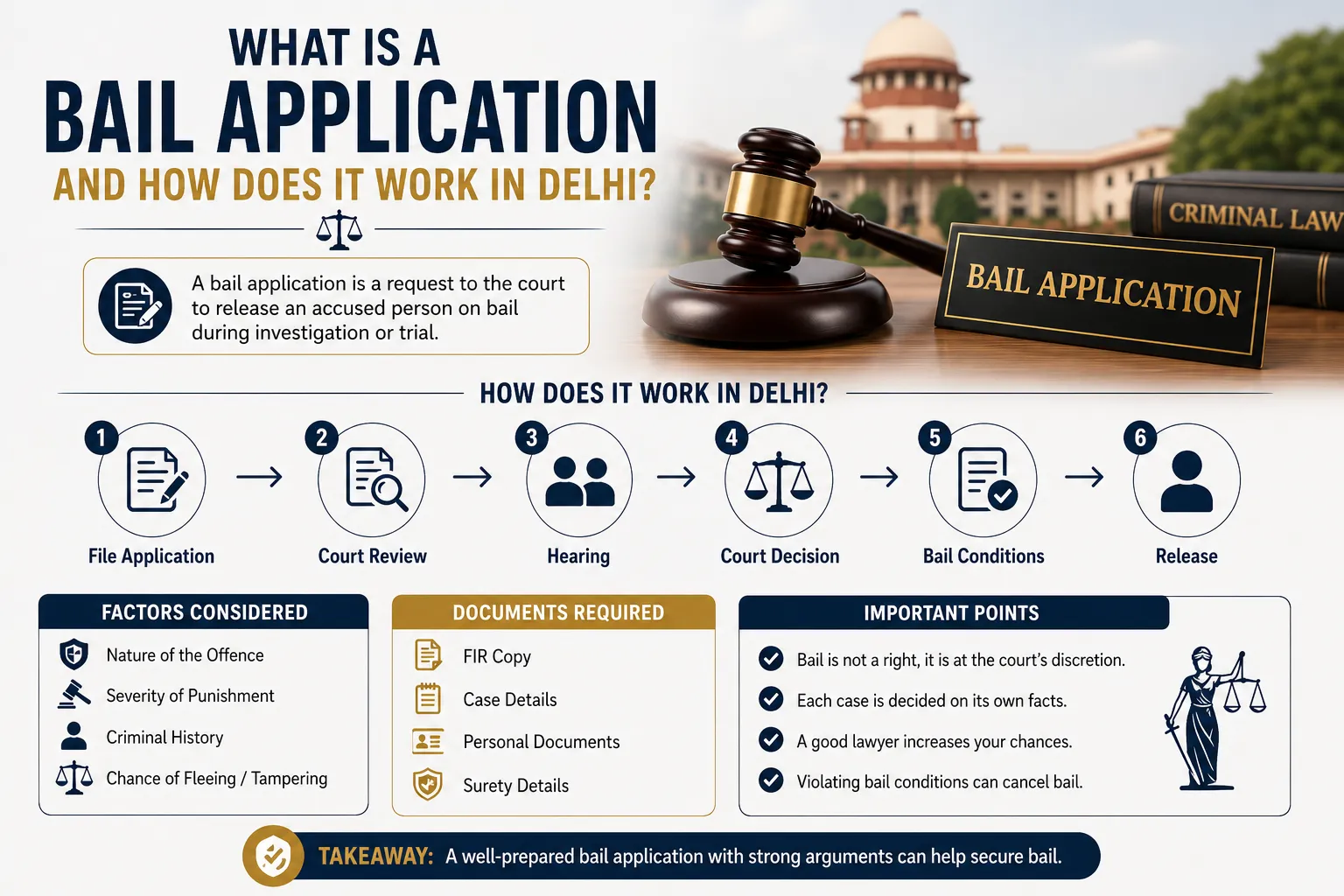
A bail application is a formal legal petition filed before a court requesting the release of an arrested or about-to-be-arrested person from custody, subject to conditions set by the court. In Delhi, bail applications are filed before magistrate courts, sessions courts, or the Delhi High Court depending on the nature of the offence and the stage of the case. The bail application must be supported by a lawyer who argues why bail should be granted.
Bail is not automatic in most criminal cases in India. For non-bailable offences — which include most serious crimes like fraud, assault, NDPS drug offences, and cybercrime — the accused must apply for a bail application before a court, and the court exercises discretion. The quality of the bail application and the advocacy at the hearing directly affects whether bail is granted or rejected.
Why Bail Matters — The Stakes of Every Bail Application
- Every day in custody before trial is a day lost — to family, employment, health, and dignity
- A rejected bail application at the magistrate court can be challenged before the Sessions Court or Delhi High Court
- The grounds argued in the first bail application set the tone for all subsequent applications
- A poorly drafted bail application — or one with factual errors — gives prosecutors ammunition to oppose all future bail attempts
- Bail conditions (surety amount, travel restrictions, court appearance requirements) are negotiable — a skilled advocate can secure reasonable conditions
What Are the Types of Bail in Delhi?
There are five types of bail recognised under Indian criminal law — regular bail for those already arrested, anticipatory bail to prevent an expected arrest, interim bail as temporary protection while the main bail application is heard, default bail when police fail to file a chargesheet within the statutory deadline, and statutory bail available under specific special laws. Each applies at a different stage and before a different court.
| Bail Type | When to Apply | Which Court | Legal Provision | Key Condition |
|---|---|---|---|---|
| Regular bail (bailable) | After arrest | Police station or Magistrate | S.479 BNSS (S.436 CrPC) | Right — cannot be refused |
| Regular bail (non-bailable) | After arrest | Magistrate or Sessions Court | S.480/483 BNSS (S.437/439 CrPC) | Court’s discretion |
| Anticipatory bail | Before arrest | Sessions Court or High Court | S.482 BNSS (S.438 CrPC) | Expected arrest, fear of false case |
| Interim bail | During bail hearing | Same court hearing bail application | Court discretion | Temporary — pending final order |
| Default bail | 60 or 90 days in custody without chargesheet | Magistrate Court | S.187 BNSS (S.167(2) CrPC) | Indefeasible right — cannot be refused |
| Medical bail | On medical grounds | Any court | Court discretion | Serious illness, hospitalisation |
Note: CrPC section references are given alongside BNSS sections as courts continue to apply both during the transition period following the Bharatiya Nagarik Suraksha Sanhita (BNSS) coming into force in July 2024.
What Is Regular Bail and How Do You Apply for It in Delhi?
Regular bail is applied for after a person has been arrested. For bailable offences, regular bail is a right and must be granted at the police station itself. For non-bailable offences, the arrested person must file a bail application before a magistrate or sessions court. In Delhi, the bail application is filed before the duty magistrate at the relevant district court — Tis Hazari, Saket, Rohini, Karkardooma, Patiala House, or Dwarka — within 24 hours of arrest.
Factors courts consider for regular bail in Delhi:
- Nature and gravity of the offence — More serious charges face stricter scrutiny
- Prior criminal record — First-time offenders are generally viewed more favourably
- Risk of flight — Local ties, family, employment, and roots in Delhi reduce flight risk
- Risk of tampering with evidence — Courts deny regular bail if witnesses or evidence may be interfered with
- Likelihood of the accused appearing for trial — Regular court attendance history matters
- Health and age — Elderly, seriously ill, or juvenile accused are given consideration
- Stage of trial — Regular bail is easier to obtain when the chargesheet has not yet been filed
What Is Anticipatory Bail and When Should You Apply?
Anticipatory bail is pre-arrest bail — filed before an arrest takes place when a person apprehends they may be arrested on a criminal charge, often based on a filed FIR or reliable information. In Delhi, anticipatory bail is filed before the Sessions Court or the Delhi High Court. If granted, the accused is directed to present themselves for arrest but is released on bail immediately upon arrest. Anticipatory bail is the most effective protection against arbitrary detention.
Apply for anticipatory bail immediately if:
- ✅ An FIR has been filed against you in any Delhi police station
- ✅ You have received police summons or notice to appear for questioning
- ✅ You have reliable information that a complaint is being filed against you
- ✅ You are involved in a matrimonial dispute with 498A or domestic violence allegations
- ✅ You are a business person facing allegations of financial fraud, cheque bounce, or conspiracy
- ✅ You are an NRI who has returned to India and faces an old FIR
Do not wait for the arrest warrant. Once an arrest warrant is issued or police arrive at your door, it is too late for anticipatory bail.
| Factor | Sessions Court | Delhi High Court |
|---|---|---|
| Jurisdiction | Cases triable in district courts | Cases triable in Sessions Court or HC; appellate jurisdiction |
| Processing time | 3 – 10 days typically | 7 – 21 days typically |
| Cost | Lower | Higher |
| When preferred | First anticipatory bail application; routine FIR cases | Sessions Court rejected or refused; serious offences |
| Appeal route | High Court | Supreme Court |
What Is Default Bail and Why Is It Important?
Default bail — also called statutory bail or compulsive bail — is an indefeasible right of the accused when the police fail to file a chargesheet within the statutory deadline: 60 days for offences punishable with less than 10 years, and 90 days for offences punishable with 10 years or more (including death). If the chargesheet is not filed within this window, the accused must file a default bail application immediately — any delay forfeits this right.
Default bail is one of the most overlooked rights in Indian criminal law. Many accused persons — and even some lawyers — miss the filing deadline, allowing the police to file the chargesheet on the 60th or 90th day and extinguish the default bail right.
Critical rule: The default bail application must be filed before the police file the chargesheet. If the chargesheet arrives even one day before your bail application, the right is lost.
Step-by-Step Process to File a Bail Application in Delhi
Filing a bail application in Delhi involves six steps — assessing the type of bail needed, preparing the application with supporting documents, engaging an advocate, filing at the correct court, attending the hearing, and fulfilling bail conditions after grant. The entire process for urgent regular bail can be completed in 24 to 48 hours.
Step 1 — Assess the Type of Bail Application and the Correct Court
- Already arrested → Magistrate court for regular bail (within 24 hours of arrest)
- Not yet arrested, FIR filed → Sessions Court for anticipatory bail (file immediately)
- Sessions Court denied → Delhi High Court for anticipatory bail
- 60/90 days without chargesheet → Magistrate court for default bail (file on the exact deadline date)
Step 2 — Engage a Criminal Advocate Immediately
Do not attempt to file a bail application without an advocate. The bail hearing is an adversarial proceeding — the public prosecutor will oppose bail, present the FIR, and argue against release. Your advocate must counter these arguments in real time. For urgent matters, contact Delhi Legal Expert immediately at +91 8130789810. We accept urgent criminal consultation calls and can appear at morning bail hearings in Delhi courts the same day.
Step 3 — Prepare the Bail Application and Supporting Documents
- ☐ Copy of the FIR (if available)
- ☐ Arrest memo (if already arrested)
- ☐ Identity proof of the accused (Aadhaar, PAN, passport)
- ☐ Proof of local ties — residential address proof, property documents, employment proof
- ☐ Character affidavits from family members or employers
- ☐ Medical documents (if bail on health grounds)
- ☐ Previous bail orders (if this is a subsequent bail application)
- ☐ Surety details — Surety’s Aadhaar, address proof, and proof of assets
Step 4 — File the Bail Application at the Correct Delhi Court
| Bail Type | Filing Court | Delhi Court Location |
|---|---|---|
| Regular bail (North/NW Delhi) | Tis Hazari District Court | Tis Hazari, Delhi 110054 |
| Regular bail (South Delhi) | Saket District Court | Saket, New Delhi 110017 |
| Regular bail (East Delhi) | Karkardooma District Court | Karkardooma, Delhi 110032 |
| Regular bail (West/SW Delhi) | Dwarka District Court | Sector 10, Dwarka, Delhi 110075 |
| Regular bail (Central Delhi) | Patiala House Courts | Tilak Marg, New Delhi 110001 |
| Regular bail (Rohini / NW) | Rohini District Court | Rohini Sector 14, Delhi 110085 |
| Anticipatory bail / FIR quashing | Delhi High Court | Sher Shah Road, New Delhi 110003 |
Step 5 — Attend the Bail Application Hearing
At the hearing, your advocate will present the bail application and argue the legal grounds, counter the public prosecutor’s opposition, cite relevant Supreme Court and High Court precedents, propose reasonable bail conditions, and address any specific concerns the judge raises about flight risk or evidence tampering. The judge will consider the FIR allegations, the accused’s prior record, local ties, conduct since the FIR was filed, and whether the investigation is complete or ongoing.
Step 6 — Comply With Bail Conditions After Bail Application Is Granted
- Personal bond — A self-undertaking of a specified amount (forfeited if bail is jumped)
- Surety — One or two persons who guarantee the accused’s court appearance, backed by their assets
- Address not to be changed without court permission
- Passport to be deposited with the court (common in cases involving travel risk)
- Regular court appearances on all scheduled dates
- No contact with complainant or witnesses
Violation of any bail condition leads to immediate cancellation of bail and arrest.
How Much Does a Bail Application Cost in Delhi?
Bail application costs in Delhi depend on the type of bail, the court, and the advocate’s experience. Regular bail applications before magistrate courts cost ₹5,000 to ₹25,000 in advocate fees. Anticipatory bail at the Sessions Court costs ₹15,000 to ₹75,000. Delhi High Court anticipatory bail applications cost ₹30,000 to ₹2,00,000 or more for senior advocates. Court fees and stamp duties are nominal — typically ₹200 to ₹2,000.
| Bail Type | Court | Junior Advocate | Mid-Level Advocate | Senior Advocate |
|---|---|---|---|---|
| Regular bail | Magistrate court | ₹5,000 – ₹10,000 | ₹10,000 – ₹25,000 | ₹25,000 – ₹60,000 |
| Regular bail | Sessions Court | ₹10,000 – ₹20,000 | ₹20,000 – ₹50,000 | ₹50,000 – ₹1,00,000 |
| Anticipatory bail | Sessions Court | ₹15,000 – ₹25,000 | ₹25,000 – ₹75,000 | ₹75,000 – ₹2,00,000 |
| Anticipatory bail | Delhi High Court | ₹25,000 – ₹50,000 | ₹50,000 – ₹1,50,000 | ₹1,00,000 – ₹5,00,000 |
| Default bail | Magistrate court | ₹5,000 – ₹15,000 | ₹15,000 – ₹35,000 | ₹35,000 – ₹75,000 |
| Bail cancellation opposition | Any court | ₹8,000 – ₹20,000 | ₹20,000 – ₹60,000 | ₹60,000 – ₹2,00,000 |
| Court fees and stamp duty | All courts | ₹200 – ₹2,000 | ₹200 – ₹2,000 | ₹200 – ₹2,000 |
How Long Does a Bail Application Take in Delhi?
A regular bail application after arrest in Delhi is typically heard within 24 to 72 hours of filing. Anticipatory bail applications before the Sessions Court are usually heard within 3 to 10 days. Delhi High Court anticipatory bail applications take 7 to 21 days for the first hearing. Default bail must be applied for on the exact day the statutory deadline expires and can be argued urgently the same day.
| Bail Type | Time to First Hearing | Time to Order (if urgent) |
|---|---|---|
| Regular bail (magistrate) | Same day or next day | 1 – 3 days |
| Regular bail (Sessions Court) | 2 – 5 days | 3 – 7 days |
| Anticipatory bail (Sessions Court) | 3 – 10 days | 7 – 14 days |
| Anticipatory bail (Delhi HC) | 7 – 21 days | 14 – 30 days |
| Default bail | Same day (urgent mention) | Same day or next day |
| Interim bail (pending main hearing) | Same as main bail application | Same day as filing |
What Are the Most Common Reasons a Bail Application Is Rejected in Delhi?
The most common reasons a bail application is rejected are the serious nature of the offence, a prior criminal record, risk of the accused tampering with evidence or intimidating witnesses, insufficient surety or proof of local ties, and a poorly drafted bail application that fails to address the prosecution’s specific objections. A rejected bail application can be challenged — but a strong first application is always better than a weak one followed by an appeal.
- ❌ Serious offence with high punishment — Courts are stricter on bail applications for offences carrying 10+ years
- ❌ Prior conviction or bail violations — Any history of jumping bail or prior convictions weakens the bail application severely
- ❌ Ongoing investigation — Courts are reluctant to grant bail when evidence collection is still in progress
- ❌ Risk of witness intimidation — Common in domestic violence, fraud, or organised crime cases
- ❌ Insufficient local ties — No permanent address, no family in Delhi, or employment instability
- ❌ Poorly argued bail application — Advocate who does not address the prosecution’s objections proactively
- ❌ Multiple previous bail rejections — Each rejection raises the bar for the next bail application; first impression matters
How Delhi Legal Expert Handles Bail Applications in Delhi
At Delhi Legal Expert, we understand that when someone is arrested — or when an arrest is imminent — every hour counts. Our criminal advocates are available for urgent bail application consultations and appear daily across all Delhi magistrate courts, Sessions Courts, and the Delhi High Court.
- ⚡ Same-day urgent consultations — Call +91 8130789810 and speak to a criminal advocate immediately for bail application emergencies
- ✍️ Precisely drafted bail applications — Every bail application addresses the prosecution’s likely objections before they are raised in court
- 🏛️ Court appearances at all Delhi courts — Tis Hazari, Saket, Rohini, Karkardooma, Patiala House, Dwarka, Sessions Courts, and Delhi High Court
- 📋 Default bail tracking — We monitor your case timeline and file the default bail application on the exact day the statutory deadline expires
- 🔄 Anticipatory bail before arrest — Proactive filing the moment an FIR is reported or police contact is made
- 📞 Family communication — We keep families informed throughout the bail application process, answering every question clearly
- ⚖️ Bail condition negotiation — We argue for the most reasonable bail conditions possible, minimising surety amounts and avoiding unnecessary travel restrictions
📞 Call or WhatsApp for urgent bail matters: +91 8130789810 | 🌐 Visit: delhilegalexpert.com | 🕐 Mon–Sat 10am–10pm | Sun 10am–5pm
FAQ: Bail Application in Delhi
What is the difference between regular bail and anticipatory bail in Delhi? Regular bail is applied for after arrest — it secures the release of a person already in custody. Anticipatory bail is applied for before arrest — it protects a person who apprehends they will be arrested on a criminal charge. Regular bail applications are filed before the magistrate or sessions court. Anticipatory bail applications are filed before the Sessions Court or Delhi High Court. If an FIR has been filed against you and you are still free, apply for anticipatory bail immediately.
Can a bail application be granted on the same day in Delhi? Yes — in urgent cases, a regular bail application after arrest can be argued and granted on the same day of filing, particularly at magistrate courts where duty magistrates hear urgent bail matters throughout the day. Default bail can also be argued and granted the same day. For any bail application emergency in Delhi, call Delhi Legal Expert at +91 8130789810 — we appear at morning, afternoon, and urgent board hearings.
What is default bail and who is entitled to it? Default bail — also called compulsory bail or Section 167(2) bail (now Section 187 BNSS) — is an indefeasible right of the accused when police fail to file a chargesheet within 60 days (for offences with less than 10 years punishment) or 90 days (for offences with 10 years or more, including death penalty). The default bail application must be filed before the chargesheet is filed. If the chargesheet arrives first, the default bail right is permanently lost.
What surety is needed for a bail application in Delhi and can it be reduced? Surety requirements vary by case and court. Magistrate courts typically require one or two local sureties with proof of identity, address, and assets. Your advocate can argue for lower surety amounts or cash security in place of property sureties. Courts can also accept personal recognisance (PR bond) in suitable cases, releasing the accused on their own undertaking without a third-party surety.
What happens if a bail application is rejected by the magistrate court in Delhi? If the magistrate court rejects the bail application, the accused can immediately file a fresh application before the Sessions Court under Section 483 BNSS (formerly Section 439 CrPC). If the Sessions Court also rejects the bail application, it can be taken to the Delhi High Court. If the High Court rejects, a Special Leave Petition (SLP) can be filed before the Supreme Court. Each higher court independently considers the application — rejection at a lower court does not bind the higher court.
Can bail be cancelled after a bail application is granted in Delhi? Yes. Bail can be cancelled if the accused violates bail conditions, if new evidence substantially strengthens the prosecution case, or if the accused is misusing the liberty granted. The prosecution or complainant can apply for bail cancellation. Strict compliance with all bail conditions is essential to avoid cancellation of the bail application order.
Does having a criminal lawyer significantly improve bail application chances in Delhi? Yes — significantly. Courts expect structured, legally grounded arguments. The public prosecutor always appears with preparation. A skilled bail advocate anticipates the prosecution’s objections, cites relevant Supreme Court and Delhi HC precedents, and proposes acceptable bail conditions — all within a 15 to 30 minute bail application hearing. The quality of the advocate directly affects the outcome.
Conclusion: Act Quickly on Every Bail Application in Delhi
Bail is not just about freedom — it is about your ability to participate in your own defence, maintain your employment, and support your family while your case proceeds. In Delhi’s courts, bail application decisions happen fast — and the quality of your bail application and advocacy at that first hearing sets the tone for everything that follows.
Whether you need a regular bail application after an arrest, anticipatory bail before one, or default bail because the police missed their chargesheet deadline — act immediately. Every day matters.
Next steps:
- Identify your bail type — regular bail, anticipatory bail, or default bail
- Locate the correct Delhi court for your bail application
- Call Delhi Legal Expert at +91 8130789810 right now — we handle urgent bail applications across all Delhi courts the same day
Contact Delhi Legal Expert at delhilegalexpert.com — experienced criminal advocates handling bail applications in Delhi across all courts since 2010. Available for urgent matters.