Property Title Search Report in Delhi: Why It's Essential Before You Buy Property
A property title search verifies that the seller genuinely owns the property and that it is free of disputes, loans, or legal defects, by examining the chain of ownership (typically 30+ years), the Encumbrance Certificate, mutation records, and pending court cases. In Delhi, this means checking records at the jurisdictional Sub-Registrar's office, DORIS (Delhi Online Registration Information System), MCD/NDMC property tax records, and the Delhi land revenue department. Since the Supreme Court's 2025 rulings clarified that a registered sale deed by itself does not prove ownership, a title search is no longer optional — it is the only real safeguard for a buyer.
Why This Matters More Than Ever in Delhi
Delhi's property market carries unique risks that many buyers underestimate: unauthorised colonies, disputed ancestral property, power-of-attorney sales (common before 2011 in Delhi but now legally restricted), DDA leasehold conversions, and land under acquisition or litigation. Layer on top of this a series of 2025 Supreme Court rulings — including Mahnoor Fatima Imran & Ors. v. State of Telangana & Ors. and K. Gopi v. Sub-Registrar — which held that registration is only proof that a transaction took place, not proof that the seller had valid title to sell. If the seller's own title was defective, a buyer's registered sale deed offers little protection.
In short: a registered deed is necessary, but it is not sufficient. A title search is what actually tells you whether the seller had the legal right to sell in the first place.
What a Property Title Search Actually Covers
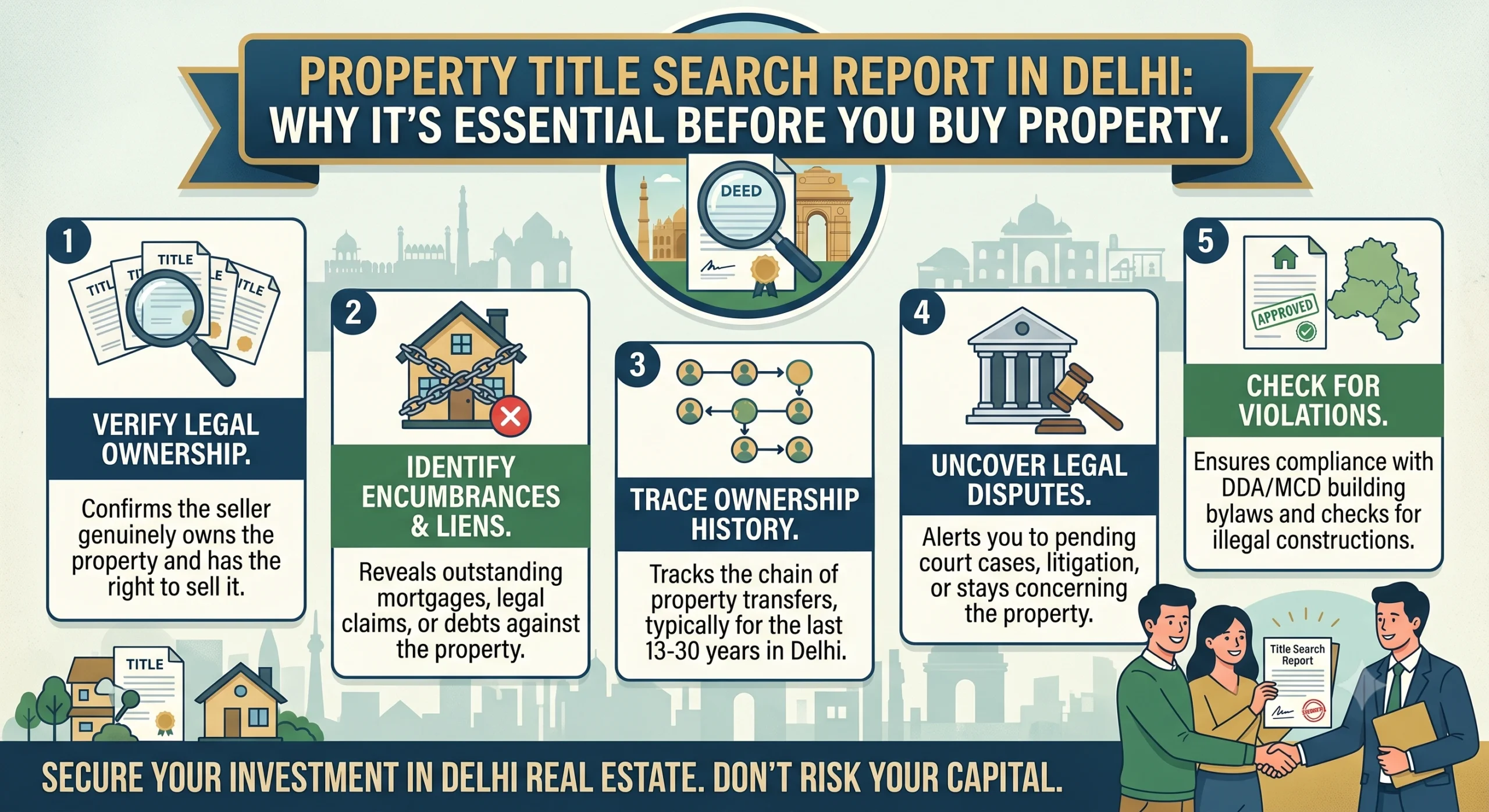
A proper title search report verifies:
- Current ownership and chain of title — tracing the property back through Mother Deed, Sale Deeds, Gift Deeds, Will/Inheritance documents, and Relinquishment Deeds
- Encumbrances — outstanding home loans, mortgages, or charges registered against the property
- Litigation history — pending civil suits, injunctions, partition disputes among co-owners or legal heirs
- Statutory dues — unpaid property tax, water/electricity dues, or society maintenance arrears
- Land use and zoning status — whether the property falls in an authorised colony, and whether its use (residential/commercial) matches its sanctioned status
- Government acquisition or DDA/L&DO restrictions — especially relevant for leasehold properties in Delhi, where unpaid conversion charges or unauthorised construction can block a clean transfer
How a Title Search Works in Delhi — Step by Step
Step 1: Verify the Document Chain
Collect and examine the Mother Deed and every subsequent Sale/Gift/Will/Partition Deed in the chain — ideally going back 30 years, longer for ancestral or agricultural land.
Step 2: Pull the Encumbrance Certificate
In Delhi, this is checked through the jurisdictional Sub-Registrar's office or via DORIS (doris.delhigovt.nic.in), which allows online search of registered documents by property or party name.
Step 3: Check Mutation and Municipal Records
Confirm the property's mutation (dakhil-kharij) reflects the current owner in MCD or NDMC/DDA records, and check for pending property tax dues through the MCD property tax portal.
Step 4: Search Court Records
Check for pending litigation involving the property or the seller at the relevant Delhi District Court (Saket, Rohini, Dwarka, Karkardooma, Patiala House, Tis Hazari) and, where relevant, the Delhi High Court.
Step 5: Confirm L&DO / DDA Status (for leasehold property)
A large share of Delhi properties are leasehold, governed by the Land & Development Office (L&DO) or DDA. Check whether conversion to freehold has been completed, and whether any unauthorised construction or misuse notices exist.
Step 6: Physical Verification and Title Insurance (optional but recommended)
Confirm that the documents match what exists on the ground, and consider title insurance for high-value transactions as an added layer of protection.
Common Red Flags a Title Search Uncovers in Delhi Property Deals
- Property still registered in the name of a deceased person, with no completed succession/mutation
- Power-of-attorney-based "sales" without an underlying registered conveyance — a structure the Supreme Court has repeatedly held does not transfer ownership
- Leasehold DDA/L&DO flats sold without freehold conversion or with unpaid conversion charges
- Unauthorised construction beyond sanctioned building plans, risking demolition or regularisation issues
- Co-owned or ancestral property sold by one heir without consent or release from other legal heirs
- Property falling within an area affected by government acquisition, road-widening, or an unauthorised colony not yet regularised
Where You Can Conduct a Title Search in Delhi
- Sub-Registrar's Office (jurisdiction-based across Delhi districts) — for certified copies of registered deeds
- DORIS Portal — online search of registration records
- MCD / NDMC Property Tax Department — for tax dues and mutation status
- L&DO / DDA — for leasehold conversion and land-use compliance
- District Courts and Delhi High Court — for litigation checks
- A property lawyer in Delhi — for a consolidated due-diligence report combining all of the above, with a legal risk assessment
How Delhi Legal Expert Can Help
Our property law team conducts end-to-end title search and due diligence for buyers, homebuyer associations, and investors in Delhi, including:
- Chain-of-title verification going back 30+ years
- Encumbrance Certificate and DORIS record checks
- Municipal tax, mutation, and L&DO/DDA leasehold status verification
- Litigation and court record review across Delhi's district courts
- A consolidated legal due-diligence report with a clear risk assessment before you sign
Frequently Asked Questions
1. Is a registered sale deed enough proof of ownership in Delhi?
No. Recent Supreme Court rulings have clarified that registration only records that a transaction occurred — it does not certify that the seller had valid title. A title search is what actually verifies ownership.
2. How far back should a property title search go?
Generally at least 30 years, and longer where the property has passed through inheritance or partition among family members.
3. What is DORIS and how does it help?
DORIS (Delhi Online Registration Information System) lets you search registered property documents in Delhi online, which is a useful first step before a full physical verification at the Sub-Registrar's office.
4. Is leasehold property in Delhi riskier to buy?
It requires extra checks — specifically freehold conversion status with L&DO/DDA and any pending conversion charges — but it is not inherently unsafe if properly verified.
5. How long does a title search typically take?
Depending on the property's history and whether litigation checks are required, a thorough report usually takes one to three weeks.
6. Can I do a title search myself instead of hiring a lawyer?
You can access several records yourself (DORIS, MCD tax portal), but interpreting encumbrances, succession gaps, and litigation risk correctly requires legal expertise — errors here are exactly what lead to disputes later.
Talk to a Property Lawyer in Delhi Before You Sign
Before you pay a token amount or sign any agreement, get a proper title search and due-diligence report. It is a small upfront cost against the risk of losing your investment to a defective title.
Contact Delhi Legal Expert for a comprehensive property title search and due diligence report.
This article is for general informational purposes and does not constitute legal advice. Please consult a qualified property lawyer for guidance specific to your transaction.