Top 10 Divorce Lawyers in Delhi: How to Choose the Right Advocate
Quick Answer
There is no objectively verified “top 10 divorce lawyers in Delhi” list that can fairly rank every advocate without a transparent methodology and current verification of credentials, practice area, fees, experience and client service. Instead of relying on a promotional ranking, compare divorce lawyers in Delhi on matrimonial-law expertise, experience with your type of case, court and procedural knowledge, settlement skills, communication, fee transparency and verifiable professional credentials.
Key Takeaways
- A lawyer who is highly suitable for a contested divorce may not be the right choice for a straightforward mutual consent divorce.
- Check whether the advocate regularly handles matrimonial matters rather than relying only on a generic “top lawyer” label.
- Ask about experience with issues such as maintenance, child custody, domestic disputes, mediation and settlement where relevant to your case.
- Do not select a lawyer solely because of online rankings, testimonials or claims such as “No. 1”.
- Confirm professional credentials and understand who will actually prepare and argue your case.
- Ask for a clear explanation of professional fees, court appearances, drafting and additional proceedings before engagement.
- Delhi jurisdiction matters: the appropriate Family Court or District Court depends on the facts and applicable law, so obtain case-specific advice before filing.
What Does “Top 10 Divorce Lawyers in Delhi” Actually Mean?
The phrase top 10 divorce lawyers in Delhi sounds like a simple ranking, but matrimonial law does not work that way.
A lawyer may be particularly experienced in contested divorce litigation, while another may concentrate more heavily on mutual consent divorces and negotiated settlements. Another may have substantial experience with child custody or maintenance disputes.
Therefore, “top” should ideally mean most suitable for a particular legal requirement, rather than simply the lawyer with the largest online presence.
A useful shortlist should consider measurable factors such as:
- Matrimonial and family-law focus
- Relevant experience
- Experience with similar cases
- Court and procedural familiarity
- Negotiation and mediation skills
- Litigation capability
- Communication standards
- Fee transparency
- Professional ethics
- Verifiable credentials
This approach is more useful than presenting an unsupported ranking of ten names.
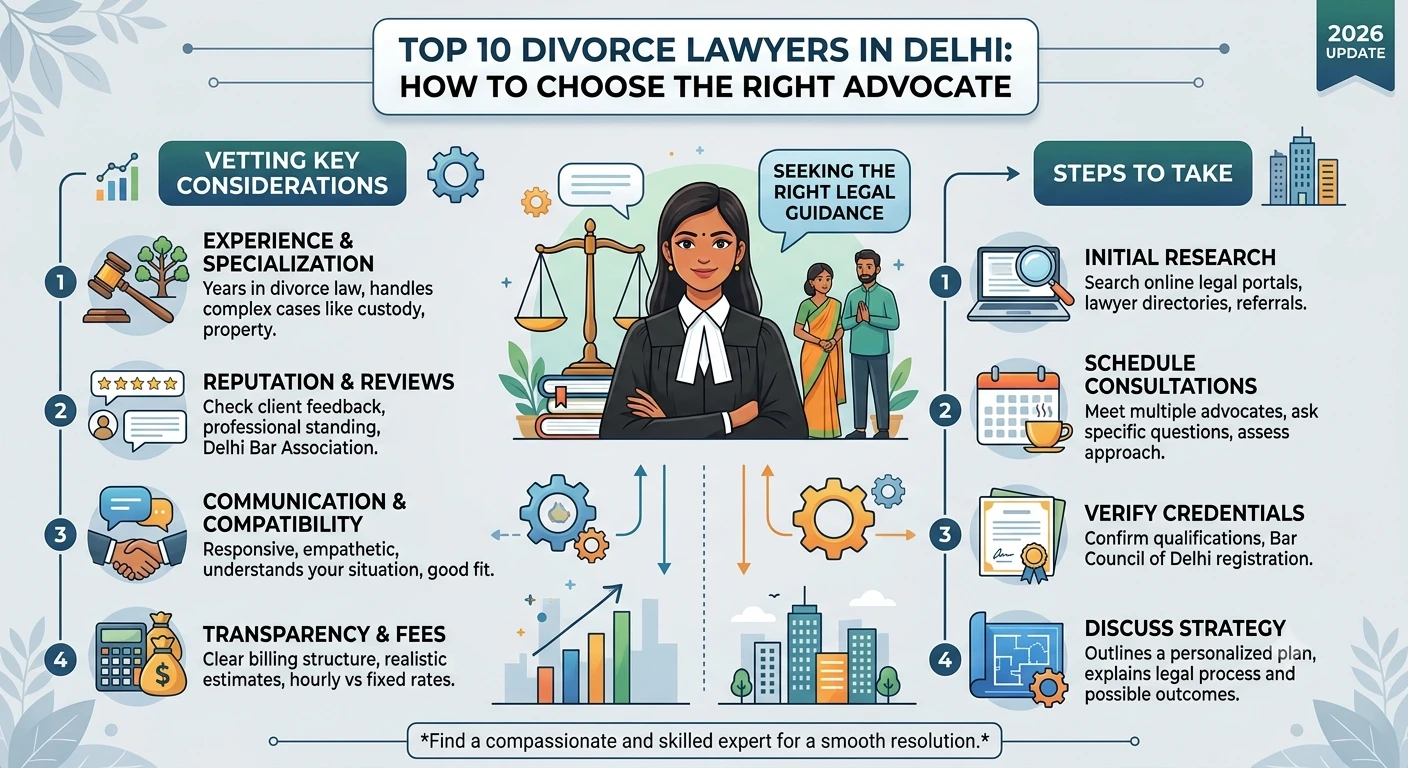
How Do I Choose a Divorce Lawyer in Delhi?
Start by identifying the nature of your legal problem. Your requirements may be very different depending on whether you are considering a mutual consent divorce, contested divorce, maintenance proceedings, child custody, domestic violence-related proceedings or several connected matters.
1. Look for matrimonial-law experience
Divorce cases can involve several areas of family law. Look for an advocate who regularly handles matrimonial matters and understands the legislation applicable to your marriage.
For example, the Hindu Marriage Act, 1955 contains provisions concerning divorce and related matrimonial reliefs for marriages governed by that legislation. Other personal laws and statutes may apply depending on the circumstances.
A lawyer should first establish which legal framework applies rather than assuming that every divorce follows the same procedure.
2. Match the lawyer to your case
Ask whether the advocate handles matters similar to yours.
Relevant questions include:
- Do you handle mutual consent divorce matters?
- Do you regularly represent clients in contested divorce cases?
- Do you handle maintenance applications?
- Do you deal with child custody and visitation disputes?
- Do you assist with mediation and negotiated settlements?
- Can you handle connected matrimonial proceedings if they arise?
A specialist whose experience matches your circumstances may be more useful than a lawyer selected solely because they appear in an online “best lawyers” list.
3. Check court and procedural experience
Divorce proceedings involve procedural requirements as well as substantive matrimonial law.
A suitable divorce lawyer in Delhi should be able to explain issues such as jurisdiction, filing requirements, appearances, mediation, evidence and settlement in terms you can understand.
You should also ask which court is likely to have jurisdiction over your matter and why. Do not assume that choosing a lawyer’s office location automatically determines where your petition should be filed.
4. Assess communication
Your lawyer may need detailed and sensitive information about your marriage, finances, children and previous proceedings.
During the first consultation, consider whether the advocate:
- Listens carefully
- Asks relevant questions
- Explains legal options clearly
- Distinguishes facts from assumptions
- Gives realistic advice
- Explains risks
- Responds within a reasonable timeframe
Good communication is particularly important in matrimonial matters because strategic decisions can involve both legal and personal considerations.
5. Consider settlement skills
Not every divorce matter needs to become a prolonged courtroom dispute.
Where settlement is legally and practically appropriate, a lawyer should be able to explain negotiation and mediation options alongside litigation.
For example, a settlement may need to address maintenance or alimony, child arrangements, property or belongings, pending proceedings and other practical issues.
6. Demand fee transparency
Before appointing an advocate, ask what the quoted professional fee covers.
Clarify whether the arrangement includes:
- Initial consultation
- Petition drafting
- Replies or written statements
- Court appearances
- Interim applications
- Mediation
- Evidence
- Cross-examination
- Additional applications
- Connected proceedings
- Appeals, if required
There is no single statutory “divorce lawyer fee” applicable to every Delhi case. Professional fees can vary according to the advocate, complexity and scope of work.
What Does a Divorce Lawyer Actually Do?
A divorce lawyer in Delhi can perform considerably more work than simply appearing before a judge.
Depending on the matter, an advocate may:
- Review the facts and applicable law
- Determine possible legal options
- Assess jurisdiction
- Prepare or respond to legal pleadings
- Draft a divorce petition
- Prepare settlement terms
- Advise on supporting documents
- Represent the client at hearings
- Assist during mediation
- Deal with maintenance-related proceedings
- Address custody or visitation issues
- Prepare responses to applications filed by the other party
- Advise on evidence and documentation
- Explain procedural developments
- Coordinate strategy for connected proceedings
The precise scope depends on the engagement and the facts of the case.
How Should a “Top 10” Divorce Lawyer Shortlist Be Created?
If you are researching the top 10 divorce lawyers in Delhi, use a consistent scoring framework instead of accepting an online ranking at face value.
Evaluation factor
| Evaluation factor | What to check |
|---|---|
| Matrimonial focus | Does the advocate regularly handle family-law matters? |
| Similar cases | Have they handled matters comparable to yours? |
| Litigation experience | Can they handle contested proceedings where required? |
| Settlement skills | Do they understand mediation and negotiated settlement? |
| Court familiarity | Are they familiar with the relevant Delhi court process? |
| Communication | Do they explain options and risks clearly? |
| Fee transparency | Are fees and additional charges explained beforehand? |
| Availability | Can you realistically communicate with the lawyer or team? |
| Professional conduct | Are claims factual rather than exaggerated? |
| Credentials | Can professional details be independently verified? |
This method allows you to create a meaningful personal shortlist of advocates rather than relying on an arbitrary ranking.
Mutual Consent vs Contested Divorce
One of the first distinctions a prospective client should understand is the difference between mutual consent and contested divorce.
| Issue | Mutual Consent Divorce | Contested Divorce |
|---|---|---|
| Agreement | Both spouses generally agree to seek divorce | Parties do not have complete agreement |
| Main focus | Settlement and statutory requirements | Grounds, pleadings and disputed issues |
| Disputes | Ideally resolved through agreed terms | May require evidence and adjudication |
| Mediation | May assist with unresolved terms | May be important during proceedings |
| Financial issues | Can be addressed through settlement | May require separate or interim applications |
| Children | Custody, visitation and expenses can be settled | Court may need to determine disputed issues |
| Litigation complexity | Often comparatively streamlined, subject to legal requirements | Can become more procedurally and factually complex |
For Hindu marriages, Section 13B of the Hindu Marriage Act, 1955 provides for divorce by mutual consent subject to its statutory requirements.
However, readers should not assume that every mutual divorce follows exactly the same path. The applicable law, facts, jurisdiction, settlement terms and court directions matter.
Is Mutual Divorce Always Faster?
Mutual consent divorce is often more straightforward where both spouses genuinely agree on the divorce and associated issues. However, a lawyer should not promise a particular completion date.
The timeline can depend on statutory requirements, court scheduling, settlement terms, documentation, jurisdiction and whether any procedural issue needs to be addressed.
The statutory six-month period associated with Section 13B(2) is also not simply an unavoidable waiting period in every case. The Supreme Court’s decision in Amardeep Singh v. Harveen Kaur recognised circumstances in which the period may be waived, subject to the principles laid down by the Court and the facts of the case.
A lawyer should assess whether those principles are applicable rather than promising that a waiver will automatically be granted.
Which Court Handles Divorce Matters in Delhi?
There is no single Delhi court that automatically handles every divorce matter.
Family Courts operate within Delhi’s district-court system, and the appropriate forum depends on the applicable law and jurisdictional facts. Depending on the matter, factors such as the parties’ residence, place of marriage and other legally relevant circumstances may affect where proceedings can be instituted.
Delhi has multiple district court complexes and Family Court arrangements. The appropriate court should therefore be confirmed based on the individual facts before filing.
This is one reason why an advocate for divorce in Delhi should discuss jurisdiction during the initial consultation rather than treating court selection as a purely administrative issue.
How Much Does a Divorce Lawyer Charge in Delhi?
There is no universal professional fee for divorce lawyers in Delhi.
The total cost can depend on:
- Type of divorce
- Complexity of the dispute
- Number of proceedings
- Drafting requirements
- Number of hearings
- Mediation
- Interim applications
- Evidence and cross-examination
- Child custody disputes
- Maintenance proceedings
- Connected criminal or civil proceedings
- Appeals or higher-court work
Fee Clarification Checklist
Before hiring a lawyer, ask:
| Fee Component | What to Ask |
|---|---|
| Consultation | Is the initial consultation separately charged? |
| Petition drafting | Is drafting included in the quoted fee? |
| Court appearances | Is the fee per appearance or stage-based? |
| Interim applications | Are they included or charged separately? |
| Mediation | Is mediation representation included? |
| Evidence stage | Are evidence and cross-examination separately charged? |
| Connected cases | Will separate proceedings require a separate engagement? |
| Miscellaneous costs | Which court or administrative expenses are additional? |
Do not select a lawyer solely because they quote the lowest fee. Equally, a high quoted fee does not automatically establish that an advocate is the best choice.
What Documents Should You Take to Your First Consultation?
Organising your documents before meeting a divorce lawyer in Delhi NCR can make the first consultation more productive.
Depending on the circumstances, consider taking:
- Marriage certificate, if available
- Wedding-related documentation
- Identity and address documents
- Details of children
- Previous legal notices
- Existing court orders
- Copies of petitions or replies from earlier proceedings
- Relevant financial records
- Evidence relating to disputed facts
- Important correspondence
- Details of pending cases
- A brief chronology of significant events
Do not edit, delete or manufacture documents or communications simply to strengthen a case. Preserve relevant material in its original form and allow your lawyer to advise you about its legal relevance.
Questions to Ask Before Hiring a Divorce Lawyer
A first consultation should be an opportunity to evaluate the lawyer as well as obtain preliminary legal guidance.
Ask:
- What legal options may apply to my circumstances?
- Which law governs my marriage?
- Which court is likely to have jurisdiction?
- Is mutual consent or contested divorce potentially applicable?
- What documents should I preserve?
- Are there immediate applications or protective steps to consider?
- How should maintenance issues be approached?
- What should I consider regarding child custody or visitation?
- Could mediation be useful?
- Who will draft the pleadings?
- Who will appear at hearings?
- What does your professional fee cover?
- What additional costs could arise?
- What information do you need from me before filing?
Be cautious if someone promises an outcome before properly understanding the facts.
Red Flags When Choosing a Divorce Lawyer
An online “top lawyer” label should not replace due diligence.
Watch for:
- Guaranteed divorce outcomes
- Guaranteed custody
- Guaranteed maintenance amounts
- Promises of a fixed result by a particular date
- Unverifiable awards or rankings
- Pressure to file immediately without understanding the facts
- Unclear fee arrangements
- Requests to exaggerate or fabricate facts
- Lack of explanation about risks
- Refusal to provide clarity about who will handle the matter
- Claims that legal results are certain
A responsible lawyer should explain both strengths and weaknesses in your position.
How Long Can Divorce Proceedings Take?
There is no single timeline that applies to every divorce case.
A mutual consent matter may be procedurally less complicated than a heavily contested divorce, but its duration still depends on statutory requirements, court scheduling, documentation, settlement and other circumstances.
Contested proceedings may take considerably longer because they can involve pleadings, interim applications, evidence, cross-examination, arguments and orders.
The presence of related disputes involving maintenance, custody, domestic violence allegations, property or other proceedings can also affect the overall legal process.
A lawyer can provide a more meaningful assessment only after reviewing the facts.
Child Custody Considerations
Divorce and child-related issues often require separate attention.
Where children are involved, parents may need to consider:
- Physical custody
- Legal decision-making
- Visitation or parenting time
- Schooling
- Medical care
- Travel
- Children’s expenses
- Communication arrangements
- Holidays and special occasions
The child’s welfare is a central consideration in custody decisions. Parents should therefore discuss custody strategy early rather than treating it as an issue to address only after the divorce itself.
If both parties can reach an appropriate arrangement, the terms should be carefully documented and considered in light of the child’s welfare and applicable law.
Maintenance and Alimony
Financial issues can form an important part of matrimonial proceedings.
It Depends on the applicable law and facts, parties may seek or negotiate financial relief during or after matrimonial proceedings. For marriages governed by the Hindu Marriage Act, Sections 24 and 25 address interim maintenance and expenses of proceedings, and permanent alimony and maintenance respectively, subject to their statutory requirements.
Other laws may provide different remedies.
A lawyer should therefore assess:
- Income and earning capacity
- Financial dependence
- Existing obligations
- Assets and liabilities
- Children’s expenses
- Pending proceedings
- The statutory provision under which relief is sought
Do not rely on online calculators or general figures as a substitute for case-specific legal advice.
Why Mediation Can Matter in Delhi Matrimonial Matters
Mediation can provide an opportunity for spouses to discuss disputed issues with the assistance of a neutral mediator.
It can be particularly relevant where the parties need to resolve practical questions such as:
- Divorce by mutual agreement
- Financial settlement
- Maintenance
- Child custody
- Visitation
- Return of belongings
- Withdrawal or resolution of connected proceedings
- Future communication arrangements
Mediation does not mean that every dispute must be settled. If a satisfactory agreement cannot be reached, the matter may continue through the appropriate legal process.
A matrimonial lawyer can help a client understand what should be negotiated, what should not be conceded without proper advice and how any settlement should be documented.
Practical Insights From Matrimonial Practice in Delhi
Prepare a factual timeline
Instead of arriving with only a general statement that the marriage has broken down, prepare a chronological account of significant events.
Include dates, major incidents, periods of separation, important communications, previous complaints or cases and relevant financial events.
A clear timeline helps the lawyer distinguish legally relevant facts from background information.
Separate facts from assumptions
Tell your lawyer what you personally know and what you believe may have happened.
For example, a message, bank record or court document is different from an assumption about another person’s intentions. This distinction can become important when pleadings and evidence are prepared.
Think about settlement beyond the divorce decree
A settlement should not focus only on the sentence stating that the marriage is dissolved.
Depending on the circumstances, practical issues may include:
- Financial settlement
- Jewellery and personal belongings
- Child arrangements
- Visitation
- Children’s education and expenses
- Property-related questions
- Pending litigation
- Future obligations
Overlooking these matters can create disputes after the divorce.
Ask who is actually handling the case
If you meet a senior advocate or law firm, ask who will:
- Draft the petition
- Prepare responses
- Communicate with you
- Attend routine hearings
- Conduct important arguments
- Handle evidence, if necessary
This gives you a realistic understanding of the representation arrangement.
Why Consider a Delhi Legal Expert?
Delhi Legal Expert is a viable option for individuals needing professional help regarding matrimonial and family law issues in Delhi.
Before engaging any legal service provider, prospective clients should discuss the facts of their matter, applicable legal options, jurisdiction, likely procedural steps and professional fees.
The goal is to secure clear and precise legal counsel appropriate to the unique situation, not to hire a lawyer because a website calls him or her “top” or “best”.
Frequently Asked Questions
Who is the best divorce lawyer in Delhi?
No one divorce lawyer is “best” for every client or case. The appropriate advocate depends on factors such as the type of matrimonial dispute, relevant law, jurisdiction, litigation requirements, settlement objectives, communication and fees. A clear shortlist should be compiled using only information and experience of the profession that is verifiable and relevant to the specific matter.
How do I choose a good divorce lawyer in Delhi?
Compare lawyers based on matrimonial-law experience, similar-case experience, knowledge of the relevant court process, settlement and mediation skills, communication, availability and fee transparency. At the initial consultation, inquire of the advocate about your legal options and risks instead of merely promising you a specific outcome.
How much does a divorce lawyer charge in Delhi?
No fixed professional charge for all divorce lawyers in Delhi. Fees may be based on the nature of the action, whether it is a contested or mutual action, the number of hearings, drafting, interim applications, mediation, evidence, custody and maintenance actions and related actions, etc. Ask for a written explanation of what the quoted professional fee covers.
Which lawyer is suitable for a mutual divorce?
Look for a matrimonial lawyer who regularly handles mutual consent divorce matters and settlement drafting. For Hindu marriages, mutual consent divorce is governed by the provisions of Section 13B of the Hindu Marriage Act, 1955, subject to the conditions of the said Section. The lawyer should also help address financial, custody and other settlement terms where applicable.
Which lawyer is suitable for a contested divorce?
For a contested matter, consider an advocate with relevant experience in matrimonial litigation, pleadings, interim applications, evidence and court arguments. If maintenance, custody or other related cases come into play, inquire about their familiarity with such cases.
Do I need a Delhi-based divorce lawyer?
Not necessarily in every situation. The important thing is that the advocate can adequately represent you in the court where the case is pending and meet the procedural requirements. But if the matter is to be taken up in Delhi an advocate who knows the working of the relevant Delhi Family Court and district court will help.
Which court handles my divorce in Delhi?
The relevant Family Court, or other competent court, will depend on the relevant law and facts of jurisdiction. Some factors like where a person lives, where they married, and other legal situations can be important. Do not file in a court for convenience, but first consult the court for case-specific advice.
What documents should I take to a divorce lawyer?
Obtain Marriage documents, identity and address documents, information about children, financial information, old notices and documents from court, orders and significant communications or evidence. A chronology of important events could also assist the attorney in grasping the case effectively.
Can the six-month mutual divorce period be waived?
The Supreme Court has held that the six months period given in Section 13B(2) of the Hindu Marriage Act may be dispensed with in merited cases. In the case of Amardeep Singh v Harveen Kaur, the Court has outlined principles to be considered in making such a waiver. It is not automatic, and it may depend on the circumstances and court’s judgment.
How long does a divorce take in Delhi?
There is no timetable that is guaranteed. The time required for mutual consent and contested proceedings can vary widely, and scheduling, settlement, documentation, evidence and applications related thereto can impact the time period. A lawyer can give a better evaluation once he or she can see the particular situation.
Can custody and divorce issues be dealt with together?
Any child custody or visitation matters related to the spouse’s marriage case may be covered by the marital case, but court jurisdiction and the applicable law should be taken into account. Welfare is a key issue. At an early stage, parents should discuss custody, visitation and children’s expenses with their lawyer.
Can a divorce lawyer guarantee the outcome?
No sane lawyer should promise a specific result in court. Judicial decisions are based on the law that applies to the case and evidence; and can be affected by facts that are disputed or can change during the course of the case itself. A lawyer will be able to inform you of options, provide you with some strengths and weaknesses and potential risks, but not guarantee you a result.
Authoritative Legal Sources
For legal information, readers should prioritise official sources, including:
- India Code — statutory texts, including the Hindu Marriage Act, 1955: https://www.indiacode.nic.in/
- Supreme Court of India — judgments and official court information: https://www.sci.gov.in/
- Delhi High Court — judgments, notices and court information: https://delhihighcourt.nic.in/
- Delhi District Courts — district-court information and services: https://delhidistrictcourts.nic.in/
For the six-month mutual-consent issue, consult the Supreme Court’s judgment in Amardeep Singh v. Harveen Kaur and subsequent applicable jurisprudence rather than relying on a commercial summary.
Author and Legal Review
Written by: Delhi Legal Expert Editorial Team
Legally reviewed by: [REAL ADVOCATE NAME]
Practice area: Matrimonial & Family Law
Last reviewed: 28 August 2026
Legal content should be reviewed against current legislation, judicial decisions and procedural requirements before publication. Replace the reviewer placeholder only after the named advocate’s identity, professional credentials and review have been independently verified.
Need Clarity About Your Divorce Case in Delhi?
If you are considering divorce or are already involved in a matrimonial dispute, a consultation can help you understand the legal route that may apply to your circumstances.
Before filing or responding to proceedings, consider obtaining advice on:
- Applicable matrimonial law
- Jurisdiction and appropriate court
- Mutual versus contested divorce options
- Relevant documents and evidence
- Maintenance and financial issues
- Child custody and visitation
- Mediation and settlement possibilities
- Potential next steps and procedural requirements
For a personal legal matter, professional advice should be based on the actual facts rather than on a general online article.
Final Thoughts
Searching for the top 10 divorce lawyers in Delhi should be the beginning of your research, not the final basis for appointing an advocate.
A credible choice comes from comparing matrimonial-law expertise, experience with similar disputes, court familiarity, settlement capability, communication, professional fees and verifiable credentials. The lawyer who is appropriate for one person’s mutual consent divorce may not be the right advocate for another person’s contested case involving custody, maintenance or extensive evidence.
Instead of asking only who is “top”, ask a more useful question: which divorce lawyer is suitably experienced and equipped for my particular legal situation?
That approach can help Delhi residents make a more informed and legally responsible decision.