Mutual Divorce Lawyer in Delhi: Process, Fees, Documents & Legal Guidance
Quick Answer
A mutual divorce lawyer in Delhi helps spouses who have agreed to end their marriage prepare the divorce petition, record settlement terms, address maintenance, alimony, child custody and related issues, and navigate the required court proceedings. For marriages governed by the Hindu Marriage Act, 1955, mutual consent divorce is dealt with under Section 13B. The right lawyer should focus on settlement clarity, jurisdiction, documentation and accurate procedural guidance rather than promising a guaranteed result or timeline.
Key Takeaways
- Mutual consent divorce is based on the spouses jointly seeking dissolution of marriage after satisfying the applicable statutory requirements.
- For marriages governed by the Hindu Marriage Act, Section 13B provides the statutory framework for mutual consent divorce.
- A written settlement should clearly address financial claims, maintenance or alimony, children, belongings and relevant connected proceedings.
- The appropriate Delhi court depends on the applicable jurisdictional facts; simply living in Delhi does not automatically mean every Delhi court has jurisdiction.
- A lawyer can assist with drafting, filing, appearances, settlement documentation and procedural issues, but cannot guarantee that a court will grant divorce.
- The statutory six-month period associated with Section 13B(2) is not automatically eliminated in every case. The Supreme Court has recognised circumstances in which the period may be waived.
- Professional fees vary according to the lawyer, complexity, drafting requirements, court appearances and connected matrimonial issues.
What Is Mutual Consent Divorce?
Mutual consent divorce is a legal route in which both spouses agree that the marriage should be dissolved and approach the court jointly, subject to the requirements of the law governing their marriage.
For Hindu marriages, Section 13B of the Hindu Marriage Act, 1955 provides for divorce by mutual consent. The provision refers, among other statutory requirements, to the spouses having lived separately for a period of one year or more, being unable to live together and mutually agreeing that the marriage should be dissolved.
The exact legal position depends on the law applicable to the marriage. The Hindu Marriage Act should therefore not automatically be treated as applicable to every marriage.
When Do You Need a Mutual Divorce Lawyer in Delhi?
A mutual divorce may appear straightforward because both spouses agree to separate. In practice, however, the legal paperwork and settlement terms can have important consequences.
A mutual divorce lawyer in Delhi can be particularly useful when:
- The spouses have agreed to divorce but have not finalised settlement terms.
- Maintenance or permanent alimony needs to be documented.
- The couple has children.
- There are questions about custody, visitation or children’s expenses.
- Jewellery, personal belongings or other property need to be returned or dealt with.
- There are existing domestic violence, maintenance, criminal or matrimonial proceedings.
- The spouses live in different cities or countries.
- There is uncertainty about which court has jurisdiction.
- One or both parties need assistance understanding the legal documents before signing them.
A lawyer’s role is not simply to file papers. Good legal advice should help ensure that the settlement reflects what the parties actually intend and does not unintentionally leave important disputes unresolved.
What Does a Mutual Divorce Lawyer Actually Do?
The precise scope of legal work depends on the engagement, but commonly includes the following.
Reviewing the marriage and jurisdiction
The lawyer first examines the marriage documents, residence details, relevant addresses and other facts to determine which legal provisions and court jurisdiction may apply.
Preparing the mutual consent petition
The lawyer can prepare the necessary pleadings based on information supplied by both spouses. The contents should accurately reflect the parties’ circumstances and agreement.
Drafting the settlement
Settlement drafting is one of the most important parts of a mutual divorce matter. The agreement may address:
- Permanent alimony or maintenance
- Child custody
- Visitation and access
- Children’s education and medical expenses
- Return of jewellery and belongings
- Property-related arrangements
- Withdrawal or resolution of connected proceedings
- Financial claims
- Other agreed obligations
Not every issue will apply to every couple.
Court representation
The lawyer can guide the parties regarding the required court appearances and procedural stages. The exact process can vary according to the applicable law, facts and court directions.
Handling procedural issues
If there are defects in documents, questions regarding jurisdiction or other procedural objections, a lawyer can advise the parties on the appropriate response.
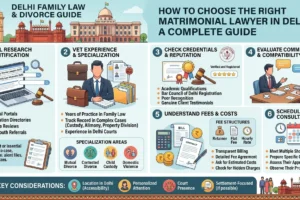
How to Choose the Right Mutual Divorce Lawyer in Delhi
Searching for the best divorce lawyer in Delhi can produce many names. For a mutual divorce, however, the most suitable lawyer is not necessarily the person making the strongest marketing claim.
Consider these factors instead.
1. Relevant matrimonial-law experience
Look for an advocate who regularly handles matrimonial matters and understands mutual consent proceedings.
2. Experience with settlement drafting
A mutual divorce depends heavily on the clarity of the agreement. Ask whether the lawyer will carefully review issues such as maintenance, custody, belongings and connected proceedings.
3. Understanding of jurisdiction
The lawyer should examine the facts before advising where proceedings may appropriately be filed.
4. Clear communication
You should understand what you are signing, what the next procedural steps are and which obligations remain after the settlement.
5. Transparent fees
Before engagement, ask what the professional fee covers and whether drafting, court appearances, mediation, additional applications or connected matters are charged separately.
6. Who will actually handle the matter?
If you are engaging a law firm or chamber, ask whether the named advocate will personally handle your matter or whether another lawyer will appear.
7. No unrealistic promises
Be cautious of anyone who guarantees a divorce, promises a particular court outcome or claims that every mutual divorce can be completed within a fixed number of days.
Mutual Consent vs Contested Divorce
| Factor | Mutual Consent Divorce | Contested Divorce |
|---|---|---|
| Agreement between spouses | Both spouses agree to seek divorce | Spouses may disagree about divorce or related issues |
| Main approach | Settlement and joint legal process | Litigation and adjudication |
| Disputes | Ideally resolved through agreement | May require court determination |
| Evidence | Usually less adversarial where facts are agreed | Evidence and cross-examination may become important |
| Maintenance/custody | Can be incorporated into settlement where legally appropriate | May require separate applications or adjudication |
| Lawyer’s role | Drafting, settlement, filing and procedural assistance | Pleadings, evidence, hearings, arguments and litigation strategy |
| Predictability | Often greater where the agreement is complete | Generally less predictable |
| Timeline | Depends on statutory requirements, court process and circumstances | Can vary considerably depending on disputes and proceedings |
Mutual divorce is therefore not simply a faster version of contested divorce. Its foundation is genuine mutual agreement and compliance with the applicable legal requirements.
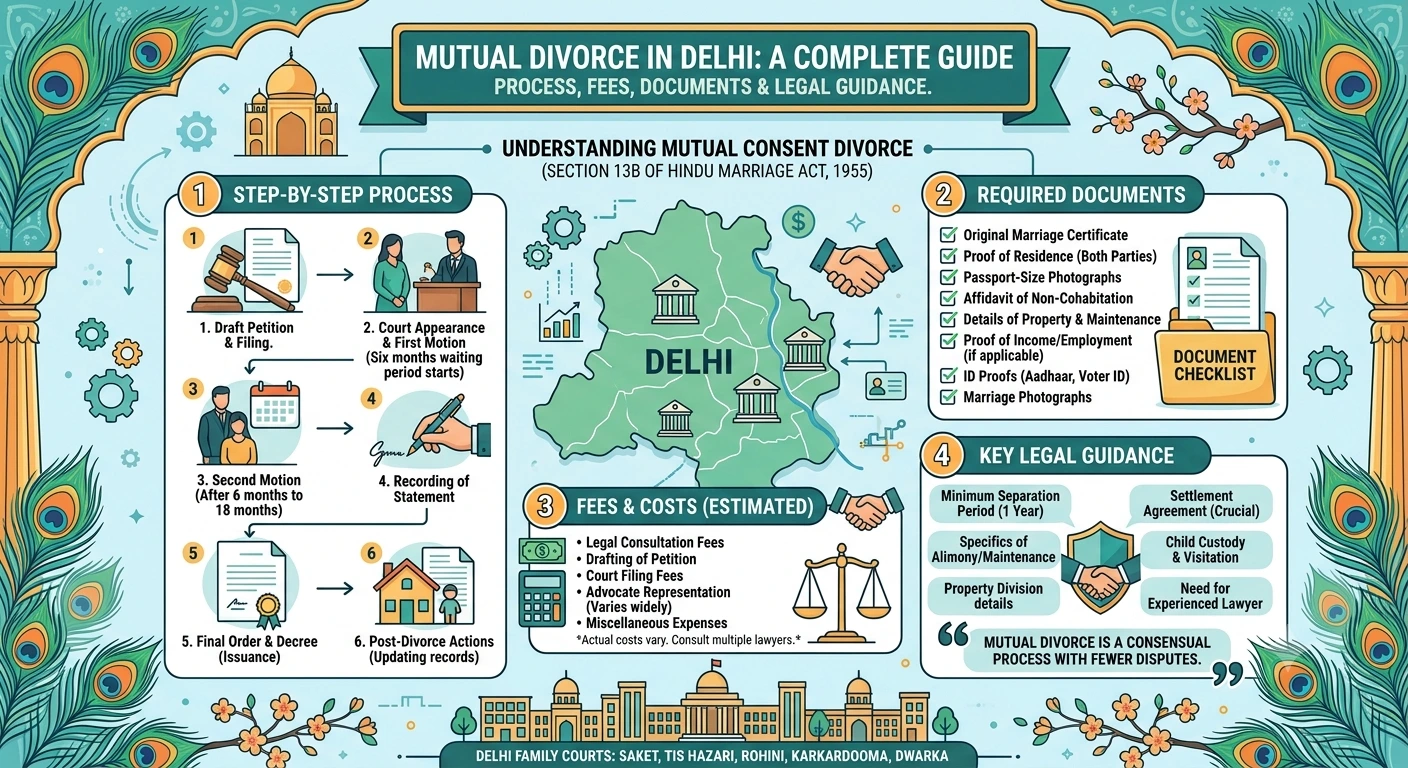
How Does Mutual Divorce Work in Delhi?
For a Hindu marriage to which Section 13B applies, the process broadly involves several stages.
Step 1: Discuss the settlement
Before filing, both spouses should identify the issues that need to be resolved.
This can include financial claims, custody, visitation, children’s expenses, belongings and pending proceedings.
Step 2: Check eligibility and jurisdiction
The lawyer reviews whether the statutory requirements are met and identifies the appropriate court based on the parties’ circumstances.
Step 3: Prepare the petition and settlement documents
The necessary pleadings and supporting documents are prepared based on the facts of the marriage and the agreement reached.
Step 4: First motion
The parties approach the appropriate court under the applicable statutory provision. The court follows the procedure prescribed by law and applicable judicial practice.
Step 5: Statutory waiting period and second motion
Section 13B(2) of the Hindu Marriage Act contains a six-month period between the first motion and the second motion, subject to the legal framework and applicable judicial decisions.
The six-month period should not be described as an automatic requirement in every case without considering the law and relevant Supreme Court decisions concerning waiver.
Step 6: Second motion and final decision
The spouses proceed with the subsequent statutory stage in accordance with the applicable procedure. If the legal requirements are satisfied, the court may pass the decree of divorce.
Can the Six-Month Period Be Waived?
Potentially, yes.
In Amardeep Singh v. Harveen Kaur, (2017) 8 SCC 746, the Supreme Court held that the six-month period mentioned in Section 13B(2) can, in appropriate circumstances, be waived by the court. The decision identified factors relevant to considering such a request.
This does not mean that every couple is automatically entitled to immediate waiver.
Whether waiver is appropriate depends on the facts, the stage of the proceedings and the applicable judicial approach. A lawyer can assess whether seeking waiver is legally appropriate in a particular case.
Which Court Handles Divorce Matters in Delhi?
The appropriate court depends on the jurisdictional facts of the marriage and the parties.
Delhi has dedicated Family Courts, and matrimonial matters may also fall within the jurisdictional framework of the relevant Delhi district judiciary. The appropriate court may depend on factors such as where the parties reside, where they last lived together and other jurisdictional facts recognised by the applicable matrimonial law.
Delhi’s district judiciary includes court complexes such as:
- Tis Hazari
- Karkardooma
- Rohini
- Dwarka
- Saket
- Patiala House
However, the existence of a court complex in a particular part of Delhi does not by itself establish jurisdiction over an individual divorce case.
Before filing, obtain case-specific advice on jurisdiction rather than choosing a court solely because it is geographically convenient.
How Much Does a Mutual Divorce Lawyer Charge in Delhi?
There is no single statutory professional fee applicable to all divorce lawyers in Delhi.
The total professional cost can depend on:
- The advocate’s experience and practice structure
- Complexity of the matter
- Petition drafting
- Settlement drafting
- Number of court appearances
- Applications required during the proceedings
- Mediation or settlement assistance
- Child custody issues
- Maintenance or alimony issues
- Connected matrimonial or other proceedings
- Whether the engagement covers the entire matter or only particular stages
A fee discussion should be held before engagement.
| Fee Component | What to Ask |
|---|---|
| Consultation | Is it separately charged? |
| Petition drafting | Is drafting included in the quoted fee? |
| Settlement drafting | Is the agreement included or charged separately? |
| Court appearances | Per appearance or stage/package? |
| Interim applications | Included or additional? |
| Mediation | Is mediation assistance covered? |
| Second motion | Included in the overall engagement? |
| Connected proceedings | Are these separately charged? |
Do not select a lawyer solely because the quoted fee is the lowest. Equally, a high fee by itself does not establish that an advocate is the right choice.
Documents to Take to Your First Consultation
Preparing documents can make the first consultation more productive.
Depending on your circumstances, consider taking:
- Marriage certificate, if available
- Marriage photographs or other marriage-related records where relevant
- Identity and address documents
- Details of both spouses’ current addresses
- Details concerning where the spouses lived together
- Information about children
- Existing maintenance or custody orders
- Details of pending matrimonial proceedings
- Relevant settlement discussions
- Financial documents relevant to agreed financial arrangements
- Records concerning jewellery, belongings or property where relevant
- Copies of previous legal notices or court documents
Do not hide relevant facts from your lawyer simply because the matter is intended to be mutual. Complete information helps the advocate identify potential legal and procedural problems before filing.
What Should a Mutual Divorce Settlement Cover?
A settlement should be specific enough to reduce uncertainty.
Depending on the circumstances, consider addressing:
Financial claims
Clarify whether maintenance, permanent alimony or other financial claims have been settled and record the agreed terms accurately.
Children
If there are children, the agreement may need to address:
- Custody
- Visitation
- Schooling
- Medical expenses
- Day-to-day expenses
- Travel and communication
- Major future decisions
The welfare of a child remains an important consideration for the court. A private agreement cannot override the court’s legal responsibilities.
Jewellery and personal belongings
Specify what is to be returned, retained or otherwise dealt with, where this is relevant.
Pending proceedings
If related proceedings exist, the settlement should clearly identify the agreed treatment of those matters and the steps each party is expected to take.
Future claims
The parties should obtain legal advice on the wording and legal effect of any clauses dealing with future claims. Broad wording should not be inserted merely because it appears convenient.
Common Mistakes in Mutual Divorce Cases
Even couples who agree on divorce can encounter avoidable problems.
Filing before the settlement is genuinely clear
A verbal understanding may not be enough. Important terms should be documented clearly.
Ignoring jurisdiction
Filing in the wrong court can create procedural complications and delay.
Treating the six-month period as either mandatory or automatically waivable
Both assumptions can be misleading. The legal position should be assessed under the applicable law and current judicial principles.
Forgetting connected disputes
Maintenance, custody, domestic violence, property or other proceedings should not be overlooked merely because the divorce itself is mutual.
Signing without understanding the settlement
Do not sign a legal document simply because the other spouse or family members say it is routine.
Assuming mutual divorce means no lawyer is useful
Where the settlement involves significant financial, custody or procedural issues, independent legal advice can help each spouse understand the consequences of the agreement.
Is Mutual Divorce Faster Than Contested Divorce?
It can be more straightforward where both spouses genuinely agree on the divorce and all significant issues. However, it is incorrect to say that all mutual divorces will be completed within a specific time of days or months.
Statutory requirements, court scheduling, document problems, jurisdiction, settlement negotiations, and requests regarding the statutory waiting period and individual circumstances can all impact the timeline.
A lawyer should discuss the probable steps in the process, not the timeline for its conclusion.
Child Custody in a Mutual Divorce
Where children are involved, divorce does not make their interests secondary.
Parents should discuss in detail custody and visitation schedules and what they will do for their financial obligations. The parents’ consent to childcare arrangements may be noted in a settlement but the role of the court remains legal in relation to the child’s welfare.
Parents should consider not only where the child will live, but also:
- School arrangements
- Medical decisions
- Holidays
- Travel
- Communication with the other parent
- Educational expenses
- Healthcare costs
- Important future decisions
A lawyer can help translate an informal parenting arrangement into clearer legal documentation.
Maintenance and Alimony
Financial settlement is often one of the most sensitive parts of a mutual divorce.
Depending on the law applicable to the marriage and the circumstances, issues may include interim maintenance, permanent alimony or other financial claims.
In marriages under the Hindu Marriage Act Sections 24 and 25 cover maintenance pendente lite and permanent alimony, respectively.
The amount and legal entitlement cannot be reliably estimated with a formula that is available online in general. Income, financial circumstances, needs, obligations, assets and other relevant facts may need to be considered.
Can Mediation Help With Mutual Divorce?
Mediation can be useful where spouses agree in principle to separate but still disagree about particular terms.
For example, they may agree on divorce but disagree about:
- Alimony
- Child visitation
- Children’s expenses
- Return of belongings
- Property-related arrangements
- Withdrawal or resolution of connected proceedings
Mediation offers a formal means of discussing. It is not a requirement that all disputes be mediated, and it should not be offered as a settlement promise.
The judicial system in Delhi has provisions for mediation of eligible disputes, as per procedure, before the relevant court.
Practical Insights From Matrimonial Practice in Delhi
A mutual divorce becomes considerably easier to manage when the parties distinguish between agreeing to divorce and agreeing on the consequences of divorce.
The second part can be a point of difficulty.
It can be beneficial to come up with a list of all the issues you and your spouse have discussed beforehand if you are considering speaking with a lawyer. Don’t restrict it to the divorce. Money, children, possessions, property, commitments that each person expects the other to make, existing cases.
A second useful step is to separate facts from assumptions. For instance, a spouse might think a certain court invariably has jurisdiction or that the waiting period will automatically be waived. Those questions should be considered as issues in which case the relevant legislation should be consulted and not assumed.
Lastly, have your attorney clarify the settlement in simple terms prior to signing it. A contract signed by both spouses, but not completely understood by either, can cause issues.
Questions to Ask Before Hiring a Mutual Divorce Lawyer
Before engaging an advocate, consider asking:
- Do you regularly handle mutual consent divorce matters?
- Which law applies to our marriage?
- Which court may have jurisdiction based on our facts?
- What documents will you need?
- What should our settlement agreement cover?
- How will child custody and visitation be documented?
- How should maintenance or alimony be addressed?
- Are there existing proceedings that need to be considered?
- What does your professional fee include?
- Are court appearances included?
- Are drafting and settlement negotiations included?
- Will another advocate appear on my behalf?
- What procedural stages should I expect?
- Is a waiver request concerning the six-month period potentially relevant to our circumstances?
A clear answer to these questions can help you compare lawyers on substance rather than advertising claims.
Red Flags When Choosing a Divorce Lawyer
Be cautious if a prospective lawyer:
- Guarantees that you will definitely receive a divorce.
- Promises a fixed completion date without examining your circumstances.
- Claims to be “No. 1” without verifiable independent evidence.
- Uses guaranteed custody or maintenance claims as a sales tactic.
- Refuses to explain the fee structure.
- Does not identify who will actually handle your matter.
- Encourages you to sign a settlement without properly explaining it.
- Discourages you from disclosing relevant facts.
- Makes legal claims that conflict with the applicable statute or court decisions.
Good legal representation should involve realistic advice, confidentiality, clear communication and informed decision-making.
Why Consider a Delhi Legal Expert?
Delhi Legal Expert can serve as a starting point for people seeking information about matrimonial and family-law matters in Delhi and the National Capital Region.
If you are considering a mutual consent divorce, professional legal guidance can help you understand the applicable legal framework, possible jurisdiction, documentation requirements, settlement considerations and procedural next steps.
The appropriate advocate should be selected based on the facts of your matter, relevant matrimonial-law experience, communication, fee transparency and the scope of representation—not on an unsupported claim of being the “best” lawyer.
Need Clarity About Your Divorce Case in Delhi?
If you are considering a mutual consent divorce, a consultation can help you understand:
- Which legal provisions may apply to your marriage
- Whether the proposed court has jurisdiction
- What documents you should prepare
- Which settlement terms need to be addressed
- How maintenance, alimony or children’s issues may be handled
- What the likely procedural stages are
- Whether questions concerning the statutory waiting period require further legal consideration
The purpose of a consultation is to help you make an informed decision based on your individual circumstances. No online article can replace case-specific legal advice.
Frequently Asked Questions
Who is the best mutual divorce lawyer in Delhi?
No one has an objective answer as to what the “best” mutual divorce lawyer is in all cases. An appropriate advocate must have the necessary experience in matrimonial law, ensure an awareness of the understanding of mutual consent matters, have good communication skills, discuss settlement options, and be familiar with how jurisdiction may be assessed prior to filing. Claims about being the “best” should be treated cautiously unless supported by independently verifiable evidence.
How much does a mutual divorce lawyer charge in Delhi?
There is no uniform professional fee applicable to all advocates. Fees may vary based on consultation, petition and settlement preparation, court attendance, mediation, further applications and related proceedings. Prior to engagement request a written breakdown of what the quoted professional fee covers, and what services may be billed at a different rate.
Which lawyer is suitable for a mutual divorce?
Look for an advocate with relevant matrimonial-law experience, particularly in mutual consent proceedings and settlement drafting. If children, significant financial arrangements or existing proceedings are involved, choose someone who can address those issues as part of the overall legal strategy rather than treating the divorce petition in isolation.
Do I need a Delhi-based divorce lawyer?
Not necessarily in every situation. What matters is whether the advocate can appropriately advise and represent you in the court having jurisdiction over the matter. If your case involves Delhi, another state or international residence, jurisdiction should be assessed from the actual facts before deciding where and through whom to proceed.
Can the six-month period for mutual divorce be waived?
In appropriate circumstances, a court may waive the six-month period under Section 13B(2) of the Hindu Marriage Act. The Supreme Court’s decision in Amardeep Singh v. Harveen Kaur recognised the possibility of waiver. It is not an automatic entitlement, and the circumstances of the individual case must be considered.
How long does mutual consent divorce take in Delhi?
There is no universally guaranteed timeline. The process depends on the applicable law, statutory requirements, court scheduling, documentation, settlement and other circumstances. Requests concerning waiver of the statutory waiting period may also affect the procedural timeline where legally available.
What documents should I take to a divorce lawyer?
Take your marriage certificate if available, identity and address documents, information about where the spouses have lived, children’s documents where relevant, details of financial arrangements, existing court orders, legal notices and information about any pending proceedings. Your lawyer can identify additional documents required for your specific case.
Can custody be settled during a mutual divorce?
Parents can agree on arrangements concerning custody, visitation and children’s expenses and record those terms in the settlement where legally appropriate. However, the court retains its legal responsibility concerning the child’s welfare. Parenting arrangements should therefore be drafted carefully and with the child’s interests in mind.
Can a divorce lawyer guarantee the outcome?
No responsible lawyer would make any court promise. The competent court will make the final decision, depending on the facts and applicable law, and an advocate can only advise on the law, prepare documents, present the case and explain the available options.
Is mutual divorce automatically easier than contested divorce?
It can be less adversarial in terms of procedure when both parties are actualizing a divorce and the related issues they have in common. But financial issues, children, property, jurisdiction or pending litigation can also cause problems. The quality and completeness of the settlement are important.
Can maintenance or alimony be included in a mutual divorce settlement?
Financial arrangements can be addressed in a mutual divorce settlement where legally appropriate. The type of treatment depends on the specific matrimonial law and persons involved. The proposed wording should be reviewed by a lawyer, and the legal impact of the agreement should be explained to the parties before the agreement is signed.
Can existing matrimonial cases be resolved as part of a settlement?
There are legal processes and procedures to each proceeding, and a settlement can include agreed actions for connected proceedings. All pending matters should be reviewed by a lawyer before advising as to what can be withdrawn, disposed of, compromised, or otherwise resolved.
Authoritative Legal Sources
For readers and editors reviewing the legal information on this page, the following primary sources are preferable to commercial law blogs:
- India Code – Hindu Marriage Act, 1955, including Sections 13, 13B, 24 and 25: https://www.indiacode.nic.in/
- Supreme Court of India – judgments and case information: https://www.sci.gov.in/
- Delhi District Courts – court information and judicial services: https://delhicourts.nic.in/
- Delhi High Court – judgments, orders and court information: https://delhihighcourt.nic.in/
- Amardeep Singh v. Harveen Kaur, (2017) 8 SCC 746 – Supreme Court authority concerning waiver of the Section 13B(2) waiting period.
Legal provisions and judicial interpretations can change. The page should be reviewed periodically against the current statutory text and relevant judgments.
Final Thoughts
Choosing a mutual divorce lawyer in Delhi should be based on the lawyer’s ability to understand your circumstances, assess jurisdiction, explain the applicable law, prepare accurate documents and help create a clear settlement.
For a mutual consent divorce, agreement between spouses is important, but so is the quality of the legal documentation. Questions involving alimony, children, belongings, pending proceedings and the statutory process should be addressed before the matter is filed.
Delhi Legal Expert aims to provide accessible information about matrimonial and family-law matters. For advice about your particular circumstances, seek assistance from a qualified legal professional who can review the facts and applicable law.