Mutual Divorce Agreement in Delhi: Important Clauses to Include
What Should a Mutual Divorce Agreement in Delhi Include?
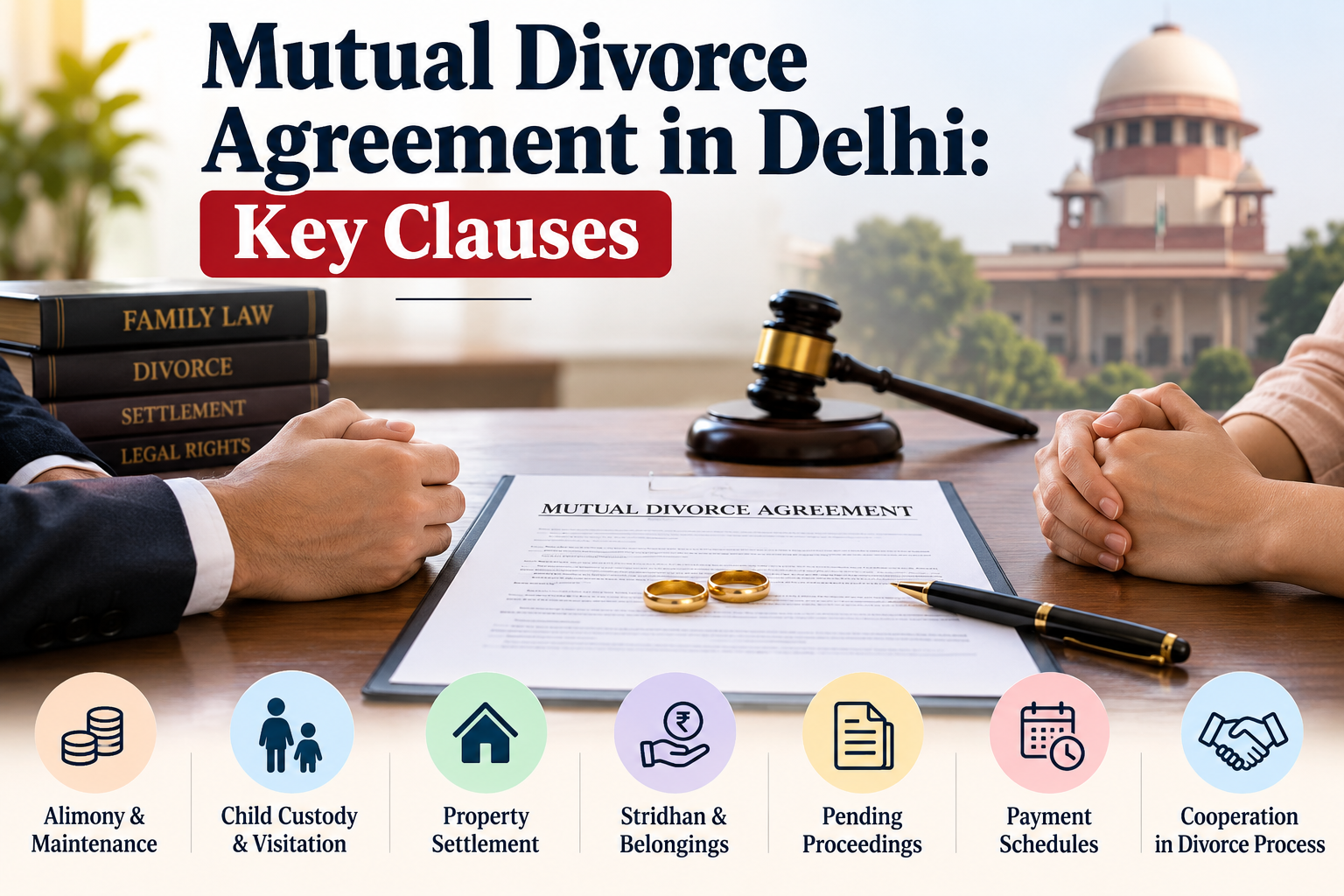
Before taking the divorce process forward, each of the spouses should clearly document all the terms agreed upon between them in a mutual divorce agreement in Delhi. This can involve permanent alimony or maintenance, child custody and visitation, child expenses, return of stridhan and personal property, property and financial settlements, and motions to withdraw and dispose of pending cases, payment schedules, and cooperation during the first and second motions.
Section 13B of the Hindu Marriage Act, 1955 provides for divorce by mutual consent between the husband and wife, and both parties have to agree to the divorce, and the parties have been living apart for a period of one year or more, as per the provisions of the statute. The Act provides for a second motion after six months and within eighteen months of presentation of the petition.
A well-drafted settlement is crucial since the divorce is just as important as the settlement. It is important to be aware of what will happen to financial claims, children, property and any pending legal action or debts upon separation.
Why Your Mutual Divorce Agreement Matters
When spouses decide to separate amicably, the immediate thought is often: “We have agreed to divorce, so what else is left?”
Quite a lot.
Today you may agree on maintenance, custody, property or pending complaints, but later, it can be a disagreement due to a vague oral understanding.
For example:
- When exactly will the settlement amount be paid?
- Is the payment full and final?
- Who will pay the child’s school and medical expenses?
- Where will the child live?
- What visitation arrangement will apply?
- When will jewellery, stridhan or personal belongings be returned?
- What happens to pending matrimonial or connected proceedings?
- Who will complete a property transfer?
- What happens if one party does not perform an agreed obligation?
A well-drafted mutual consent divorce agreement in Delhi attempts to answer these questions before they create another dispute.
This guide clarifies the vital clauses to take into account, the mutual divorce procedure in Delhi, and the way a divorce lawyer can assist you in preparing a divorce settlement that is appropriate for your situation.
About Delhi Legal Expert
Delhi Legal Expert is a legal firm in Delhi that offers expert legal services to those who are facing divorce, matrimonial and related family law problems.
Our advocates help clients understand their legal rights, negotiate and review settlement terms, prepare mutual consent divorce petitions, organise the necessary paperwork and deal with the Family Court.
According to the Delhi Legal Expert website, its matrimonial practice includes the following: Mutual consent divorce, contested divorce, child custody, maintenance, alimony and related matters before the Delhi Family Court.
The goal of a mutual divorce issue is not only to get signatures. The settlement should be a true reflection of the settlement that both spouses have agreed and reduce any ambiguity about their future obligations.
What Is a Mutual Divorce Agreement?
A mutual divorce agreement, also known as a divorce settlement agreement, is a written agreement that details the terms of a separation or divorce between spouses.
The agreement may include financial and non-financial issues.
Depending on the case, it may cover:
- Divorce by mutual consent
- Permanent alimony
- Maintenance
- Child custody
- Visitation or parenting arrangements
- Child-related expenses
- Stridhan and jewellery
- Personal belongings
- Joint property
- Bank accounts and financial liabilities
- Pending matrimonial litigation
- Payment schedules
- Cooperation in divorce proceedings
In Delhi, if a settlement is reached in court-referred mediation, the mediation procedure to which it is subject mandates that the settlement be put in writing and signed by the parties.
Any agreement or agreements will have different terms and legal implications depending on the parties involved and the law. Thus, an internet-derived generic contract is not a substitute for drafting a contract specific to a particular case.
Mutual Consent Divorce Under Section 13B
Section 13B of the Hindu Marriage Act allows for divorce by mutual consent.
Generally, Section 13B(1) allows for a petition to be filed jointly by both spouses if they have been living apart for a period of one year or more, and have been unable to live together and agree that the marriage should be dissolved.
The court has to be satisfied of the validity of the consent. The Hindu Marriage Act clearly stipulates that there must not have been consent to mutual divorce obtained by force, fraud or undue influence.
This places the concept of true and ongoing consent at the heart of the mutual-divorce.
Important: The divorce provision may vary depending on the law by which your marriage was registered. The Hindu Marriage Act is referred to in Section 13B, which is discussed here. If couples are married under a different legal system, they should seek guidance on the provision that applies to them.
12 Important Clauses in a Mutual Divorce Agreement in Delhi
A settlement should be customised. However, the following issues commonly require careful consideration.
1. Details of the Marriage and Parties
The agreement should correctly identify both spouses and basic details relevant to the marriage.
These may include:
- Names of both spouses
- Date of marriage
- Place of marriage
- Current addresses
- Relevant marriage registration details
- Date or period of separation
Accuracy matters because these details may also appear in the joint divorce petition and supporting documents.
2. Mutual Decision to Seek Divorce
The agreement should clearly record that both parties have decided to seek dissolution of the marriage by mutual consent.
The language should make it clear that the decision is voluntary.
Neither spouse should be signing because of coercion, fraud or undue influence. This is particularly important because the court itself must be satisfied regarding the genuineness of consent.
3. Alimony and Maintenance Clause
Financial settlement is one of the most important areas to address.
If permanent alimony or another monetary settlement has been agreed, the agreement should clearly specify matters such as:
- Total agreed amount
- Whether it is lump-sum or structured
- Instalment amounts, if applicable
- Payment dates or milestones
- Mode of payment
- Treatment of existing maintenance claims
- Whether particular financial claims are being settled, subject to applicable law
Avoid simply writing: “All financial matters are settled.”
A more carefully drafted agreement identifies what has actually been settled and how the agreed obligations will be performed.
4. Payment Schedule Linked to Divorce Stages
Where settlement money is payable in stages, the agreement should clearly identify the trigger for each payment.
Depending on what the parties negotiate, payments may be linked to events such as:
- Signing the settlement
- First-motion proceedings
- Completion of an agreed procedural step
- Second-motion proceedings
- Passing of the divorce decree
The arrangement should be legally reviewed rather than copied from another case.
Clear dates, amounts and payment methods reduce uncertainty.
5. Child Custody Clause
If the spouses have children, custody terms require particular care.
The agreement may address:
- With whom the child will ordinarily reside
- Parenting arrangements
- Decision-making regarding education
- Medical treatment
- Travel arrangements
- Schooling
- Communication with the other parent
Parents should remember that agreements involving children are not treated purely as commercial bargains. Courts remain concerned with the child’s welfare and applicable family law principles.
6. Visitation and Parenting Arrangements
If one parent has primary physical custody, the agreement should consider how the other parent will maintain contact with the child.
Rather than simply stating “reasonable visitation”, consider whether the circumstances require clarity about:
- Weekends
- School holidays
- Festivals
- Birthdays
- Video or telephone calls
- Pick-up and drop-off arrangements
- Domestic or international travel
- Advance notice requirements
The objective should be a workable arrangement that avoids repeated disagreements.
7. Child Maintenance and Future Expenses
Child-related financial arrangements should be addressed separately from spousal maintenance where relevant.
Consider issues such as:
- Monthly expenses
- School fees
- Tuition
- Medical expenses
- Health insurance
- Extracurricular activities
- Higher education
- How extraordinary expenses will be shared
The agreement should clearly identify responsibilities rather than leaving important future expenses uncertain.
8. Stridhan, Jewellery and Personal Belongings
Where applicable, the settlement should clearly record the agreed arrangements regarding stridhan, jewellery, gifts, documents and personal belongings.
An itemised list may be useful where significant property is being returned.
The agreement can record:
- Items already returned
- Items yet to be returned
- Date and place of handover
- Acknowledgment of receipt
- Any remaining claims concerning specified belongings
This can prevent disagreements later about whether particular articles were returned.
9. Property and Asset Settlement
If the spouses own property or significant assets, vague language should be avoided.
Depending on the circumstances, the settlement may need to address:
- Jointly owned property
- Residential property
- Vehicles
- Bank accounts
- Investments
- Loans
- EMIs
- Other jointly held assets or liabilities
Further documentation, registration, stamp-duty or legal requirements may be required if the property is to be transferred, sold or relinquished. A divorce settlement will not necessarily be a complete transfer of all property.
Get specific property-law counsel when significant assets are involved.
10. Pending Court Cases and Complaints
There are some matrimonial cases that involve multiple proceedings simultaneously.
The settlement should outline any pending issues that need to be addressed and the lawful actions that the parties agree to do with respect to the issues.
This could include, depending on the case:
- Matrimonial proceedings
- Maintenance proceedings
- Domestic violence proceedings
- Custody proceedings
- Other connected civil proceedings
- Criminal complaints or cases, where legally permissible procedures are available
This clause is one that should be taken with care.
Parties are not free to formally withdraw a case by writing a case “stands withdrawn” unless there are statutory grounds for doing so. Applications, statements, orders, compounding, and other legal actions may be different for different proceedings.
Each pending case should be mapped individually by a lawyer.
11. No Further Claims Clause
A settlement often records which matrimonial and financial disputes have been resolved between the spouses.
However, a broad statement such as “neither party will ever make any claim against the other” should not be inserted mechanically.
The clause should be drafted in light of:
- The claims actually being settled
- Existing litigation
- Rights of children
- Applicable statutory rights
- Property arrangements
- Any obligations that continue after divorce
Precision is safer than sweeping language.
12. Cooperation and Implementation Clause
A settlement is useful only if its terms can actually be implemented.
The agreement may therefore specify that the parties will cooperate in agreed procedural steps, such as:
- Signing necessary petitions and applications
- Appearing before the Family Court when required
- Providing agreed documents
- Completing agreed payments
- Returning specified belongings
- Executing agreed property documents
- Taking agreed steps concerning connected proceedings
The exact consequences of non-performance should be drafted with legal advice rather than relying on punitive language copied from templates.
Mutual Divorce Process in Delhi: Step by Step
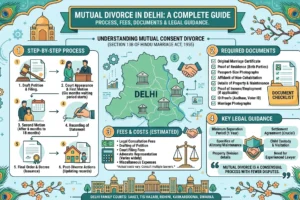
Step 1: Discuss and Finalise Settlement Terms
Before filing, both spouses should identify unresolved issues.
These commonly include:
- Alimony
- Maintenance
- Children
- Property
- Stridhan
- Pending litigation
- Financial liabilities
The settlement should then be reviewed and properly documented.
Step 2: Prepare the Joint Petition
The mutual consent petition is prepared under Section 13B of the Hindu Marriage Act for eligible spouses who are proceeding under this act.
The petition contains the facts of the marriage and the parties’ mutual consent.
Step 3: File Before the Appropriate Family Court
The petition must be filed in a court that has jurisdiction over the matrimonial proceeding.
A Delhi divorce lawyer can check jurisdiction before filing rather than taking it for granted that the closest Family Court is the right court to file in.
Delhi District Courts also offer e-filing facility in Delhi Family Courts in the respective districts.
Step 4: First Motion
Usually, both spouses are required to appear in court and attest to their consent and statements.
The court reviews the petition and circumstances.
Step 5: Cooling-Off Period
The second motion is to be made not earlier than six months after presentation of the petition, and not later than eighteen months after that date, as mentioned in Section 13B(2).
The Supreme Court, however, has ruled that the six-month waiting period is directory rather than mandatory and that it may be waived in appropriate situations when the waiting period would be meaningless.
This does not mean every couple automatically receives a waiver.
Step 6: Second Motion and Final Decree
If the parties agree and the requirements are met, then the second motion is made.
Their statements are taken into consideration by the court, and if it is legally satisfied, the court may issue the decree of divorce.
Can the Six-Month Cooling-Off Period Be Waived?
Yes, in some cases a waiver might be requested.
The Supreme Court in its interpretation of Section 13B has given the courts discretion to dispense with the six month condition and does not either make it a strict condition or presume that it will always be applicable.
Whether or not a waiver should be allowed will depend on the facts and the court’s evaluation.
Therefore, avoid relying on claims such as: “Guaranteed divorce without six months.”
Your divorce attorney will be able to determine if a waiver is appropriate in your situation, but it is up to the court to decide.
Documents Commonly Required for Mutual Divorce in Delhi
Exact requirements can vary, but your lawyer may ask for documents such as:
- Marriage certificate, where available
- Marriage photographs or other marriage proof where relevant
- Identity proof of both spouses
- Address proof
- Passport-size photographs
- Details relating to children, if any
- Settlement agreement
- Financial documents relevant to agreed monetary terms
- Details and copies of pending proceedings, where applicable
- Property documents if property settlement is involved
- Proof relating to payments already made under the settlement
Your lawyer should check the documents required for your particular Family Court and circumstances before filing.
How Long Does Mutual Consent Divorce Take in Delhi?
There is no single timeline that applies to every case.
Section 13B of the statutory structure allows for the second motion after the set time and within the statutory outer time. In exceptional cases the six-month period may be shortened as explained above.
Actual time may depend on:
- Whether settlement terms are already finalised
- Court scheduling
- Document readiness
- Whether a waiver is sought and granted
- Whether both spouses continue to consent
- Whether connected disputes must first be resolved
If someone promises you a guaranteed divorce within a fixed number of days without reviewing your case, treat that claim cautiously.
How Much Does a Mutual Divorce Agreement Cost in Delhi?
There is no universal professional fee for drafting a matrimonial settlement or handling a mutual divorce.
Costs can depend on:
- Complexity of settlement
- Number of assets involved
- Child custody arrangements
- Alimony negotiations
- Number of connected proceedings
- Property documentation
- Lawyer’s professional fee
- Additional applications required
Ask your divorce lawyer for a clear scope of work and fee structure before proceeding.
A straightforward settlement with no children, significant assets or pending cases will generally require less drafting and negotiation than a matter involving custody, substantial property and multiple proceedings.
Common Mistakes to Avoid in a Mutual Divorce Settlement
Using an Internet Template Without Customisation
Every marriage has different financial, family and legal circumstances.
Leaving Payment Terms Vague
Specify amounts, stages, methods and relevant deadlines.
Ignoring Existing Cases
List connected proceedings and determine the lawful procedure required for each.
Using Vague Child Custody Language
A practical parenting arrangement can reduce future disagreements.
Ignoring Future Child Expenses
Education and medical expenses can become significant issues later.
Assuming the Agreement Automatically Transfers Property
Property transactions can involve separate legal and registration requirements.
Signing Without Understanding the Consequences
Each spouse should understand the document before signing it.
Making Promises That Cannot Legally Be Performed
A private agreement cannot override mandatory law or bind a court to take an action it is not legally permitted to take.
Mediation and Mutual Divorce Settlements in Delhi
Mediation may be helpful when spouses have a general agreement to divorce, but have issues concerning finances, children, property, or related actions.
According to Delhi District Courts, mediation is a negotiation process facilitated by a neutral third party who assists the parties in reaching a mutual settlement without taking the decision for them.
The court mediation centres in Delhi are located at Tis Hazari, Karkardooma, Rohini, Dwarka, Saket and Patiala House Courts Complexes.
Delhi District Courts recognise matrimonial disputes as suitable for mediation.
This can be especially helpful when the spouses desire an amicable divorce, but require support to convert their general agreement to specific settlement terms.
Mutual Consent Divorce Legal Services in Delhi
In Delhi, the Family Court is the forum where family and matrimonial disputes are addressed based on jurisdiction and nature of the proceedings.
Matrimonial issues can involve Family Courts that are part of court complexes, including:
- Tis Hazari
- Saket
- Rohini
- Karkardooma
- Dwarka
- Patiala House
In appropriate applications, appeals, transfer applications etc., the Delhi High Court may come into the picture but an ordinary mutual consent divorce petition should not be said to commence in the Delhi High Court just because the parties reside in Delhi.
Selecting the right forum from the outset can save on needless procedural hassles.
Why Have a Divorce Lawyer Review the Agreement?
You and your spouse may already be in agreement about the divorce. This doesn’t always mean that the legal drafting is simple.
A divorce attorney will be able to help you find issues that you may not have thought of.
For example:
“The husband will pay ₹10 lakh as settlement.”
That statement alone does not answer:
When will it be paid? In one payment or instalments? By bank transfer or another method? What claims does it settle? What happens to payments already made? Is any amount linked to an agreed procedural milestone?
Likewise:
“The mother will keep custody and the father can meet the child.”
This does not explain frequency, holidays, travel, communication, education, medical decisions or expenses.
A properly drafted agreement turns a broad understanding into specific obligations that both parties can understand.
How Delhi Legal Expert Can Assist
Delhi Legal Expert provides matrimonial-law assistance for people considering or proceeding with mutual consent divorce in Delhi.
Depending on your circumstances, assistance may include:
- Initial legal consultation
- Review of your proposed settlement
- Drafting a mutual divorce settlement agreement
- Alimony and maintenance settlement drafting
- Child custody and visitation terms
- Stridhan and belongings settlement
- Property-related settlement coordination
- Review of pending matrimonial proceedings
- Preparation of the mutual-consent petition
- Family Court representation
- Advice concerning cooling-off-period waiver where applicable
- Assistance through first and second motion
- Final decree-related assistance
Delhi Legal Expert’s existing matrimonial service page states that its mutual-consent service includes drafting consent terms, filing the joint petition, appearances for first and second motions, and waiver applications where appropriate.
Frequently Asked Questions
Q1. What is a mutual divorce agreement in Delhi?
A mutual divorce agreement is a written settlement recording the terms agreed between spouses who intend to separate and seek divorce by mutual consent.
It may deal with alimony, maintenance, children, property, stridhan, pending proceedings, payment arrangements and other issues arising from the marriage.
The document should be customised to your circumstances instead of copied from a standard template.
Q2. Is a settlement agreement compulsory for mutual divorce?
Section 13B itself sets out the statutory requirements for mutual-consent divorce rather than prescribing one universal settlement format for every couple.
However, where financial, custody, property or connected litigation issues exist, recording agreed terms clearly can be extremely important. Your lawyer can advise what documentation is appropriate for your circumstances.
Q3. What clauses should be included in a mutual divorce agreement?
Depending on the case, important clauses can cover alimony, maintenance, custody, visitation, child expenses, property, loans, stridhan, belongings, pending proceedings, payment schedules and cooperation with the divorce process.
There is no one-size-fits-all list. The clauses should reflect the actual issues between the spouses.
Q4. Can we get mutual divorce without waiting six months?
Possibly, but not automatically.
The Supreme Court has held that the six-month period under Section 13B(2) is directory and can be waived by the court in appropriate circumstances. Whether it is waived depends on the facts and judicial discretion.
A lawyer can assess whether a waiver application is appropriate in your case.
Q5. Can a mutual divorce agreement decide child custody?
Parents can record their agreed custody and parenting arrangements, but child-related issues remain subject to applicable law and the child’s welfare.
The agreement should therefore be drafted with the child’s practical needs in mind rather than treating custody simply as an exchange between spouses.
Q6. Should alimony be paid before or after the divorce?
There is no single payment structure suitable for every case.
Spouses may agree on a payment schedule connected to different stages, but the arrangement should clearly specify the amount, timing, method and purpose of each payment.
Take legal advice before finalising the payment mechanism.
Q7. Can we include property settlement in the divorce agreement?
Yes, property-related settlement terms may be recorded where relevant.
However, if ownership of immovable property must actually be transferred, additional documentation, registration, stamp-duty or other legal requirements may apply. Have the property aspect independently checked before assuming that the divorce agreement alone completes the transfer.
Q8. What happens to pending cases after a mutual divorce settlement?
The parties can agree on lawful steps to resolve connected proceedings, but signing the settlement does not necessarily make every pending case disappear automatically.
The procedure depends on the nature of each proceeding. Your lawyer should identify each case and advise what application, statement, order or other procedural step is required.
Q9. Can one spouse withdraw consent before the mutual divorce is completed?
Mutual consent must remain legally effective through the relevant process; a settlement should therefore not be drafted on the assumption that a divorce decree becomes automatic merely because an agreement was signed.
If consent is withdrawn or a settlement obligation is breached, obtain case-specific legal advice promptly rather than taking unilateral action.
Q10. Which Family Court should I approach for mutual divorce in Delhi?
The correct court depends on matrimonial jurisdiction and the facts of your case. Delhi has Family Courts across different court districts.
A mutual consent divorce lawyer in Delhi can check jurisdiction based on your marriage, residence and other legally relevant facts before filing.