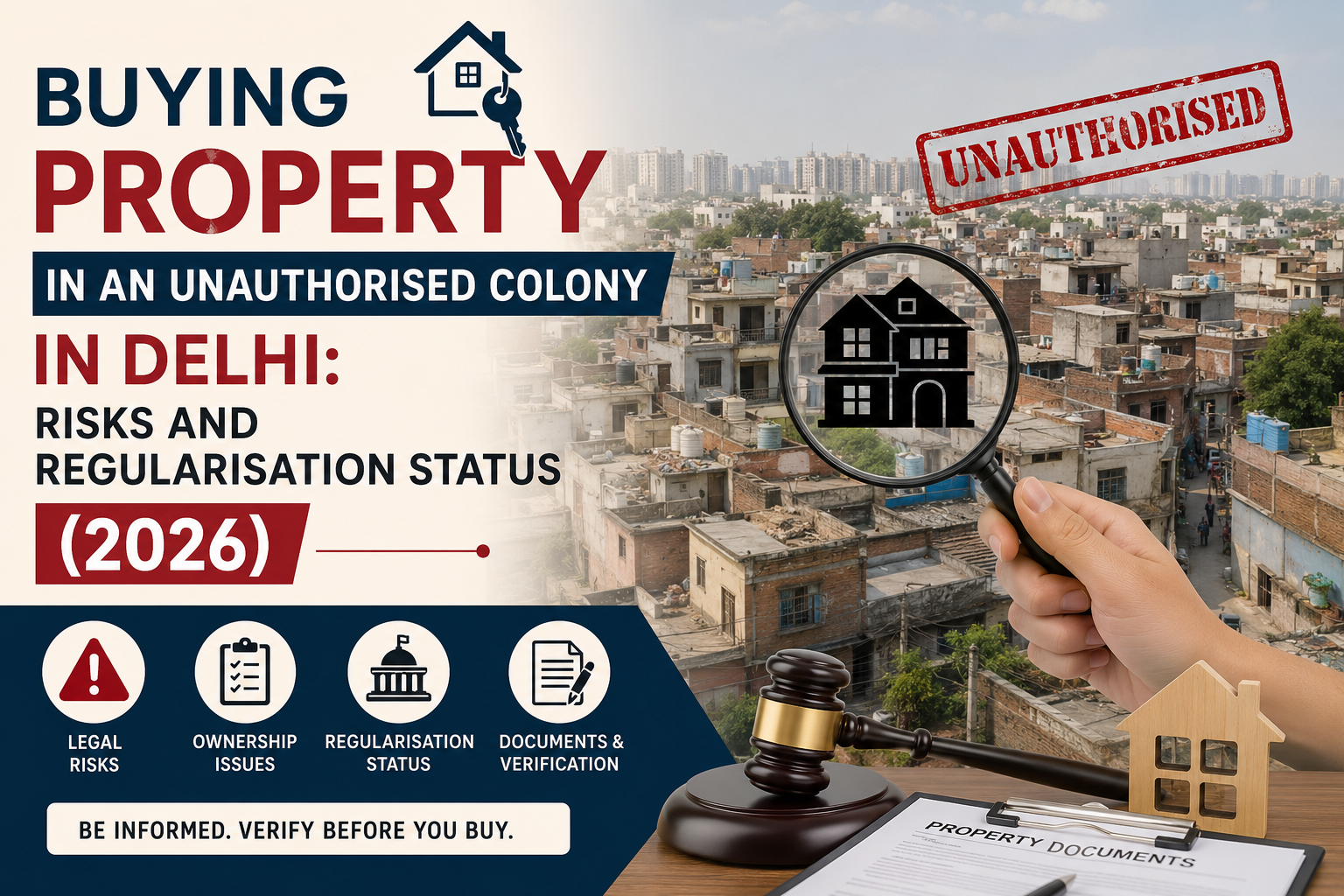
Buying Property in an Unauthorised Colony in Delhi: Risks and Regularisation Status (2026)
Quick answer: An unauthorized colony in Delhi is a residence in an area that is not laid out by the authority. Millions of people stay in such colonies in Delhi. As announced in April 2026, the government has now regularised 1511 out of 1731 unauthorised colonies under the PM-UDAY scheme (Pradhan Mantri Unauthorised Colonies in Delhi Awas Adhikar Yojana) on an “as is, where is” basis. This allows residents to apply for a Conveyance Deed to then be able to register a Sale Deed, but it requires careful legal handling and is subject to deadlines and risks.
Call Now: +91 8130789810 WhatsApp Us
What Is an Unauthorised Colony
A colony that has been developed and sold without permission from the Delhi Development Authority (DDA) or the Municipal Corporation of Delhi (MCD) is called an unauthorized colony. These colonies were for the most part established before 2003. In the past, buyers in such colonies lacked formal ownership documentation, just a series of agreements that were not registered and were passed on for decades.
The Big 2026 Update: PM-UDAY “As Is, Where Is”
In April 2026, the Central Government and Delhi Government jointly announced regularisation of 1,511 unauthorised colonies, covering roughly 45 lakh residents. The key changes:
- The “As Is, Where Is” principle now applies — existing structures are recognised in their current form, without needing prior layout plan approval (which had stalled the scheme for years).
- DDA’s GIS survey of colonies is to be completed within 7 days, deficiencies resolved within 15 days, and Conveyance Deeds issued within 45 days of a valid application.
- Small shops up to 20 square metres are also being regularised under certain conditions.
- As of March 2026, roughly 40,000 Conveyance Deeds/Authorisation Slips had been issued — a small fraction of the estimated 10 lakh eligible families, so most residents still need to apply.
- Future construction in these colonies must still follow proper MCD building norms, even though existing structures are recognised.
- Application deadline: Under PM-UDAY 2.0, the Delhi Government has set 31 October 2026 as the cut-off date to apply for a Conveyance Deed or Authorisation Slip. Applications after this date may not be accepted.
How the Regularisation Process Works
- Check if your colony is on the regularised list — search your colony name on the DDA PM-UDAY portal.
- Apply through the PM-UDAY portal, submitting proof of possession, purchase documents, and identity proof.
- DDA conducts a GIS survey of your plot and colony.
- Pay the applicable charge — a nominal amount based on plot size and whether the land is government or private.
- Receive your Conveyance Deed or Authorisation Slip.
- Register a Sale Deed at the Sub-Registrar’s office based on the Conveyance Deed — this is the step that gives you full, transferable legal ownership.
Why Buying in an Unauthorised Colony Was (and Still Is) Risky
Even with regularisation underway, buyers should understand these risks:
- Incomplete regularisation: Not every colony is on the approved list, and not every resident has applied yet.
- Unclear chain of ownership: Many unauthorised colony properties changed hands through unregistered agreements or General Power of Attorney (GPA), which courts do not treat as valid proof of ownership.
- Loan difficulty: Banks are often reluctant to give home loans against unregularised property, since there is no clean, registered title.
- Construction beyond sanctioned limits: Even after regularisation, illegal or excess construction may still attract action under MCD norms for anything built going forward.
- Reduced resale value: Property without a Conveyance Deed and registered Sale Deed is harder to sell and typically fetches a lower price.
What to Check Before Buying Property in a Delhi Unauthorised Colony
- Confirm the colony’s name appears on the official regularised colony list
- Ask the seller whether they already hold a Conveyance Deed or Authorisation Slip
- If not, understand that you may be buying an application-stage property, not a fully titled one
- Verify the full chain of past agreements — sale agreements, GPAs, and possession letters — going as far back as possible
- Check whether any construction violates MCD building norms, since this can affect future regularisation or resale
- Never rely only on a GPA or unregistered Agreement to Sell as proof of ownership — Indian courts have repeatedly held these do not transfer legal title
How Delhi Legal Expert Can Help
Our property law team assists buyers and existing residents with:
- Checking whether a specific property’s colony is regularised under PM-UDAY
- Filing and following up on Conveyance Deed applications
- Reviewing the full ownership chain before you buy in an unauthorised colony
- Registering the Sale Deed once a Conveyance Deed is issued
- Advising on risk where a colony is not yet regularised, or where an application is still pending
Frequently Asked Questions
How do I check if my colony is regularised under PM-UDAY?
Look for your colony’s name on the DDA PM-UDAY portal or on the list of 1511 regularized colonies published on the portal.
Is it safe to buy property in an unauthorised colony right now?
It is more risky than purchasing regularized property. The risk would be significantly reduced if the colony is on the approved list and the seller already owns a Conveyance Deed. Otherwise, take legal action with a lot of caution.
What is the deadline to apply for regularisation under PM-UDAY 2.0?
The Delhi Government has set the last date for application for a conveyance deed and authorization slip as 31st October 2026.
Does a Conveyance Deed alone give me full ownership?
It’s a big step, but it is the Sale Deed registered in the Sub-Registrar’s office that would complete the legal transfer.
Can I get a home loan on property in an unauthorised colony?
It is not easy till the property is regularized under Conveyance Deed and Sale Deed. It is a general rule that banks will NOT provide a loan without a clean registered title.
What happens to illegal construction after regularisation?
Existing structures are recognized on an “as is, where is” basis. But any new construction going forward must follow the proper norms of MCD buildings.
Talk to a Property Lawyer in Delhi
Regularisation is a real opportunity, but the process still involves paperwork, deadlines, and legal verification that most buyers should not handle alone.
Contact Delhi Legal Expert at +91 8130789810 for help checking your colony’s status and completing the regularisation process.
This article is for general informational purposes and does not constitute legal advice. Please consult a qualified property lawyer for guidance specific to your property and colony.