Common Mistakes to Avoid During Mutual Divorce Proceedings
Mutual consent divorce can appear straightforward because both spouses have agreed to end their marriage. However, agreeing to divorce is only the beginning. You also need clarity about financial settlement, maintenance or alimony, child custody, property, pending litigation and the terms that will govern the separation.
Small drafting or procedural mistakes can create disagreements later and may complicate what was intended to be an amicable divorce.
For marriages governed by the Hindu Marriage Act, 1955, Section 13B provides for divorce by mutual consent. It requires a joint petition based on mutual agreement and, among other statutory requirements, states that the parties have been living separately for one year or more and have been unable to live together.
If you are considering a mutual consent divorce in Delhi, understanding the common mutual divorce mistakes before filing can help you approach the process with greater clarity.
Delhi Legal Expert assists individuals with understanding divorce procedures, preparing documents, reviewing settlement terms and navigating the relevant Family Court process in Delhi.
About Delhi Legal Expert
Delhi Legal Expert provides professional legal assistance in Delhi for people dealing with divorce, matrimonial disputes and other family law matters.
Our advocates help clients understand their legal rights, prepare necessary documents, review settlement terms, handle court procedures and receive practical legal guidance according to their circumstances.
In a mutual consent divorce, the objective is not simply to obtain signatures from both spouses. Important matters should be discussed and documented clearly so that both parties understand what they are agreeing to before approaching the court.
What Is Mutual Consent Divorce?
A mutual consent divorce is a divorce in which both spouses jointly agree that their marriage should be dissolved.
For spouses proceeding under the Hindu Marriage Act, Section 13B requires mutual agreement and a joint petition. The statutory provision also requires the parties to have been living separately for at least one year and to have been unable to live together.
This is fundamentally different from a contested divorce, where one spouse seeks divorce on a legal ground and the other may oppose the petition.
Mutual consent proceedings usually require spouses to reach agreement on important connected issues before the divorce is concluded.
These may include:
- Maintenance or permanent alimony
- Child custody and visitation
- Child expenses
- Return of belongings or valuables
- Property or financial arrangements
- Pending matrimonial proceedings
- Payment schedules
- Other settlement obligations
The precise issues will depend on your circumstances.
Why Mutual Divorce Mistakes Matter
People sometimes assume that because both spouses want a divorce, detailed legal planning is unnecessary.
That can be risky.
The Delhi High Court reiterated in a 2025 decision that mutual consent is not merely a procedural formality under Section 13B. The joint nature of the petition and genuine mutual agreement are substantive requirements.
A poorly drafted settlement may also leave questions unanswered about money, children or pending proceedings.
This is why you should understand the terms of your settlement rather than treating mutual divorce as paperwork that only needs signatures.
12 Common Mistakes to Avoid During Mutual Divorce Proceedings
1. Filing Before Settling Important Issues
One of the most common mutual divorce mistakes is deciding to file immediately while leaving major disagreements unresolved.
Before filing, discuss issues such as:
- Alimony or maintenance
- Child custody
- Visitation arrangements
- Children’s education and medical expenses
- Financial settlement
- Return of personal belongings
- Property-related arrangements
- Existing matrimonial litigation
You do not necessarily need to have a dispute about each of these subjects. The point is to identify which issues apply to you and record the agreed terms clearly.
2. Using a Vague Settlement Agreement
A settlement agreement should not rely heavily on phrases such as:
- “Payment will be made later.”
- “Child access will be decided mutually.”
- “Property matters will be resolved separately.”
Such wording can leave important questions unanswered.
Where relevant, a properly prepared settlement should specify matters such as:
- Amount payable
- Payment stages
- Payment method
- Custody arrangement
- Visitation schedule
- Responsibility for children’s expenses
- Treatment of pending proceedings
- Return of belongings
- Obligations of each spouse
The wording should reflect the actual agreement between the spouses.
3. Signing Documents Without Understanding Them
Do not sign a petition, affidavit or settlement merely because you have been told it is “standard”.
Read the document carefully.
Check your:
- Name
- Address
- Date and place of marriage
- Separation details
- Financial terms
- Child-related terms
- Pending case details
- Settlement obligations
If something is unclear, ask your divorce lawyer to explain it before signing.
4. Hiding Financial Information
Financial transparency can be particularly important when maintenance, permanent alimony, loans, jointly held assets or other monetary obligations form part of the settlement.
Depending on your circumstances, relevant information may include:
- Income
- Bank accounts
- Investments
- Loans
- Joint assets
- Financial liabilities
- Property interests
Incomplete information can undermine negotiations and create disputes about whether the settlement accurately reflects what the parties intended.
5. Ignoring Child Custody and Visitation Details
Where children are involved, divorce ends the marital relationship between spouses, but parental responsibilities continue.
A settlement may need to address:
- Who will have primary custody
- Visitation or access
- Schooling
- Medical decisions
- Travel arrangements
- Holidays
- Child expenses
- Communication with the child
Avoid vague arrangements where predictable issues can be addressed clearly.
The appropriate terms should take account of the child’s welfare and the circumstances of the family.
6. Assuming the Six-Month Period Can Always Be Skipped
This is an important legal misconception.
Section 13B(2) of the Hindu Marriage Act refers to the second motion being made not earlier than six months after presentation of the petition and not later than eighteen months after that date.
However, the Supreme Court held in Amardeep Singh v. Harveen Kaur that the six-month waiting period is directory rather than mandatory and may be waived by the court in appropriate circumstances. Subsequent Supreme Court authority has reiterated that waiver depends on the facts and circumstances; it is not something couples should simply assume will be granted.
Therefore, do not plan your divorce timeline on the assumption that the cooling-off period will automatically be waived.
Ask your lawyer whether seeking waiver may be appropriate in your particular case.
7. Confusing Separation With the Cooling-Off Period
These are different concepts.
Under Section 13B(1), spouses proceeding under the Hindu Marriage Act must satisfy the statutory conditions for presenting the joint petition, including the requirement concerning living separately for one year or more. Section 13B(2) separately addresses the interval connected with the second motion.
Confusing these two periods can lead to unrealistic expectations about when a petition can be filed or concluded.
8. Ignoring Pending Legal Cases
Some couples seeking mutual divorce may already have related matrimonial or other proceedings pending.
Do not assume those cases automatically disappear when you decide to settle.
Your settlement should clearly address, where applicable, what the parties intend to do regarding pending proceedings and what legal steps are required to implement that agreement.
A divorce lawyer can review the existing cases and help ensure that the settlement and procedural steps are coordinated properly.
9. Making Payments Without Proper Documentation
If your settlement involves alimony, maintenance or another financial payment, maintain proper records.
Depending on the arrangement, documentation may include:
- Bank transfer records
- Demand drafts
- Receipts
- Written acknowledgements
- Settlement documents
Payment stages should also correspond with the agreed terms wherever appropriate.
Proper records can reduce confusion about whether an obligation has been fulfilled.
10. Treating the First Motion as the Final Divorce
Another important mistake is assuming that filing the petition or completing the initial stage means the marriage has legally ended.
Under Section 13B, the court ultimately passes a decree after satisfying itself about the relevant requirements.
Until the appropriate legal process is completed and the decree is passed, you should not assume that the marriage has been legally dissolved.
11. Assuming Consent Cannot Change
Mutual consent must remain genuine.
The Delhi High Court has emphasised that mutual agreement is central to Section 13B and cannot simply be treated as a technical formality.
This makes it particularly important that neither spouse signs settlement documents without understanding and voluntarily accepting their terms.
The Hindu Marriage Act also directs the court, when divorce is sought by mutual consent, to consider whether consent was obtained through force, fraud or undue influence.
12. Choosing a Settlement Only to Finish the Case Quickly
Speed should not replace clarity.
A settlement may affect your finances, parenting arrangements and future legal obligations. Before agreeing, ask yourself:
- Do I understand every clause?
- Are all important financial issues covered?
- Are child-related arrangements practical?
- Are payment obligations clear?
- Have pending cases been considered?
- Do I know what happens at each stage?
If the answer to any of these is unclear, obtain legal advice before finalising the terms.
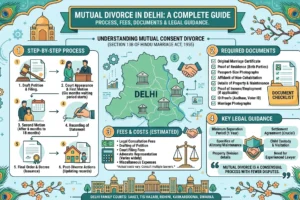
Mutual Divorce Process in Delhi: Step-by-Step
Understanding the procedure can help you avoid mistakes.
Step 1: Legal Consultation
Both spouses should understand the legal implications of the proposed settlement and divorce.
Relevant issues are identified at this stage.
Step 2: Settlement Discussions
The spouses discuss and resolve applicable issues such as finances, maintenance, custody, property arrangements and pending proceedings.
Step 3: Prepare the Joint Petition
The petition and supporting documents are prepared according to the applicable law and facts.
Step 4: File Before the Appropriate Family Court
The petition must be filed before a court having jurisdiction.
Delhi has established Family Courts for matrimonial and family disputes. The Department of Justice currently reports 30 functional Family Courts in Delhi.
Step 5: Court Proceedings
The parties appear before the court as required, and the court considers their statements and the petition.
Step 6: Cooling-Off Period or Waiver, Where Applicable
Where Section 13B(2) applies, the statutory framework provides for the interval before the second motion. A court may waive that period in an appropriate case, but waiver is discretionary rather than automatic.
Step 7: Second Motion and Final Decree
Subject to the applicable procedure and the court being satisfied with the statutory requirements, the matter proceeds toward the divorce decree.
Documents Commonly Required for Mutual Divorce
The exact documents depend on your case and applicable personal law, but commonly relevant records may include:
- Marriage certificate, where available
- Marriage photographs or other marriage proof
- Identity proof of both spouses
- Address proof
- Passport-size photographs
- Details concerning the date of marriage and separation
- Settlement agreement
- Income or financial documents where relevant
- Child-related documents where relevant
- Details or copies of pending proceedings, where applicable
Your lawyer should confirm the documents required for your specific petition rather than relying only on a generic checklist.
How Long Does Mutual Divorce Take in Delhi?
There is no single timeline that applies to every case.
Factors can include:
- Applicable personal law
- Whether statutory requirements have been satisfied
- Whether the settlement is complete
- Court scheduling
- Whether there are pending disputes
- Whether a waiver of the waiting period is sought and granted
- Completion of procedural requirements
For cases under Section 13B of the Hindu Marriage Act, the statutory text sets out the framework for the second motion, while Supreme Court precedent permits waiver of the six-month period in appropriate circumstances.
Be cautious of anyone promising a fixed completion date without first reviewing your circumstances.
How Much Does Mutual Divorce Cost in Delhi?
The cost can vary according to:
- Lawyer’s professional fee
- Complexity of the settlement
- Documentation involved
- Child custody or financial arrangements
- Number of proceedings or appearances required
- Whether other pending matters need to be addressed
Ask for clarity regarding professional fees and the scope of legal services before proceeding.
Mutual Divorce and Family Courts in Delhi
The appropriate Family Court depends on legal jurisdiction rather than simply whichever court is most convenient.
Family Court-related judicial experience in Delhi includes court complexes such as Saket, Dwarka, Rohini and Tis Hazari, as reflected in Delhi High Court judicial records.
The Delhi High Court also publishes the Delhi Family Court Rules and related practice directions.
A lawyer can help determine the appropriate jurisdiction for your case based on the applicable law and facts.
Why Hiring a Divorce Lawyer Can Help
Mutual divorce is cooperative, but that does not mean legal details are unimportant.
A divorce lawyer can help you:
- Understand your rights before agreeing to terms
- Identify issues that have not been addressed
- Draft the petition and settlement accurately
- Explain maintenance and financial provisions
- Structure child custody arrangements
- Review pending legal proceedings
- Prepare required documentation
- Navigate Family Court procedure
- Understand first and second motion requirements
- Consider whether a cooling-off-period waiver may be legally appropriate
The objective should be to create a legally workable settlement that accurately records what both spouses have agreed.
How Delhi Legal Expert Assists With Mutual Divorce
Delhi Legal Expert provides legal assistance for individuals considering or proceeding with mutual consent divorce in Delhi.
Depending on your circumstances, assistance may include:
- Legal consultation — Understanding your rights and the applicable divorce procedure.
- Settlement review and drafting — Helping document financial, custody and other agreed terms.
- Document preparation — Preparing the petition and supporting legal documents.
- Family Court assistance — Guidance regarding filing and court proceedings.
- Maintenance and alimony guidance — Understanding proposed financial settlement terms.
- Child custody guidance — Helping structure clear arrangements concerning children.
- Pending-case review — Identifying related proceedings that may need to be addressed.
- Court representation — Professional assistance through the relevant stages of the matter.
Frequently Asked Questions
Q1. What are the most common mutual divorce mistakes?
Common mistakes include signing vague settlements, failing to address finances or child custody, misunderstanding the cooling-off period, overlooking pending cases and signing documents without understanding their legal effect.
Good preparation before filing can reduce the likelihood of disagreements during the mutual divorce process.
Q2. What should be decided before filing mutual divorce in Delhi?
You should identify and discuss all relevant issues before filing. These may include maintenance or alimony, child custody, visitation, child expenses, financial arrangements, belongings, property-related issues and pending litigation.
The exact settlement terms depend on your circumstances.
Q3. Is six months compulsory in mutual consent divorce?
Section 13B(2) of the Hindu Marriage Act contains a six-month interval before the second motion. However, the Supreme Court has held that this period is directory and may be waived by a court in appropriate circumstances.
Waiver is therefore not automatic. Your lawyer can assess whether requesting it is appropriate in your case.
Q4. Can mutual divorce be completed without a settlement agreement?
The applicable legal requirements depend on the case and personal law, but where spouses have financial, custody, property or pending-litigation issues, clearly documenting their agreed terms can be important.
A lawyer can advise what documents and settlement terms are appropriate for your situation.
Q5. Can one spouse change their mind during mutual divorce?
Mutual consent is a substantive requirement for divorce under Section 13B. The Delhi High Court has specifically emphasised the importance of genuine, joint mutual agreement.
This is one reason both spouses should understand and voluntarily accept the settlement before beginning proceedings.
Q6. What happens to child custody in a mutual divorce?
Parents can discuss custody, visitation, expenses, schooling and other arrangements concerning their children. The child’s welfare remains an important consideration.
Avoid treating child-related clauses as an afterthought simply because both spouses agree to divorce.
Q7. How long does mutual divorce take in Delhi?
There is no guaranteed timeline. The duration depends on the applicable law, court process, settlement, statutory requirements and whether any permissible waiver is sought and granted.
A lawyer can provide a more meaningful procedural estimate after reviewing your case.
Q8. Which Family Court should I approach for mutual divorce in Delhi?
The appropriate court depends on legal jurisdiction and the facts of the marriage and parties. Delhi has multiple Family Courts, and the correct filing location should be determined before submitting the petition.
A divorce advocate can examine your details and identify the appropriate court.
Q9. Do both spouses need to appear in mutual divorce proceedings?
Mutual divorce is based on the participation and consent of both spouses. The precise appearance and procedural requirements should be confirmed for your case with the lawyer handling the petition and the relevant court.
Do not assume that signing papers privately completes the divorce.
Q10. Do I need a divorce lawyer for mutual consent divorce?
Legal advice can be particularly useful when your settlement involves maintenance, children, property, financial obligations or pending proceedings.
Even where spouses agree on separation, a lawyer can help ensure that the petition and settlement accurately reflect that agreement and comply with the applicable procedure.