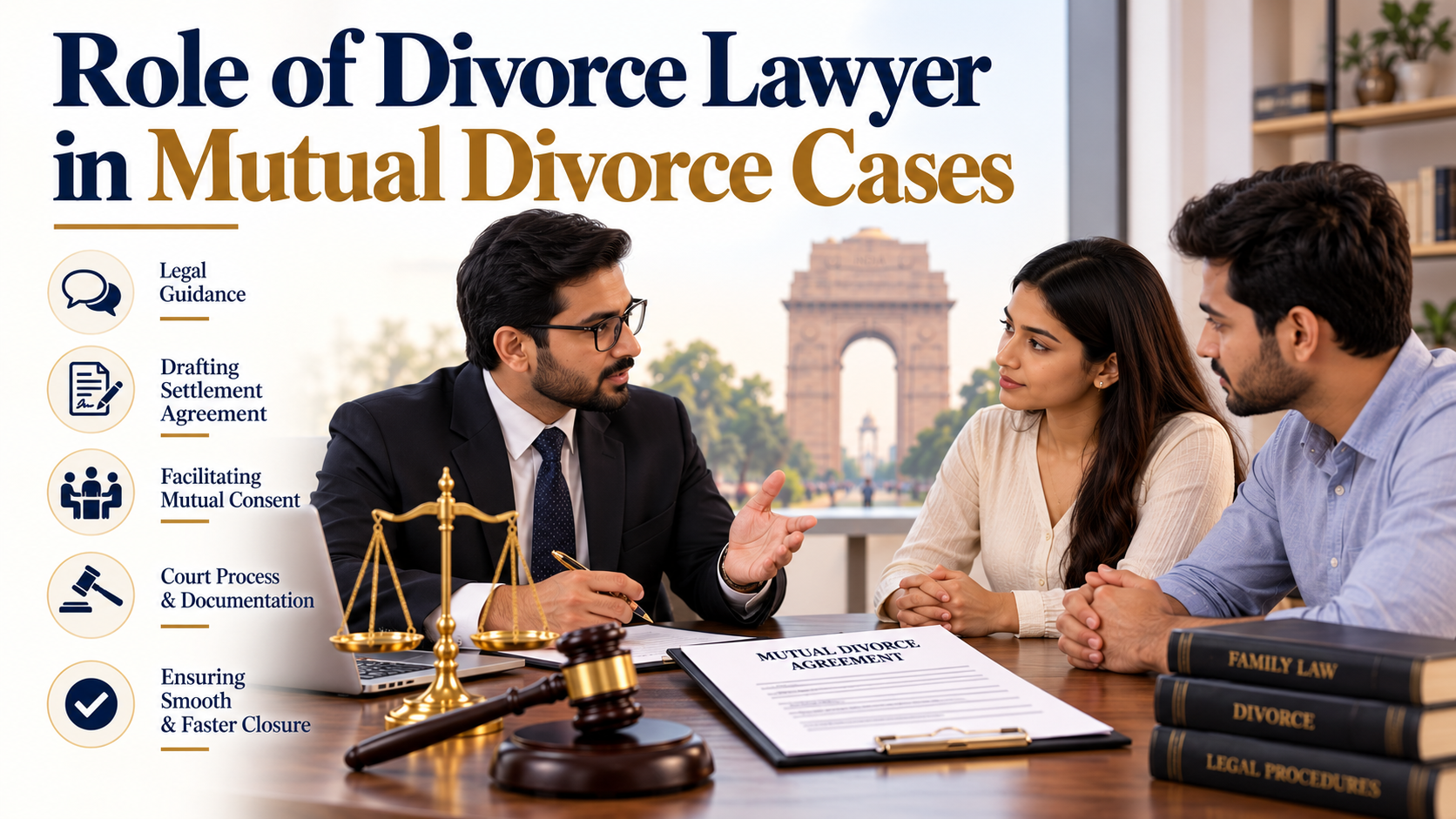
Role of Divorce Lawyer in Mutual Divorce Cases
When both spouses agree that continuing their marriage is no longer possible, mutual consent divorce can provide a less adversarial way to legally end the marriage. But agreeing to divorce is only one part of the process. You also need to address issues such as maintenance or alimony, child custody, property, pending disputes, documentation and the terms on which both parties will separate.
This is where the role of a divorce lawyer in mutual divorce becomes important.
For marriages governed by the Hindu Marriage Act, Section 13B provides for divorce by mutual consent. Broadly, the provision contemplates a joint petition by spouses who have been living separately for at least one year, have been unable to live together, and mutually agree that the marriage should be dissolved.
A divorce lawyer can help you understand whether the mutual-consent route applies to your circumstances, negotiate and document the settlement, prepare the petition and assist through the Family Court proceedings.
At Delhi Legal Expert, individuals seeking a Mutual Consent Divorce in Delhi can obtain legal assistance with settlement terms, documentation, petition preparation and court procedure according to their individual circumstances.
Important: This article provides general legal information. Divorce procedure and available remedies can differ depending on the law governing your marriage and the facts of your case. Obtain advice for your specific circumstances before acting.
About Delhi Legal Expert
Delhi Legal Expert provides professional legal assistance in Delhi for people dealing with matrimonial and family law matters.
In a mutual divorce case, our advocates can help you understand your legal rights, identify issues that should be resolved before filing, prepare the necessary documents and settlement terms, assist with Family Court procedure and provide practical legal guidance based on your particular situation.
The objective in a mutual consent case is not simply to file papers. A carefully prepared settlement should reduce uncertainty about important matters that may otherwise create disputes later.
What Is Mutual Consent Divorce?
Mutual consent divorce is a process through which both spouses jointly seek dissolution of their marriage instead of one spouse pursuing divorce against the other.
For couples governed by the Hindu Marriage Act, Section 13B states that both parties may jointly present a petition where they have been living separately for one year or more, have not been able to live together, and have mutually agreed that the marriage should be dissolved.
The applicable law may differ for couples married under other marriage or personal laws. Therefore, the first job of your lawyer is to identify the correct legal framework rather than assuming that the same provision applies to every marriage.
Why Do You Need a Lawyer When Both Spouses Already Agree?
This is one of the most common questions people ask.
You and your spouse may agree about ending the marriage, but the consequences of divorce can extend well beyond the divorce decree.
Questions may still arise about:
- Permanent alimony or maintenance
- Return of jewellery, belongings or other articles
- Child custody
- Visitation and parenting arrangements
- Child-related expenses
- Financial settlements
- Property-related arrangements
- Pending matrimonial or other proceedings
- Timing and method of payments
- Withdrawal or disposal of pending cases, where legally permissible
A verbal understanding can leave important details unresolved. A divorce lawyer helps convert the understanding between the spouses into clear legal terms and ensures that the petition and supporting documents accurately reflect the agreed arrangement.
Role of Divorce Lawyer in Mutual Divorce: 10 Important Responsibilities
1. Determining Whether Mutual Divorce Is Appropriate
The lawyer first understands your marriage, separation and current relationship with your spouse.
The lawyer may ask:
- When did you get married?
- How long have you been living separately?
- Do both spouses voluntarily want a divorce?
- Are there children from the marriage?
- Is maintenance or alimony involved?
- Are there joint properties or financial arrangements?
- Are other matrimonial proceedings pending?
This preliminary assessment helps identify the applicable law and whether a joint divorce petition is appropriate.
2. Explaining Your Legal Rights Before You Agree
Mutual consent should be informed and voluntary.
Before signing a settlement, you should understand what you are agreeing to regarding money, children, property and pending disputes.
A mutual divorce lawyer in Delhi can explain the legal implications of proposed terms so that you can make an informed decision.
3. Negotiating the Settlement Terms
Settlement is often the most important stage of a mutual divorce.
A lawyer can assist the parties or their respective counsel in discussing issues such as:
- One-time permanent alimony
- Monthly maintenance, where applicable
- Child custody
- Visitation arrangements
- Educational and medical expenses of children
- Return of personal belongings
- Jewellery or other articles
- Financial arrangements
- Property-related issues
- Pending proceedings
The aim is to make the terms sufficiently clear to minimise future misunderstanding.
4. Drafting the Mutual Divorce Settlement
Once the terms have been agreed upon, they should be recorded carefully.
A well-drafted settlement can specify what each spouse has agreed to do, relevant payment stages, custody arrangements and how connected disputes will be dealt with where legally permissible.
Ambiguous wording can become a source of disagreement later. Drafting is therefore a significant part of the role of a divorce lawyer in mutual divorce.
5. Preparing the Joint Divorce Petition
The lawyer prepares the mutual consent divorce petition according to the applicable law and facts.
The petition may contain information relating to:
- Date and place of marriage
- Details of the spouses
- Period of separation
- Reasons the spouses have been unable to continue together
- Their mutual decision to dissolve the marriage
- Children, if any
- Settlement arrangements
- Other information required for the proceeding
Accuracy is important because the court may question the parties regarding the statements contained in their petition.
6. Checking and Organising Documents
A lawyer can identify which documents are relevant to your particular case.
Commonly required or useful documents may include:
- Marriage certificate, where available
- Wedding photographs
- Identity proof
- Address proof
- Passport-size photographs
- Details of the parties
- Settlement document
- Documents concerning children, where relevant
- Financial or payment documents connected with settlement terms
- Copies/details of connected proceedings, if applicable
The exact requirements can vary, so you should confirm the document list for your case with your lawyer.
7. Filing Before the Appropriate Family Court
Jurisdiction is an important procedural issue.
A lawyer examines the relevant facts and applicable statutory rules to determine where the petition should be presented.
Delhi has Family Courts dealing with matrimonial and family disputes. The official Delhi District Courts portal also provides information relating to Family Courts and states that e-filing is available for Delhi Family Courts across districts.
8. Assisting During the First Motion
After filing, the parties ordinarily participate in the first-motion proceedings.
The court needs to be satisfied regarding the petition and the voluntary nature of the parties’ decision.
Your lawyer helps you understand:
- What happens during the hearing
- Which documents need to be available
- How the settlement is being implemented
- What procedural steps follow
The lawyer should prepare you for the process without coaching you to give anything other than truthful answers.
9. Advising on the Cooling-Off Period and Possible Waiver
This area is frequently misunderstood.
Section 13B(2) of the Hindu Marriage Act refers to a second motion after the prescribed interval. However, the Supreme Court in Amardeep Singh v. Harveen Kaur (2017) held that the six-month period is directory rather than invariably mandatory and may be waived by the court in appropriate circumstances.
The Supreme Court identified factors relevant to the exercise of this discretion, including whether the relevant separation period has already elapsed, reconciliation efforts have failed, the parties have genuinely settled issues such as alimony and custody, and further waiting would merely prolong the situation.
Therefore, you should not assume that every mutual divorce automatically requires exactly six additional months, or that every case qualifies for immediate waiver.
A divorce lawyer can assess the facts and advise whether seeking waiver may be appropriate. The final decision remains with the court.
10. Assisting With the Second Motion and Divorce Decree
If mutual consent continues and the statutory and procedural requirements are satisfied, the parties proceed with the subsequent stage of the case.
Section 13B(2) provides for the court, after hearing the parties and making such inquiry as it considers appropriate, to pass a decree when satisfied about the relevant requirements.
A lawyer assists with the second-motion documentation, compliance with settlement obligations and completion of the proceedings.
Step-by-Step Mutual Divorce Process in Delhi
For a straightforward case, you can understand the process in the following sequence:
- Step 1 – Legal consultation: The circumstances of the marriage, separation and applicable law are reviewed.
- Step 2 – Settlement discussions: The spouses resolve financial, custody, property and other relevant issues.
- Step 3 – Settlement drafting: Agreed terms are documented clearly.
- Step 4 – Preparation of joint petition: The mutual divorce petition and supporting documents are prepared.
- Step 5 – Filing: The petition is presented before the Family Court having jurisdiction.
- Step 6 – First motion: The court considers the joint petition and records the parties as required.
- Step 7 – Waiting period or waiver application: Depending on the applicable provision and facts, the prescribed interval is followed or an appropriate waiver request may be considered.
- Step 8 – Second motion: The parties continue with the mutual consent process and confirm their position before the court.
- Step 9 – Divorce decree: If the court is satisfied that the legal requirements are met, it may grant the decree of divorce.
This outline is general. Your actual mutual divorce process in Delhi may vary based on the governing law, court directions and circumstances of your case.
What Should Be Settled Before Filing Mutual Divorce?
Ideally, the major consequences of separation should be discussed before filing.
Alimony and Maintenance
The parties may need to decide whether maintenance or permanent alimony will be paid and, if so:
- Amount
- Payment schedule
- Mode of payment
- Stage at which payments will be made
Your lawyer can help ensure the settlement records the agreed arrangement clearly.
Child Custody and Visitation
Where children are involved, the settlement may address:
- Living arrangements
- Access or visitation
- Education
- Medical expenses
- Travel
- Other parenting responsibilities
Child-related arrangements remain subject to applicable law and the child’s welfare.
Property and Personal Belongings
The parties should discuss any arrangements concerning jointly held property, personal articles, jewellery and other belongings where relevant.
Pending Cases
If other proceedings exist between the parties, the settlement should clearly address how those matters are intended to be handled, subject to applicable law and the orders of the relevant courts.
Documents Required for Mutual Divorce in Delhi
Your lawyer may ask you to keep the following available:
- Proof of marriage
- Marriage certificate, where available
- Marriage photographs
- Identity proof of both spouses
- Address proof
- Passport-size photographs
- Settlement agreement
- Information regarding children
- Income/financial documents where relevant
- Details of pending litigation, where applicable
Do not assume that every case requires exactly the same documents. Your advocate should provide a case-specific checklist.
How Long Does Mutual Consent Divorce Take in Delhi?
There is no responsible way to promise one fixed timeline for every case.
For divorce under Section 13B of the Hindu Marriage Act, the statute provides for the first and second-motion framework, including the interval described in Section 13B(2).
As explained above, the Supreme Court has held that the six-month cooling-off period may be waived in appropriate cases rather than treating it as mandatory in every situation.
The practical timeline can therefore depend on:
- Applicable marriage law
- Court schedule
- Completeness of documents
- Whether settlement terms are final
- Whether a waiver is sought and granted
- Whether both spouses continue to consent
- Other connected proceedings
Your lawyer can explain the likely procedural path after reviewing your specific circumstances.
How Much Does a Mutual Divorce Lawyer Cost in Delhi?
There is no universal advocate fee for mutual divorce.
Professional fees can vary depending on:
- Complexity of the settlement
- Number of legal issues involved
- Child custody arrangements
- Financial or property matters
- Connected proceedings
- Documentation required
- Number and nature of court appearances
Before engaging an advocate, ask what services are included in the quoted professional fee and whether additional proceedings would be charged separately.
Common Mistakes to Avoid in Mutual Divorce Cases
Even an amicable separation can become complicated if important matters are overlooked.
Common mistakes include:
- Signing a settlement without understanding its consequences
- Leaving alimony or payment terms unclear
- Using vague child-custody arrangements
- Ignoring pending legal proceedings
- Relying only on verbal promises
- Providing incomplete information to your lawyer
- Assuming cooling-off waiver is automatic
- Missing procedural requirements
- Treating mutual divorce as merely a paperwork exercise
A carefully structured process can reduce the possibility of disputes emerging during the divorce proceedings.
Why Hiring a Divorce Lawyer Helps in Mutual Divorce
A mutual divorce lawyer does more than appear in court.
The lawyer helps connect three important parts of the process: your settlement, the applicable law and the Family Court procedure.
Professional legal assistance can help you:
- Understand your rights before signing
- Identify unresolved issues
- Draft clear settlement terms
- Prepare legally appropriate documents
- Determine the appropriate court
- Navigate first and second-motion proceedings
- Assess whether a cooling-off waiver may be sought
- Complete the proceeding in accordance with court requirements
The Family Courts Act itself is designed around family disputes and expressly includes promoting conciliation and settlement among its objectives.
Mutual Divorce Legal Services in Delhi
If you are planning a mutual consent divorce in Delhi, the relevant Family Court will depend on jurisdiction and the facts of your matter.
Delhi’s district court system includes Family Courts, and the official Delhi District Courts portal provides Family Court and e-filing resources.
Depending on jurisdiction, matrimonial matters may be associated with court complexes serving areas such as:
- Tis Hazari
- Saket
- Rohini
- Dwarka
- Karkardooma
You should not select a court merely because it is geographically convenient. Your lawyer should determine jurisdiction under the applicable law.
The Delhi High Court may become relevant in appropriate appellate or other proceedings, but an ordinary mutual consent divorce petition is dealt with through the competent matrimonial/Family Court rather than being filed directly in the High Court merely because the parties live in Delhi.
How Delhi Legal Expert Can Help With Mutual Divorce
Delhi Legal Expert can assist you at different stages of a mutual consent divorce, including:
- Initial legal consultation
- Review of your matrimonial situation
- Explanation of mutual divorce requirements
- Settlement discussions and legal guidance
- Drafting of settlement terms
- Mutual divorce petition preparation
- Document review and organisation
- Family Court filing assistance
- First-motion assistance
- Advice regarding cooling-off period waiver where applicable
- Second-motion assistance
- Court representation
- Alimony and maintenance settlement guidance
- Child custody and visitation arrangements
- Guidance concerning connected matrimonial proceedings
The appropriate legal strategy will depend on your circumstances rather than a standard solution applied to every couple.
Frequently Asked Questions
Q1. What is the role of a divorce lawyer in mutual divorce?
The role of a divorce lawyer in mutual divorce includes explaining your legal rights, reviewing the applicable law, helping negotiate settlement terms, preparing the joint petition and assisting with Family Court proceedings.
A lawyer can also identify issues such as alimony, child custody, property arrangements or pending cases that should be addressed before the divorce is completed.
Q2. Is a lawyer compulsory for mutual consent divorce in Delhi?
Legal representation and court procedure can depend on the circumstances and applicable rules. Even where spouses agree on divorce, obtaining independent legal advice can be useful because the settlement may affect important financial, parental and legal rights.
A mutual divorce lawyer in Delhi can also help prevent drafting and procedural errors.
Q3. What is Section 13B mutual consent divorce?
Section 13B of the Hindu Marriage Act provides for divorce by mutual consent for marriages governed by that Act.
Section 13B(1) provides, among other requirements, that the spouses have been living separately for at least one year, have not been able to live together and mutually agree to dissolve the marriage.
Q4. Is six months compulsory for mutual divorce?
Not necessarily in every case.
Although Section 13B(2) contains the six-month interval, the Supreme Court in Amardeep Singh v. Harveen Kaur held that the period is directory and may be waived by the court in appropriate circumstances.
Waiver is not automatic. Your lawyer can assess whether your circumstances support making such a request.
Q5. Can one lawyer represent both husband and wife in mutual divorce?
Because both spouses’ legal and financial interests can differ even when they agree to divorce, each person should understand the implications of the settlement and consider obtaining independent legal advice where appropriate.
This becomes particularly important when substantial alimony, property, custody or other rights are involved.
Q6. What should be included in a mutual divorce settlement?
Depending on the circumstances, the settlement may address alimony or maintenance, custody and visitation, child expenses, property arrangements, personal belongings, payment schedules and connected proceedings.
The terms should be specific enough that both spouses understand their obligations.
Q7. What documents are required for mutual divorce in Delhi?
Common documents may include marriage proof, identity and address documents, photographs, settlement documents and information concerning children or connected proceedings.
The exact requirements vary. A divorce lawyer in Delhi can provide a document checklist based on your case.
Q8. Can mutual divorce be completed without alimony?
Alimony is not a fixed amount automatically payable in every mutual divorce. The financial arrangement depends on the parties’ circumstances, legal rights and mutually agreed terms subject to applicable law.
If both spouses propose a particular financial settlement, it should be documented clearly after understanding its implications.
Q9. What happens if one spouse changes their mind?
Mutual consent is central to a mutual consent divorce. If consent is withdrawn or the parties no longer jointly pursue the process, the mutual-consent route may not proceed in the same manner.
If this happens, speak to your lawyer promptly about the legal options available in your circumstances.
Q10. How do I choose a mutual divorce lawyer in Delhi?
Look for an advocate with relevant matrimonial-law experience who explains the process clearly, identifies settlement issues before filing and is transparent about professional fees.
Your lawyer should help you understand the legal consequences of the settlement rather than simply asking you to sign standard documents.