How to Find a Reliable Divorce Lawyer in Delhi?
Published by Delhi Legal Expert (delhilegalexpert.com), a Delhi-based legal consultancy helping individuals navigate matrimonial, property, and civil law matters across Delhi’s District Family Courts and the Delhi High Court. If you need case-specific advice on finding the right divorce lawyer for your situation, contact the team directly via the contact page.
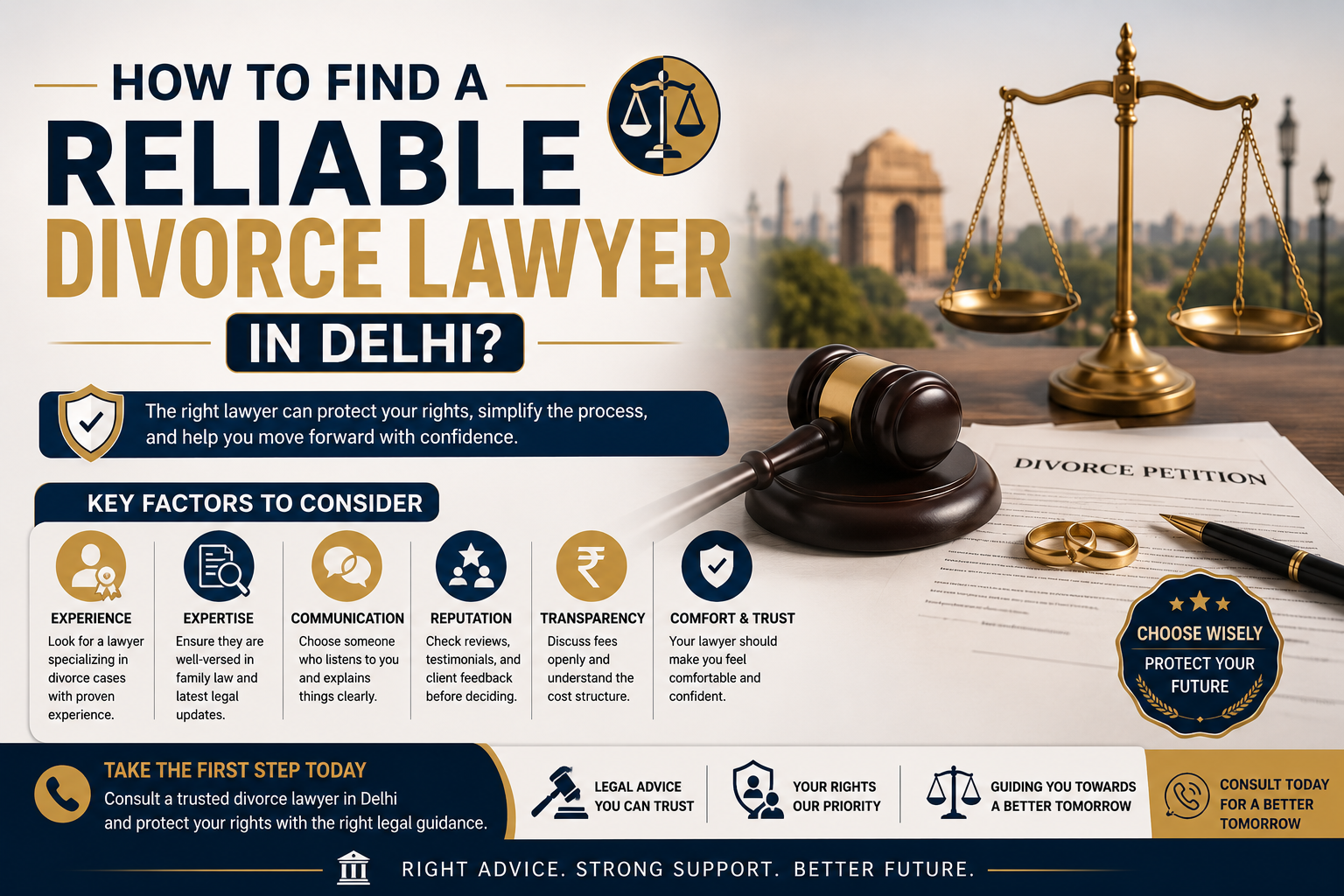
Direct Answer: Finding a reliable divorce lawyer in Delhi comes down to three pillars — verifying their Bar Council of Delhi registration, confirming they have specialized matrimonial experience in your specific district court, and getting a transparent written fee structure before signing any retainer. Any lawyer who cannot satisfy all three should not be hired.
Step 1: Check Bar Council of Delhi Credentials
Walk into the Family Court in Saket or Dwarka without verifying your advocate’s credentials, and you risk your entire family savings. We have seen fake practitioners operate in local districts twice this month alone. Every advocate practicing in Delhi must be enrolled under the Advocates Act, 1961 with the Bar Council of Delhi. This is the first and non-negotiable verification step.
How to verify in 3 minutes:
- Visit the Bar Council of India website or Bar Council of Delhi portal
- Search the advocate’s full name or enrollment number
- Confirm status is “Active” — not suspended or cancelled
- Note the enrollment year to confirm years in practice
What the enrollment number tells you: Format: D/[YEAR]/[NUMBER]. The year shows when they were admitted to the Bar. An enrollment from 2022 indicates a junior advocate; from 2005, a mid-career practitioner; from 1995 or earlier, a senior one.
In our experience, clients often hire junior lawyers believing they are engaging a veteran, simply because they did not check the date code on the license. Do not make that mistake. Any registered divorce advocate in Delhi will display their enrollment number on their visiting card and letterhead. Refusal to share it is an immediate disqualifying signal.
Step 2: Look for Practice Specialization
Do not hire a general attorney. A lawyer who handles criminal, property, and family cases simultaneously is not a matrimonial specialist. We know this from working directly with clients across Delhi’s family courts. Delhi’s family court system operates under a strict and specialized set of rules — one that requires deep, daily focus from any lawyer who practices within it. You need an expert who thoroughly understands these procedural steps in order to protect your rights.
Why specialization matters:
| General Practice Lawyer | Matrimonial Specialist |
|---|---|
| Knows basic Hindu Marriage Act provisions | Knows current judicial interpretations at Delhi family courts |
| Handles divorce as one case type among many | 60–100% of caseload is matrimonial |
| May not know Family Court-specific practice directions | Knows registrar expectations, evidence standards, bench patterns |
| Generic maintenance calculations | Tracks Delhi High Court’s latest maintenance formula decisions |
How to test for real specialization: Ask: “What percentage of your current active cases are matrimonial matters?”
A genuine specialist will answer 60–100% without hesitation. Below 40% indicates a generalist who takes divorce cases on the side.
Also ask: “What was the last significant Delhi High Court judgment on maintenance that affected how you structure Section 24 applications?”
A specialist will have a precise answer. A generalist will not.
Step 3: Evaluate Local Court Knowledge
Local court knowledge is the most overlooked factor when hiring a divorce lawyer in Delhi — and ignoring it can destroy an otherwise strong case.
Local family courts are not interchangeable. Each operates under its own distinct rules, caseloads, and documentation standards.
A divorce lawyer who practices in Saket daily holds a significant practical edge. That advocate has stood before the Saket Family Court bench hundreds of times, building direct institutional knowledge that no law degree alone can replicate.
Delhi’s primary Family Courts:
| Court | Area Served | Key Characteristics |
|---|---|---|
| Saket Family Court | South Delhi | High-income cases, many NRI matters |
| Dwarka Family Court | West/SW Delhi | Domestic violence-heavy, maintenance cases |
| Rohini Family Court | North-West Delhi | High volume, mixed matrimonial |
| Karkardooma Family Court | East Delhi | Faster-moving docket |
| Tis Hazari Family Court | Central Delhi | Oldest bench, complex matters |
The questions that reveal court-specific knowledge:
- “How many cases do you currently have active at [specific court]?”
- “What is the current average wait between hearings at that court?”
- “Who is the presiding judge for matrimonial matters at that court right now?”
A lawyer who practices there regularly will answer all three. One who does not will generalize.
Step 4: Read Verified Client Testimonials — and Know the Difference
Online reviews for lawyers in Delhi range from genuine client feedback to paid or fabricated entries. Here is how to distinguish them.
Signals of genuine reviews:
- Mention specific procedural details (court names, hearing types, case durations)
- Describe the communication experience, not just the outcome
- Include both positive and constructive observations
- Posted on Google Maps (harder to fabricate at scale than website testimonials)
Signals of paid or fabricated reviews:
- Generic superlatives (“best lawyer in Delhi,” “100% recommended”)
- All reviews posted within a short time window
- No reviewer history — accounts created only to post the review
- No mention of case type, court, or any specific experience
More reliable than reviews:
- Bar Association referrals — advocates who refer clients to each other carry professional accountability
- Personal referrals from someone whose case type and court jurisdiction matched yours
- e-Courts case history — objective data on active case volume and case types at the relevant court (ecourts.gov.in)
The 3-Lawyer Rule: Why You Should Always Interview Before Committing
Instead of risking the wrong choice, consult at least three divorce advocates in Delhi before making your decision.
What three consultations give you:
- A fee comparison baseline — this step alone can prevent overpaying
- A strategy comparison — you learn who actually builds a real plan for your case
- A communication comparison — this reveals who stays in touch with you
- A trust calibration — your own instincts will point you to the right choice
Most clients who later regret their choice consulted only one advocate. This pattern is especially common in cases filed at Tis Hazari and Saket courts. Meeting three lawyers changes that. Each consultation takes roughly 30 minutes and costs between ₹500 and ₹2,000 — easily the cheapest investment you will make in your entire case.
Voice Search FAQ: How to Find a Reliable Divorce Lawyer in Delhi
Q: How do I find a reliable divorce lawyer in Delhi?
Consult three different professionals. Verify their Bar Council of Delhi enrollment number first. Next, check their active case history on the official e-Courts portal. Make sure they have deep experience at the exact family court handling your petition, and sit down for a 30-minute consultation before paying a retainer.
Q: How do I check if a divorce lawyer is registered in Delhi?
Visit the Bar Council of India or Bar Council of Delhi website directly. Search the lawyer’s full name or enrollment number to confirm their status is active. Every registered advocate holds a unique number in the standard D/[YEAR]/[NUMBER] format.
Q: Why does it matter which Delhi district court my lawyer practices in?
Every Delhi family court — including Saket, Dwarka, Rohini, Karkardooma, and Tis Hazari — has its own rules, documentation standards, and judicial officers. A lawyer who practices in your specific court daily understands that environment in ways that accelerate your case.
Q: How do I know if a divorce lawyer in Delhi is genuinely specialized in matrimonial law?
Ask what percentage of their practice covers family law. A real specialist handles a 60–100% matrimonial caseload. Ask them about a recent Delhi High Court judgment on maintenance — a true specialist will answer instantly; a generalist will struggle.
Q: Are online reviews reliable for finding a divorce lawyer in Delhi?
Google Maps reviews offer better insight than curated website testimonials. Look for feedback that names real courts, specific case types, and clear communication experiences. Cross-verify on the e-Courts portal to confirm their actual practice volume.
Q: How many lawyers should I consult before hiring a divorce lawyer in Delhi?
Consult at least three. This gives you a clear fee benchmark, a basis to compare legal strategies, and a sense of which communication style suits you. Most dissatisfied clients hired the very first lawyer they met without exploring other options.
Q: What should I check about a divorce lawyer’s fees before hiring them in Delhi?
Request an itemized written breakdown before signing anything. This should cover the initial retainer, per-hearing charges, and documentation costs. Never engage a professional who refuses to discuss fees transparently from the outset.
Q: Can I verify a divorce lawyer’s case history in Delhi?
Yes. The government e-Courts portal lets you search records by any advocate’s name, displaying their active and disposed cases across Delhi’s district courts — giving you objective data on their real daily practice volume.