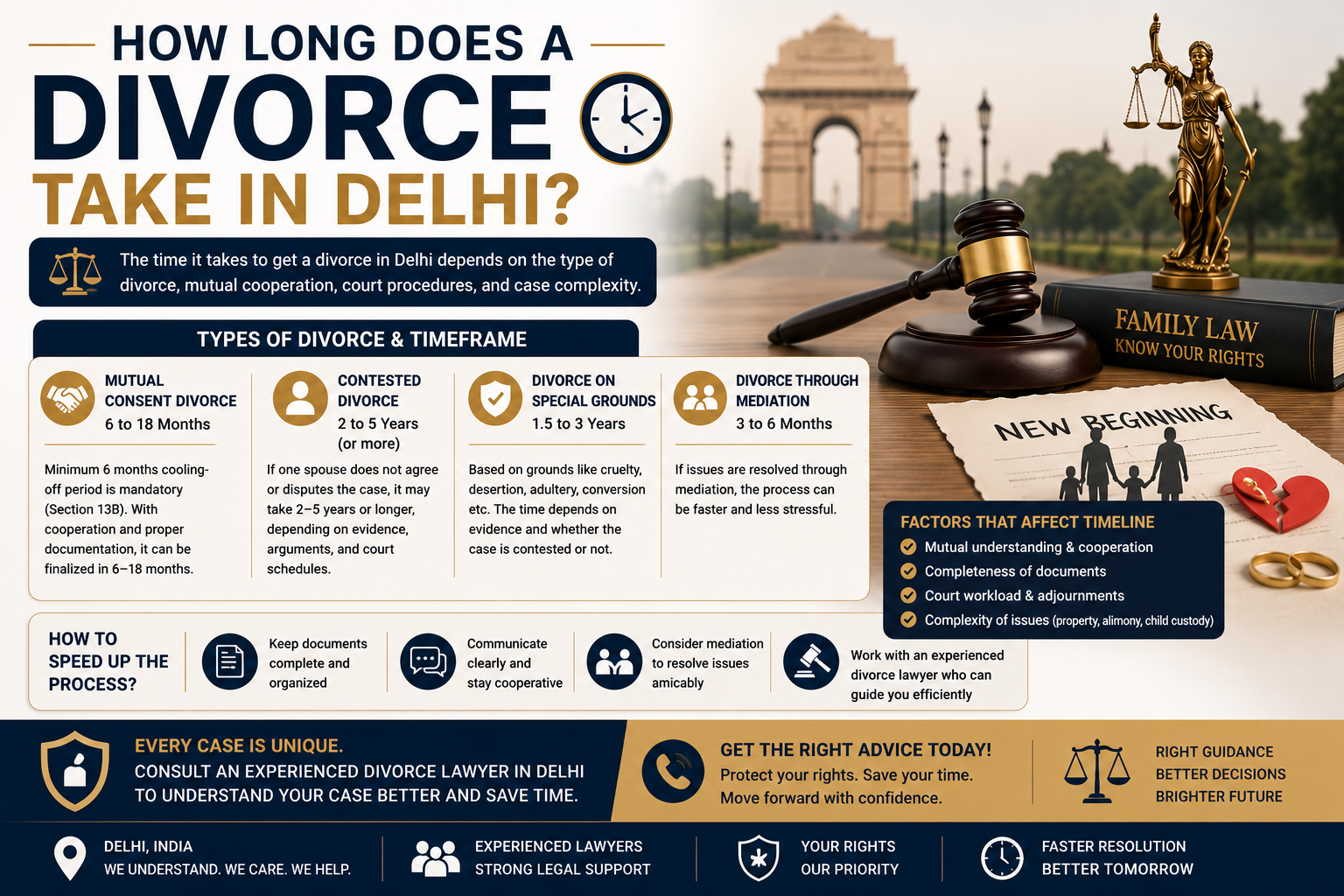
How Long Does a Divorce Take in Delhi?
Published by Delhi Legal Expert (delhilegalexpert.com), a Delhi-based legal consultancy helping individuals navigate matrimonial, property, and civil law matters across Delhi’s District Family Courts and the Delhi High Court. For a realistic timeline assessment for your specific situation, contact the team directly via the contact page.
How long does a divorce take in Delhi?
Between 7 and 12 months. That is the short answer for a mutual consent divorce in Delhi. This timeline includes the fixed six-month cooling-off period. We have seen Delhi Family Courts reduce this waiting period to as little as 2–4 months for eligible couples.
A contested divorce in Delhi is completely different. Expect that process to drag on for 3 to 7 years in a District Family Court. Your case length depends entirely on client cooperation and lawyer quality. If your spouse contests every term, your case slows down significantly.
The Mutual Consent Divorce Timeline: Stage by Stage
Mutual consent divorce under Section 13B of the Hindu Marriage Act is the fastest legal path to dissolve a marriage. It works well only if you and your spouse agree on all major settlement terms before you file the petition.
We had a case at the Saket Family Court last month where the couple avoided weeks of procedural delays simply because they had settled maintenance, asset division, and child custody terms in advance. Most Delhi courts accept this approach — though a few strict judges might request additional asset disclosures before issuing the decree. Finalising all settlement terms before filing is the single most effective way to accelerate the process.
Stage-by-Stage Breakdown
| Stage | What Happens | Duration |
|---|---|---|
| Agreement and Drafting | Both parties finalise maintenance, property, and custody terms. Joint petition and settlement agreement drafted. | 1–4 weeks |
| Filing | Joint petition filed at the relevant District Family Court. Case number assigned. | 1–2 weeks |
| First Motion Hearing | Both parties appear. Court records consent. Cooling-off period begins. | 1–3 weeks after filing |
| Cooling-Off Period | Mandatory 6-month gap to allow reconsideration (waivable). | 6 months (or 0 if waived) |
| Second Motion Hearing | Both parties reappear. Court passes final divorce decree. | 1–4 weeks after cooling-off |
| Total (standard) | 7–12 months | |
| Total (with waiver) | 2–4 months |
The 6-Month Cooling-Off Period: When Can It Be Waived?
The Supreme Court of India’s landmark 2017 judgment in Amardeep Singh v. Harveen Kaur established that Delhi courts have discretion to waive the 6-month period under the following conditions:
- The parties have been living separately for 18 months or more
- All settlement terms are finalised and documented
- No purpose of reconciliation is served by the delay
- Waiver is in the interests of justice for both parties
Your lawyer must file a formal waiver application with supporting documentation. Courts do not grant waiver automatically — it must be applied for with reasons.
The Contested Divorce Timeline: Why It Takes as Long as It Does
A contested divorce under Section 13 of the Hindu Marriage Act is, by nature, an adversarial proceeding: one spouse files a petition, and the other responds — often with counterclaims and vigorous opposition.
Stage-by-Stage Breakdown
| Stage | What Happens | Duration |
|---|---|---|
| Filing and Summons | Petition filed. Court issues summons to respondent. | 1–4 months |
| Written Statement | Respondent files formal response (and possible counter-petition). | 1–3 months after service |
| Framing of Issues | Court identifies the specific legal questions to be determined. | 1–4 months |
| Evidence Recording | Both parties present witnesses and documents. Cross-examination. | 1–4 years |
| Final Arguments | Both advocates submit written and oral arguments. | 3–12 months |
| Judgment | Court pronounces the decree. | 1–6 months after arguments |
| Total | 3–7+ years |
Why Evidence Recording Is the Longest Stage
Without active case management, the evidence stage can drag on for years. We have seen families lose years in this stage across Delhi courts simply because they did not understand how the process unfolds. Each session demands thorough preparation and active participation from both the advocate and the client.
Your legal team must guide your witness through examination-in-chief. The opposing party then conducts cross-examination. The judge records the testimony. After that, the next hearing date is typically scheduled 4–8 weeks later.
Most complex cases involve 3–8 witnesses per side. Simultaneously, parties often file interim applications for child custody or maintenance. Given this volume, it is not uncommon for evidence recording to span 40–80 hearings across 2–4 years.
6 Factors That Cause Delays in Delhi Divorce Cases
- Service Evasion by the Respondent: A respondent who evades service of court summons can delay the case significantly before it even begins. The court must attempt multiple deliveries, publish notices, and explore alternative methods of service. This adds 3–6 months to the timeline.
- Delhi Court Backlogs: Local family courts carry massive volumes of pending cases. Hearing dates are typically scheduled 4–8 weeks apart. Missing even a single hearing can set the case back by 1–2 months.
- Judicial Vacations: Delhi courts close for the summer break in May and June, and again for Diwali and the winter holidays. Cumulatively, these closures account for approximately 8–10 weeks of lost court time each year.
- Judicial Transfers: Judges move to new districts regularly. When a new judge takes over, they must review the entire case file from the beginning. In some cases, the new judge may recall witnesses for re-examination.
- Multiple Parallel Sub-Applications: Parties often file interim applications concerning child support, asset protection, or domestic violence. Each application introduces additional hearings and delays to the main proceedings. A contentious spouse can stall the main divorce proceedings for years by filing these applications in succession.
- Advocate-Side Delays: An inattentive or passive advocate may accept unnecessary adjournments without challenge. They may file documents late or depute a junior to appear at critical hearings. This is the most preventable cause of delay — and the most directly within your control when selecting representation.
5 Ways to Expedite Your Divorce Case in Delhi
- Complete Documentation From Day One: Submit every required document on time, with the proper signatures and attestations. This prevents the opposing party from seeking adjournments on the grounds of incomplete documentation. Complete, well-organised filings allow the court to proceed without interruption.
- Hire an Advocate Who Appears Personally: Retain a lead advocate who appears in person rather than delegating appearances to junior counsel. Your advocate must challenge every delay tactic proactively to keep the case on track.
- Apply for Waiver of the Cooling-Off Period (If Eligible): You may apply to waive the mandatory 6-month waiting period for a mutual consent divorce if you satisfy the Amardeep Singh v. Harveen Kaur criteria. You must have lived apart for 18+ months and reached agreement on all terms.
- Pursue Mediation Proactively: Request that the court refer your file to the mediation centres at Saket or Tis Hazari at the earliest opportunity. Mediation can resolve disputes in 3–6 months, compared to the years typically required through contested litigation. In our experience, approximately 40–60% of referred couples reach a settlement through mediation.
- Settle Interim Applications Quickly: Resolve interim disputes over temporary maintenance and child custody as expeditiously as possible. Resolving these interim matters allows the court to focus its attention on advancing the primary divorce proceedings.
FAQ: How Long Does Divorce Take in Delhi?
Q: How long does a mutual consent divorce take in Delhi?
From 7–12 months. A mutual consent divorce takes this long due to the mandatory 6-month cooling-off period. Courts can waive this period when parties have been separated for 18+ months, reducing the total timeline to 2–4 months.
Q: How long does a contested divorce take in Delhi?
From 3–7 years. A contested divorce typically takes this long at a District Family Court. The evidence recording stage alone can take 1–4 years. Cases with multiple parallel sub-applications and judicial transfers can exceed 7 years.
Q: Can the 6-month waiting period for mutual divorce be waived in Delhi?
Yes, it can. Following the Supreme Court’s Amardeep Singh v. Harveen Kaur (2017) judgment, Delhi courts can waive the 6-month cooling-off period when parties have been separated for 18+ months, all terms are finalised, and waiver serves the interests of justice.
Q: What causes delays in Delhi divorce cases?
Court backlogs and litigation tactics. The main causes are respondent service evasion, Delhi court case backlogs, judicial vacations (approximately 8–10 weeks per year), judicial transfers requiring case re-familiarisation, multiple parallel sub-applications filed by the opposing party, and passive advocacy that allows unnecessary adjournments.
Q: What is the fastest way to get divorced in Delhi?
Mutual consent filing. A mutual consent divorce with complete documentation, a waiver application for the cooling-off period, and a proactive advocate can be completed in 2–4 months. This requires full agreement on all terms — maintenance, property, and custody — before filing.
Q: How many court hearings does a divorce case in Delhi require?
It varies by case. A mutual consent divorce requires 2–4 hearings over 7–12 months. A contested divorce typically requires 20–80+ hearings over 3–7 years, depending on case complexity and the number of parallel sub-applications.
Q: How do I speed up my divorce case in Delhi?
Use proactive advocacy. Complete documentation from day one, an advocate who appears personally and challenges unnecessary adjournments, early mediation, waiver of the cooling-off period where eligible, and prompt resolution of interim maintenance and custody applications all accelerate the timeline.
Q: What is the cooling-off period in a mutual consent divorce in Delhi?
A 6-month gap. Section 13B of the Hindu Marriage Act requires this pause between the First Motion and Second Motion hearings in a mutual consent divorce. This allows parties to reconsider. The period can be waived by court order under the 2017 Supreme Court guidelines.