What Documents Should I Bring to My Divorce Lawyer in Delhi?
Published by Delhi Legal Expert (delhilegalexpert.com), a Delhi-based legal consultancy helping individuals navigate matrimonial, property, and civil law matters across Delhi’s District Family Courts and the Delhi High Court. If you are preparing for a first legal consultation and want guidance on your specific situation, contact the team directly via the contact page.
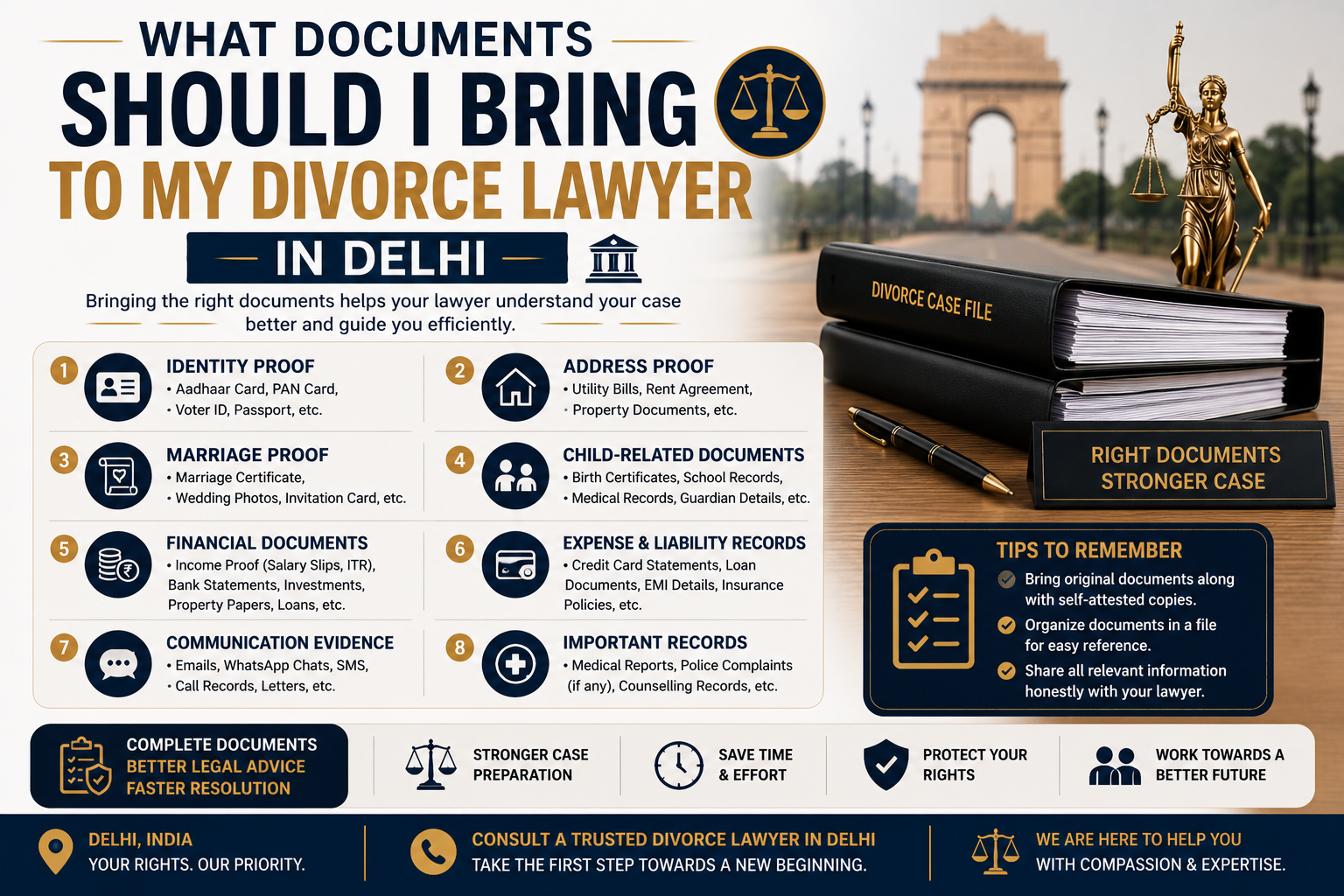
Direct Answer: Bring the “Golden Trio” to your first divorce lawyer consultation in Delhi: identity proof (Aadhaar and PAN), marriage proof (marriage certificate, wedding photographs), and financial records (bank statements and salary slips). You do not need every document at the first meeting — but these three categories give your lawyer enough to assess your case, advise on strategy, and identify what additional documentation is needed.
Why the Right Documents Change Everything in Your First Consultation
The quality of your first divorce lawyer consultation in Delhi depends entirely on the documents you bring. Bringing your complete financial records and marriage proofs allows your lawyer to assess your situation thoroughly and give you a precise strategy from the outset. Do not rely on vague memory or general descriptions. The more specific the information you provide, the more precise and actionable the legal advice you receive will be.
Missing documents slow down your timeline in Delhi family courts. Organised cases move considerably faster. Simple cases have dragged on for months simply because of missing documents. Every missing document creates a further delay. In Delhi courts, a single adjournment can mean waiting several additional weeks before the next hearing date. Begin organising your documents now to build a strong case from the very start.
Category 1: Personal Identity Documents
These establish your legal identity, your spouse’s identity, and the jurisdictional basis for your petition. Without these, nothing can be filed.
Bring originals + 2 photocopies of each:
- Aadhaar Card (front and back) — primary identity and current address proof
- PAN Card — required for financial affidavits and tax-related disclosures
- Passport (if available) — essential for NRI divorces, international asset cases, or if you plan to travel or relocate
- Voter ID Card — alternative address proof if Aadhaar address is outdated
- Driving Licence — secondary identity proof
Delhi jurisdiction note: The address on your identity documents determines which District Family Court has the authority to hear your case. If your current residence differs from the address on your ID, bring proof of both — your advocate will need to clarify the discrepancy at the time of filing.
Category 2: Marriage Proof Documents
These establish that the marriage legally occurred and is subject to the court’s jurisdiction. Without acceptable proof of marriage, a divorce petition cannot proceed.
- Marriage certificate issued by the Registrar of Marriages (under the Hindu Marriage Act or the Special Marriage Act)
- Wedding photographs — corroborate the marriage date, venue, and ceremony
- Wedding invitation card — supports the date and family acknowledgment of the marriage
- Marriage registration receipt (if the formal certificate has not yet been issued)
- Religious ceremony documents — Saptapadi record for Hindu marriages, Nikah Nama for Muslim marriages, any church registration for Christian marriages
If your marriage was not registered: Tell your advocate immediately. In such cases, your legal strategy will need to adapt accordingly. Gather your wedding photographs, invitation cards, and affidavits from guests. Bring joint bank statements that reflect your shared financial life during the marriage.
Category 3: Financial Documents
This category of documents carries the most weight in a Delhi divorce case. Your financial documents determine the final alimony, maintenance, and child support amounts. Concealing assets is inadvisable and can result in unfavourable interim maintenance or support orders. If documentation is incomplete, the court may draw adverse inferences or rely solely on the opposing party’s disclosures.
Income proof:
- Salary slips — last 6 months minimum (your own; your spouse’s if accessible)
- Income Tax Returns (ITR) — last 3 years (Form ITR-1 through ITR-4 depending on income type)
- Form 16 — employer-issued annual income certificate
- Bank statements — last 12 months, all accounts (savings, current, salary account)
- Business income proof — profit/loss statements, GST returns, balance sheets (for self-employed)
Asset documentation — mandatory for Delhi’s Affidavit of Assets and Liabilities:
- Property ownership documents — sale deed, title deed, property tax receipts
- Vehicle registration certificates (RC)
- Investment records — mutual funds, shares, PPF, NSC, fixed deposits, bonds
- PF and Gratuity statements (from employer’s HR or EPFO portal)
- Life insurance policies — policy document showing sum assured and nominee
- Jewellery inventory (approximate value) — relevant to asset disclosure in high-value cases
Liability documentation:
- Home loan statements — outstanding principal, EMI amount
- Personal loan/vehicle loan statements
- Credit card statements — last 6 months
Delhi High Court standard: In complex matrimonial cases, both parties file a formal Affidavit of Assets and Liabilities. Having your financial documents organised before the first consultation accelerates the preparation of this affidavit significantly.
Category 4: Evidence of Grounds (For Contested Divorce)
If you are filing a contested divorce in Delhi,, your grounds must be provable. The documents in this category are the raw material of your case.
For Cruelty (most common ground in Delhi courts):
- Medical reports, discharge summaries, and doctor certificates documenting physical injuries
- FIR copies (if a police complaint was filed)
- Domestic violence complaint copies (if filed under the Protection of Women from Domestic Violence Act, 2005)
- Counselling or mediation session records
- Written communications — letters, WhatsApp messages (as screenshots or exports)
- Witness contact details (neighbours, family members, colleagues who witnessed events)
For Desertion:
- Proof of last shared residence
- Evidence of attempts to contact the respondent (messages, emails, letters)
- Any acknowledgment by the respondent of separation
For Adultery:
- Investigative records if a private investigation was conducted
- Relevant digital communications (subject to Section 63 certificate requirements under the Bharatiya Sakshya Adhiniyam, 2023)
Digital evidence — special preparation required:
Preserve all digital communications — chats, emails, and social media exchanges — on the original device on which they were received. Courts accept WhatsApp messages, emails, and social media records as evidence under the Bharatiya Sakshya Adhiniyam, 2023. However, you must present a Section 63 certificate confirming the authenticity of the electronic records. This is a certificate issued by the responsible person in charge of the device or system, attesting to the authenticity and integrity of the records. Tell your lawyer about all digital evidence during your first meeting so they can advise on proper preservation and authentication. Do not delete anything, factory reset the device, or transfer records without your lawyer’s guidance.
Category 5: Child Custody Documents
If child custody is a contested matter in your divorce, these documents give your lawyer the foundation to build your custody position.
- Birth certificates of all children
- School enrolment records — confirm current school and grade (establishes current residence)
- School progress reports/report cards — demonstrates parental involvement in education
- Medical records — paediatrician reports, vaccination history, any ongoing treatment records
- Extracurricular activity records — evidence of parental involvement beyond school
- Child’s Aadhaar Card (if issued)
- Any existing custody arrangements — including informal written agreements or email records about pickup schedules
Delhi courts apply the “best interests of the child” standard. Documentary evidence of your active, day-to-day parental involvement is more persuasive than any verbal claim alone.
Category 6: Prior Legal Proceedings (If Any)
If any legal action has already been filed by either party, your lawyer must be informed immediately, as prior proceedings directly affect both strategy and timing.
- FIR copies (First Information Reports) filed by either party
- Charge sheets if criminal proceedings are pending
- Domestic violence application under the Protection of Women from Domestic Violence Act, 2005
- Section 125 CrPC maintenance application (if filed separately)
- Copies of any interim orders already passed by any court
- Legal notices sent or received, as well as informal written communications (including those sent via WhatsApp)
What You Do NOT Need at the First Consultation
The document list above is comprehensive — do not let it delay you from booking your consultation. You do not need everything listed to have a productive first meeting.
The minimum to bring:
- Marriage certificate (or inform the lawyer if the marriage is unregistered)
- Your Aadhaar Card
- A reasonable estimate of both parties’ income and major assets
- A written summary of the key events and timeline of your marriage
Your lawyer will identify which additional documents are needed after the first meeting, based on the facts of your case.
FAQ: Documents to Bring to Divorce Lawyer Delhi
Q: What documents should I bring to my first divorce lawyer consultation in Delhi?
Bring the “Golden Trio”: identity proof (Aadhaar and PAN), marriage proof, and financial records. These three categories give your divorce lawyer in Delhi enough information to begin building your strategy.
Q: Is a marriage certificate required to file for divorce in Delhi?
Yes. The marriage certificate is the foundational document for your case. If your marriage was not registered, bring wedding photographs, invitation cards, and joint bank records instead.
Q: What financial documents are needed for a divorce case in Delhi?
Bring salary slips for the last six months, income tax returns for the last three years, and bank statements for the past twelve months. Your divorce lawyer in Delhi will use these to prepare the mandatory affidavit of assets and liabilities.
Q: Can WhatsApp messages be used as evidence in a Delhi divorce case?
Yes. You must provide a Section 63 certificate under the Bharatiya Sakshya Adhiniyam, 2023, to attest to the authenticity of the records. Share all screenshots or exported chat records with your divorce lawyer in Delhi at your first meeting. Do not delete any messages.
Q: What documents do I need for child custody in a Delhi divorce case?
Bring your children’s birth certificates, school reports, and medical records. These documents demonstrate your regular parental involvement and are central to any custody determination.
Q: Do I need original documents or photocopies for a divorce lawyer consultation in Delhi?
Photocopies are sufficient for the initial consultation. Keep your original documents safely at home until the court specifically requires them.
Q: What evidence documents should I bring for a cruelty-based divorce in Delhi?
Bring medical reports, FIR copies, and any domestic violence complaints. These records provide your divorce lawyer in Delhi with concrete, documented evidence of the grounds for your petition.
Q: What should I do if my marriage was never officially registered in Delhi?
Inform your lawyer immediately. Unregistered marriages are legally valid. You will need to rely on secondary proofs such as wedding photographs, invitation cards, and joint official documents.