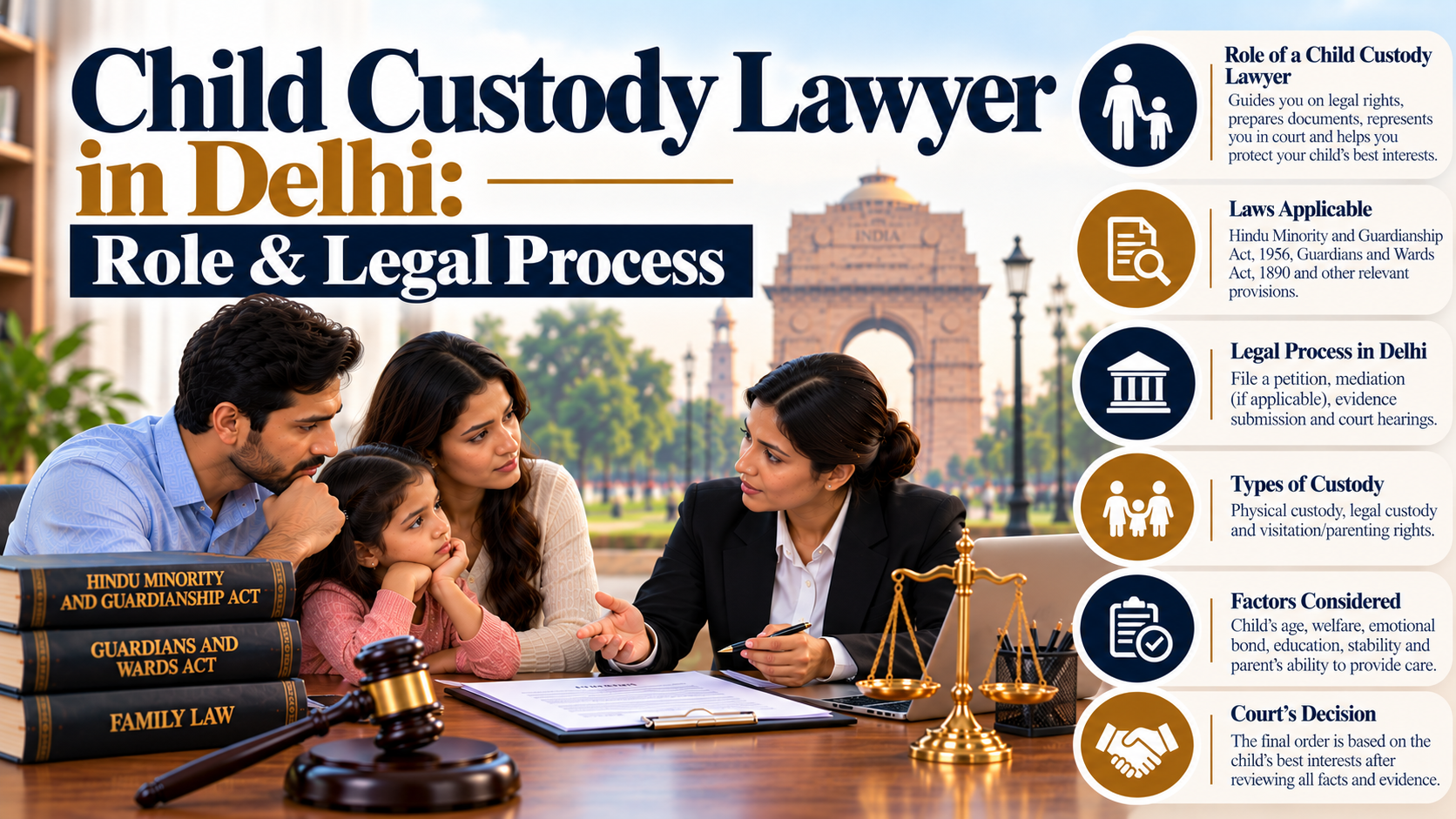
Child Custody Lawyer in Delhi: Role and Legal Process
When parents separate or their marriage breaks down, one of the most sensitive questions is often: Who will the child live with, and how will the other parent remain involved in the child’s life?
A child custody dispute is different from an ordinary legal disagreement because the court’s focus is not simply on deciding which parent “wins.” The welfare and best interests of the child are central considerations in custody and guardianship decisions. Under Section 13 of the Hindu Minority and Guardianship Act, 1956, the welfare of the minor is the paramount consideration when a court appoints or declares a guardian of a Hindu minor.
If you are facing separation, divorce, restricted access to your child, disagreement over visitation, or another parenting dispute, consulting a Child Custody Lawyer in Delhi can help you understand your legal position and the procedure ahead.
Delhi Legal Expert assists parents with child custody consultations, petitions, interim applications, visitation and access issues, guardianship matters, documentation, negotiations and court proceedings.
This guide explains how child custody works, what courts consider, what documents may be required and how a lawyer can assist you during a custody dispute in Delhi.
About Delhi Legal Expert
Delhi Legal Expert provides professional legal assistance in Delhi for individuals dealing with family and matrimonial disputes.
For child custody matters, our advocates help parents understand their legal rights and responsibilities, prepare necessary documents and applications, evaluate custody and visitation issues, and navigate proceedings before the appropriate Family Court.
Because every family situation is different, legal advice should be based on the child’s circumstances, the parents’ situation, existing court orders and the law applicable to the parties.
What Is Child Custody?
Child custody broadly concerns the care, upbringing and living arrangements of a minor child when parents are separated, divorced or otherwise unable to agree on parenting arrangements.
A custody dispute can involve several questions:
- With whom will the child primarily live?
- How will important decisions concerning the child be made?
- When can the other parent meet or communicate with the child?
- What should happen during school holidays and festivals?
- Can temporary custody be granted while the main case is pending?
- What happens if one parent does not comply with an existing arrangement?
Custody therefore involves more than simply determining where a child sleeps.
Depending on the circumstances, a case may involve physical custody, visitation or access, interim custody, guardianship and other arrangements concerning the child’s welfare.
What Is the Most Important Factor in a Child Custody Case?
The welfare of the child is fundamental.
For Hindu minors, Section 13 of the Hindu Minority and Guardianship Act expressly provides that the welfare of the minor is the paramount consideration when the court appoints or declares a guardian.
The Guardians and Wards Act, 1890 also requires the court to be guided by what appears, in the circumstances, to be for the welfare of the minor. Section 17 identifies considerations including the child’s age, the character and capacity of a proposed guardian, relationship with the minor and existing or previous relations with the child. Where a minor is old enough to form an intelligent preference, the court may consider that preference as well.
This means a custody dispute should not be approached simply as a competition between a mother and father.
A Child Custody Lawyer in Delhi can help present the circumstances relevant to the child’s welfare in a legally appropriate manner.
Types of Child Custody and Parenting Arrangements
People searching for custody advice often encounter several terms. Their practical effect depends on the particular order and facts of the case.
Physical Custody
Physical custody generally concerns the parent with whom the child primarily resides.
The other parent may receive visitation or access according to an arrangement agreed between the parents or ordered by the court.
Joint Parenting or Shared Arrangements
In suitable cases, parenting responsibilities or time with the child may be structured so that both parents continue to play meaningful roles.
The exact arrangement depends on the child’s needs and circumstances rather than a single formula applicable to every family.
Visitation and Access Rights
A parent who does not have primary physical custody may seek access to the child.
Depending on the circumstances, access arrangements can address:
- Regular meetings
- Weekends
- School holidays
- Festivals
- Birthdays
- Video or telephone communication
- Other appropriate interaction
Where parents cannot agree, the court may determine an appropriate arrangement after considering the child’s welfare.
Interim Custody
A custody case may take time to reach final determination. During that period, a parent may need a temporary arrangement.
An application for interim custody or access may therefore be made depending on the facts and applicable proceedings.
The interim arrangement does not necessarily determine the final outcome of the custody dispute.
Laws Governing Child Custody in India
There is no single rule that resolves every custody dispute.
The applicable legal framework can depend on factors such as the parties’ personal law, marital proceedings, guardianship issues and the relief being requested.
Important legislation may include the Guardians and Wards Act, 1890, and, for Hindu minors, the Hindu Minority and Guardianship Act, 1956. India Code lists both as central legislation.
The Family Courts Act, 1984 is also relevant to the jurisdiction and functioning of Family Courts. Section 7 gives Family Courts specified jurisdiction over family-related suits and proceedings.
Because the applicable provision depends on your particular case, it is important to avoid relying on a generic online rule about whether a mother or father automatically receives custody.
Does the Mother Always Get Child Custody?
No universal rule means that a mother automatically receives custody in every case.
Likewise, being the father does not by itself determine the outcome.
The applicable statutory provisions must be read together with the welfare principle and the facts of the particular case.
For Hindu minors, the Hindu Minority and Guardianship Act contains provisions concerning natural guardians, while Section 13 expressly makes the child’s welfare paramount in court decisions concerning appointment or declaration of a guardian.
If you are a mother or father concerned about custody, the more useful question is usually not “Which parent has more rights?” but “What arrangement is in the child’s welfare, and what evidence is relevant to establishing that before the court?”
What Does a Child Custody Lawyer in Delhi Do?
A child custody advocate does considerably more than appear at a hearing.
Understand Your Family Situation
Your lawyer may first discuss:
- Child’s age and circumstances
- Existing living arrangements
- Schooling
- Parents’ present relationship with the child
- Existing divorce or matrimonial proceedings
- Previous custody or access orders
- Any immediate welfare concerns
- Current access arrangements
Explain Your Legal Options
Depending on your circumstances, a lawyer can explain whether you may need to pursue:
- Custody
- Interim custody
- Visitation/access
- Guardianship-related relief
- Modification or enforcement of an existing arrangement
- Relief connected with matrimonial proceedings
Prepare the Petition and Applications
Legal drafting is important because the petition should clearly explain the relevant facts and relief requested.
A lawyer can assist with the main petition as well as appropriate interim applications.
Present Relevant Evidence
Custody proceedings are highly fact-specific.
Your lawyer can help identify documents and other material relevant to the child’s care, routine, education, living arrangements and other circumstances.
Represent You Before the Court
A family lawyer can represent you during hearings, respond to the other parent’s pleadings and make legal submissions concerning the relief sought.
Child Custody Process in Delhi: Step-by-Step
Although every case is different, the process may broadly involve the following stages.
Step 1: Legal Consultation
Begin by explaining your circumstances to a family or child custody lawyer.
Bring any existing court papers, divorce petitions, previous orders and documents relevant to the child.
Step 2: Determine the Appropriate Relief
Your lawyer will examine whether the immediate issue concerns final custody, interim custody, visitation, guardianship or another form of relief.
This is important because not every parenting dispute requires exactly the same application.
Step 3: Determine Jurisdiction
The petition must be presented before the court having jurisdiction over the matter.
The appropriate forum depends on the relevant statutory provisions and facts. A lawyer can determine where the matter should be filed rather than assuming that any Delhi court can hear it.
Step 4: Prepare and File the Petition
The petition explains the material facts, circumstances concerning the child and relief requested.
Relevant supporting documents are filed as required.
Step 5: Notice to the Other Parent
The other parent ordinarily gets an opportunity to respond to the proceedings and place their position before the court.
Step 6: Interim Applications, Where Necessary
If immediate arrangements are required while the main proceedings continue, an interim application may be considered.
For example, a parent may seek temporary custody or an access arrangement while the main dispute remains pending.
Step 7: Counselling, Mediation or Settlement Discussions
Family disputes may sometimes be resolved, wholly or partly, through discussions or mediation.
A workable parenting arrangement can reduce conflict where both parents are able to reach terms consistent with the child’s welfare.
Step 8: Evidence and Hearings
If the dispute cannot be resolved, the court may examine the parties’ evidence and submissions.
Step 9: Custody or Access Order
After considering the circumstances, the court may make appropriate directions concerning custody, access or related matters.
The precise terms depend on the individual case.
Factors Courts May Consider in Child Custody Matters
There is no mechanical checklist that determines every custody case.
Under Section 17 of the Guardians and Wards Act, relevant considerations in guardianship decisions include the minor’s age, the proposed guardian’s character and capacity, closeness of kin, existing or previous relations with the minor and, where the child is old enough to form an intelligent preference, that preference may be considered.
In practical custody litigation, circumstances concerning the child’s welfare can therefore be highly important.
Your lawyer may need to understand matters such as:
- Child’s existing routine
- Education and schooling
- Relationship with each parent
- Living arrangements
- Stability and continuity of care
- Health or special needs
- Ability of parents to provide appropriate care
- Existing parenting arrangements
- Any circumstances affecting the child’s safety or welfare
The significance of each factor depends on the case.
Documents That May Be Required for a Child Custody Case
Your lawyer may ask for documents such as:
- Child’s birth certificate
- Parents’ identity and address documents
- Marriage certificate, where relevant
- Divorce or matrimonial case documents
- Previous custody or visitation orders
- School records
- Relevant medical records
- Documents relating to the child’s current residence
- Relevant communication between the parents
- Other material supporting the facts relied upon
Not every document will be necessary in every case.
Avoid collecting or submitting irrelevant private material simply because you believe more documents automatically create a stronger case. Your advocate should help determine what is legally relevant.
How Long Does a Child Custody Case Take in Delhi?
There is no single fixed timeline applicable to every child custody dispute.
The duration can depend on:
- Nature of relief requested
- Whether interim custody/access is disputed
- Complexity of facts
- Evidence required
- Settlement or mediation efforts
- Number of applications
- Court schedule
- Conduct of proceedings by the parties
If access to your child is an immediate concern, tell your lawyer at the beginning so that the appropriate interim legal options can be considered.
Child Custody Lawyer Fees in Delhi
The cost of engaging a child custody lawyer in Delhi varies according to the work required.
Professional fees may depend on:
- Complexity of the dispute
- Nature of applications
- Number of hearings
- Documentation involved
- Whether other matrimonial litigation is pending
- Experience of the advocate
- Court and stage of proceedings
Before engaging a lawyer, ask what services the quoted professional fee covers and whether separate charges may apply to additional applications or proceedings.
Child Custody Cases and Family Courts in Delhi
Family Courts have statutory jurisdiction over specified family disputes. Delhi’s court system includes the Delhi High Court and subordinate courts operating across judicial districts.
Depending on jurisdiction, family matters in Delhi may be connected with court complexes serving areas such as Saket, Rohini, Dwarka, Tis Hazari and Karkardooma.
The Delhi High Court may become relevant at the appellate or other appropriate stage depending on the nature of the proceeding and order involved.
Because jurisdiction is a legal question, you should confirm the correct Family Court or forum before filing rather than selecting a court only because it is geographically convenient.
Can Parents Settle Child Custody Without a Long Court Battle?
In appropriate cases, yes.
Parents may be able to work towards an arrangement addressing issues such as:
- Primary residence
- Visitation schedule
- School holidays
- Festivals and birthdays
- Travel
- Communication with the child
- Education and medical decisions
- Exchange or pick-up arrangements
However, a settlement should be practical, sufficiently clear and focused on the child’s welfare.
Where there are serious safety concerns, allegations of violence or other circumstances affecting the child, legal advice should be taken before agreeing to an arrangement.
Common Mistakes Parents Should Avoid in Custody Disputes
Treating Custody as a Fight to Defeat the Other Parent
The focus of custody proceedings is the child. Personal conflict between spouses should not overshadow the child’s needs.
Making Unsupported Allegations
Serious allegations should not be made casually. Discuss the facts and available evidence with your lawyer.
Ignoring Existing Court Orders
If an order already regulates custody or access, obtain legal advice before acting inconsistently with it.
Using the Child as a Messenger
Parents should be cautious about placing children in the middle of legal disagreements.
Posting About the Dispute Online
Public social-media arguments can create additional complications and expose sensitive family information.
Waiting Too Long When Access Is Being Denied
If you are repeatedly unable to meet or communicate with your child, timely legal advice can help you understand available remedies.
Why Hiring a Child Custody Lawyer in Delhi Helps
Child custody proceedings combine legal questions with highly personal family circumstances.
An experienced family lawyer can help you separate emotional disagreements from legally relevant issues.
Professional assistance can help with:
- Legal consultation – Understanding your rights, responsibilities and available remedies.
- Case assessment – Identifying the custody, access or guardianship issues that need to be addressed.
- Document preparation – Preparing petitions, replies and applications.
- Interim relief – Seeking appropriate temporary custody or access arrangements where legally justified.
- Court representation – Presenting your case before the appropriate Family Court.
- Visitation arrangements – Helping formulate workable access proposals.
- Settlement assistance – Exploring appropriate negotiated parenting arrangements.
- Case strategy – Building the case around relevant facts and the child’s welfare.
How Delhi Legal Expert Can Assist You
If you are facing a child custody dispute, Delhi Legal Expert can help you understand the process before you make important decisions.
Our legal assistance may include:
- Initial child custody consultation
- Review of existing matrimonial proceedings
- Custody and guardianship petitions
- Interim custody applications
- Visitation and access matters
- Replies and supporting documentation
- Negotiation and settlement assistance
- Family Court representation
- Advice regarding existing custody orders
- Guidance concerning further legal remedies
The appropriate legal strategy depends on your individual circumstances.
Frequently Asked Questions
Q1. How do I file a child custody case in Delhi?
The first step is to determine the appropriate legal relief and court having jurisdiction. A child custody lawyer in Delhi can review your circumstances, prepare the appropriate petition and supporting documents, and assist with filing and hearings.
The correct procedure can vary depending on whether the issue concerns custody, interim custody, access, guardianship or a connected matrimonial proceeding.
Q2. Who usually gets child custody after divorce in Delhi?
There is no single answer that applies to every divorce.
The child’s welfare is central to custody and guardianship decisions. For Hindu minors, Section 13 of the Hindu Minority and Guardianship Act specifically makes welfare the paramount consideration in appointment or declaration of a guardian by the court.
Q3. Can a father get custody of a child in Delhi?
A father can seek custody. The result is not determined simply by the parent’s gender.
The court considers the applicable law and circumstances relevant to the child’s welfare. If you are a father seeking custody or access, a family lawyer can help identify the evidence and relief relevant to your circumstances.
Q4. Can a mother be denied custody?
Custody is not decided merely on the basis that one parent is the mother or father.
Courts consider the applicable legal framework and the welfare of the child. The outcome therefore depends on the evidence and circumstances of the individual case.
Q5. Can I meet my child if my spouse has custody?
A parent who does not have primary physical custody may seek visitation or access, depending on the circumstances and any existing court orders.
An access arrangement may deal with physical meetings, holidays and appropriate electronic communication. Where parents cannot agree, legal relief may be sought before the appropriate court.
Q6. What is interim child custody?
Interim custody is a temporary arrangement considered while the main proceedings are pending.
It can address immediate custody or access issues until the court makes further or final directions. Whether interim relief should be sought depends on the facts of the case.
Q7. Does the child’s opinion matter in a custody case?
It can matter in appropriate circumstances.
Section 17 of the Guardians and Wards Act states that where a minor is old enough to form an intelligent preference, the court may consider that preference. It is one consideration within the broader assessment of the child’s welfare.
Q8. Can child custody be settled mutually?
Parents may be able to agree on parenting and access arrangements rather than litigating every issue.
The arrangement should be practical and child-focused. Legal advice can also help ensure that important issues such as holidays, communication, schooling and access are addressed clearly.
Q9. How long does a child custody case take in Delhi?
There is no guaranteed duration. The timeline depends on the dispute, interim applications, evidence, settlement efforts, hearings and court schedule.
If there is an urgent issue involving access or the child’s welfare, inform your lawyer immediately so that appropriate remedies can be evaluated.
Q10. How can a child custody lawyer in Delhi help me?
A child custody lawyer can evaluate your circumstances, explain the applicable law, prepare petitions and applications, organise relevant evidence, seek interim relief where appropriate, assist with settlement discussions and represent you before the appropriate court.
Early legal advice can also help you avoid decisions that may unnecessarily complicate the dispute.