Mutual Divorce Settlement Agreement: Complete Legal Guide
Quick Answer: What Is a Mutual Divorce Settlement Agreement?
A mutual divorce settlement agreement is a written document recording the terms agreed between spouses who have decided to separate and resolve their matrimonial disputes consensually.
Depending on the couple’s circumstances, the agreement may deal with alimony or maintenance, child custody, visitation, children’s expenses, return of jewellery and belongings, property or financial arrangements, pending litigation, and other obligations.
For marriages governed by the Hindu Marriage Act, Section 13B provides the statutory framework for divorce by mutual consent. It requires, among other things, that the spouses have been living separately for at least one year, have been unable to live together, and mutually agree that the marriage should be dissolved.
A settlement agreement is important, but signing one does not by itself dissolve the marriage. The marriage is legally dissolved when the competent court passes the decree of divorce in accordance with the applicable law and procedure.
Introduction
When spouses mutually decide that their marriage should end, agreeing to divorce is often only the first step.
You may still need to decide:
- Will either spouse receive alimony?
- Will the payment be one-time or structured differently?
- Who will have custody of the children?
- What visitation arrangement will apply?
- Who will pay school, medical and other child-related expenses?
- What happens to jewellery, streedhan and personal belongings?
- Are there joint loans, accounts or financial liabilities?
- Are any matrimonial or related cases already pending?
- What must each spouse do before the divorce is completed?
These questions are why a carefully prepared mutual divorce settlement agreement can be important.
A vague agreement may leave room for disagreement later. A properly considered settlement attempts to record what the spouses have actually agreed, how obligations will be performed, and how the terms relate to the divorce proceedings.
Delhi Legal Expert assists individuals in Delhi with Mutual Consent Divorce, settlement drafting, matrimonial documentation and representation before the appropriate Family Court. The firm’s published matrimonial services include drafting consent terms concerning maintenance, custody, property and streedhan, as well as filing joint petitions and handling first- and second-motion proceedings.
This guide explains what you should consider before signing a divorce settlement agreement and how the mutual divorce process works in Delhi.
About Delhi Legal Expert
Delhi Legal Expert provides professional legal assistance in Delhi for people dealing with divorce and matrimonial matters.
For mutual consent divorce, the legal team can assist you in understanding your rights, identifying unresolved issues, reviewing or preparing settlement terms, drafting necessary documents, determining the appropriate court procedure and representing you during the divorce proceedings.
A settlement should reflect your actual circumstances rather than simply copying a standard online format. Issues involving children, finances, property or connected litigation may require particularly careful drafting.
What Is a Mutual Consent Divorce?
A mutual consent divorce occurs when both spouses agree to dissolve their marriage and proceed jointly under the law applicable to them.
For Hindu marriages governed by the Hindu Marriage Act, Section 13B provides for divorce by mutual consent.
Section 13B(1) states that the spouses may jointly petition for dissolution when the statutory conditions are satisfied, including that they have been living separately for one year or more, have not been able to live together and have mutually agreed that the marriage should be dissolved.
The applicable legal provision can differ depending on the law governing the marriage. Therefore, you should first determine which matrimonial law applies to you rather than assuming that Section 13B governs every marriage.
What Is the Purpose of a Mutual Divorce Settlement Agreement?
Think of the settlement agreement as a roadmap of the arrangements you and your spouse have agreed upon.
It can clarify:
- What each spouse has agreed to
- Financial obligations
- Alimony or maintenance arrangements
- Child custody and visitation
- Children’s expenses
- Return of belongings
- Property-related arrangements
- Treatment of pending legal proceedings
- Steps to be completed at different stages of divorce
- Other mutually agreed obligations
The exact terms depend entirely on the circumstances.
A couple without children or joint assets may need a comparatively straightforward settlement. A couple with children, property, substantial financial arrangements and several pending proceedings may require a much more detailed agreement.
Important Clauses in a Mutual Divorce Settlement Agreement
There is no single clause list suitable for every couple. However, the following issues commonly require consideration.
1. Details of the Marriage
The agreement generally identifies the spouses and records relevant marriage details, such as:
- Names of both spouses
- Date and place of marriage
- Applicable personal law
- Relevant addresses
- Date or period of separation
- Basic matrimonial background
The information should correspond with the documents that will be relied upon during the court proceedings.
2. Agreement to Seek Divorce by Mutual Consent
The document can clearly record that both spouses have voluntarily decided to seek dissolution of the marriage through mutual consent.
Consent is fundamental to this form of divorce.
The terms should therefore accurately reflect the parties’ agreement and should not be based on coercion, misrepresentation or unclear promises.
3. Alimony and Maintenance
Financial settlement is one of the most important issues to address.
The spouses may need to determine:
- Whether maintenance or alimony is payable
- Amount agreed, if any
- Mode of payment
- Payment schedule
- Stage at which payment will be made
- Treatment of any existing maintenance proceedings
- Other agreed financial obligations
Avoid using vague phrases such as “all financial matters are settled” if specific payments or obligations remain outstanding.
Clear terms can reduce disagreement about what was actually promised.
4. Child Custody
Where children are involved, the settlement requires additional care.
Depending on the circumstances, the spouses may discuss:
- Physical custody
- Parenting arrangements
- Visitation/access
- Holiday arrangements
- Education
- Medical expenses
- Travel
- Communication with the other parent
- Other child-related expenses
A matrimonial settlement cannot be approached as though children were merely financial assets being divided between spouses. Child-related arrangements remain subject to the applicable legal framework and the child’s welfare.
5. Visitation and Parenting Arrangements
Simply stating that one parent will receive “visitation rights” may not provide enough clarity.
Where appropriate, parties can consider issues such as:
- Frequency of meetings
- Weekend access
- Festival arrangements
- School holidays
- Video or telephone communication
- Travel arrangements
- Pickup and drop arrangements
The required level of detail depends on the family’s circumstances.
6. Children’s Education and Other Expenses
Parents should consider foreseeable expenses rather than focusing only on immediate monthly maintenance.
Possible issues include:
- School fees
- Tuition
- Medical expenses
- Insurance
- Extracurricular activities
- Higher education
- Other agreed expenses
A lawyer can help identify whether the proposed wording actually reflects the parents’ intended arrangement.
7. Streedhan, Jewellery and Personal Belongings
If jewellery, gifts, documents, personal possessions or other belongings are to be returned, the agreement should identify the relevant arrangement clearly.
Where items have already been exchanged or returned, that fact may also need to be recorded appropriately.
8. Property and Financial Arrangements
A divorce does not mean that every property issue automatically resolves itself.
If the spouses have agreed upon matters involving assets or liabilities, those arrangements need careful legal review.
Issues may include:
- Jointly held property
- Loans
- Bank accounts
- Financial liabilities
- Possession or transfer arrangements
- Other jointly managed financial interests
Property transactions may also involve separate documentation, registration, taxation or other legal requirements. A divorce settlement clause should therefore not be assumed to replace every legally required property document.
9. Pending Matrimonial and Related Proceedings
Sometimes spouses reach a settlement after litigation has already started.
There may be pending proceedings involving:
- Divorce
- Maintenance
- Domestic violence
- Custody
- Matrimonial property
- Other civil or legally permissible connected proceedings
The settlement should identify pending cases and clearly state what legally permissible steps the parties have agreed to take.
Do not assume that every type of proceeding can simply be “cancelled” by private agreement. The lawful procedure depends on the nature of the proceeding and the order of the competent court.
10. Payment Schedule and Sequence of Obligations
If money, property or belongings are to be exchanged, the timing can be as important as the amount.
For example, a settlement may need to coordinate agreed obligations with:
- Execution of the settlement
- First motion
- Performance of specified settlement obligations
- Second motion
- Other court proceedings
The exact structure should be determined according to the circumstances and legal advice.
Mutual Divorce Settlement Agreement vs Divorce Decree
This distinction is particularly important.
A settlement agreement records the terms agreed between the spouses.
A divorce decree is the judicial order that legally dissolves the marriage.
Therefore:
Signing a settlement agreement ≠ being legally divorced.
For a mutual consent divorce, the spouses must follow the applicable statutory procedure and obtain the decree from the competent court.
Under Section 13B(2) of the Hindu Marriage Act, the statutory text contemplates a second motion after the prescribed interval and within the statutory period, following which the court must satisfy itself about the relevant requirements before granting the decree.
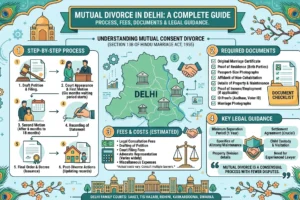
Mutual Divorce Process in Delhi: Step-by-Step
Step 1: Obtain Legal Advice
Before drafting the agreement, discuss your situation with a matrimonial lawyer.
Tell your lawyer about:
- Children
- Income
- Maintenance
- Property
- Jewellery
- Loans
- Pending cases
- Existing court orders
- Any promises already made between you
The lawyer can identify issues that may otherwise be overlooked.
Step 2: Negotiate Settlement Terms
Both spouses should discuss unresolved matters and determine whether a complete settlement is possible.
Where direct negotiation is difficult, mediation may sometimes assist.
Delhi District Courts describe mediation as a process in which a neutral mediator assists the parties in negotiating a resolution while the decision-making power remains with the parties. Matrimonial disputes are among the categories handled through Delhi’s mediation framework.
Step 3: Draft the Settlement Agreement
Once the terms are understood, they should be reduced to clear written clauses.
Each clause should answer practical questions such as:
Who has to do what? When must it be done? What amount or property is involved? Which proceeding does the obligation relate to?
The objective is clarity, not unnecessarily complicated legal language.
Step 4: Review Before Signing
Both parties should carefully review the agreement before execution.
Pay particular attention to:
- Names and identifying details
- Payment figures
- Payment dates
- Custody arrangements
- Property descriptions
- Pending case numbers
- Return of belongings
- Obligations linked to divorce stages
Never sign merely because you are under pressure to “finish the divorce quickly.”
Step 5: File the Mutual Consent Divorce Petition
Once the settlement is complete and the statutory conditions are satisfied, the joint divorce petition can be prepared and filed before the competent Family Court.
Delhi District Courts currently provide e-filing for Delhi Family Courts across all districts.
Jurisdiction should be verified from the facts of the marriage and applicable law rather than selecting a court merely because it is geographically convenient.
Step 6: First Motion Proceedings
During the first-motion stage, the court considers the joint petition and the parties’ consent in accordance with the applicable procedure.
Your advocate can guide you regarding statements, documents and court requirements.
Step 7: Cooling-Off Period and Possible Waiver
Under Section 13B(2) of the Hindu Marriage Act, the statutory text provides for a six-month interval before the second motion.
However, the Supreme Court in Amardeep Singh v. Harveen Kaur held that this six-month waiting requirement is directory rather than mandatory, allowing courts to waive it in appropriate circumstances. The Supreme Court has subsequently reiterated that waiver is discretionary and depends on the facts and circumstances; it is not an automatic entitlement.
Therefore, avoid assuming that every mutual divorce will receive a cooling-off waiver.
Step 8: Second Motion and Divorce Decree
The parties proceed with the second motion in accordance with the applicable statutory requirements and court directions.
If the legal requirements are satisfied and the court grants the petition, a decree dissolving the marriage is passed.
Only then should you treat the marriage as legally dissolved.
Documents Commonly Required for Mutual Divorce
Exact documentation can vary, but you may be asked to arrange documents such as:
- Identity proof
- Address proof
- Marriage certificate, where available
- Marriage photographs or other marriage-related records where relevant
- Passport-size photographs
- Settlement agreement
- Details relating to children
- Income/financial documents where relevant
- Documents relating to property or financial arrangements where relevant
- Copies of pending court cases/orders, if applicable
- Documents concerning agreed payments or returned belongings
Your lawyer should provide a case-specific document checklist.
How Long Does a Mutual Divorce Settlement Take?
There are two different timelines to consider.
- Settlement timeline: How long you and your spouse take to agree on all material terms.
- Court timeline: How long the legal divorce process takes after filing.
The first may take days in a straightforward case or considerably longer where maintenance, children, assets or connected proceedings remain disputed.
For marriages governed by Section 13B of the Hindu Marriage Act, the statute provides the procedural framework for the first and second motions. The six-month waiting period may be waived in appropriate cases, but whether to grant a waiver is for the court to determine.
Avoid relying on anyone who guarantees a divorce within an exact number of days without first understanding your circumstances.
How Much Does a Mutual Divorce Settlement Agreement Cost in Delhi?
There is no universal professional fee.
The cost may depend on:
- Complexity of settlement
- Number of negotiation sessions
- Child custody issues
- Maintenance/alimony arrangements
- Property issues
- Number of pending proceedings
- Drafting requirements
- Advocate’s professional fees
- Court-related procedural work
Delhi Legal Expert’s published matrimonial service information states that fees vary depending on the matter and scope of legal work. You should obtain a clear fee quotation for your particular case before engaging an advocate.
Common Mistakes to Avoid in a Divorce Settlement Agreement
Using a Generic Online Template
A downloaded mutual divorce agreement format may not address your financial, parenting or litigation circumstances.
Leaving Financial Terms Vague
Specify agreed amounts, timing and mode of performance where applicable.
Ignoring Child-Related Details
Custody is only one issue. Visitation, education, medical care and expenses may also require attention.
Forgetting Pending Cases
A settlement should consider existing matrimonial or connected proceedings where relevant.
Confusing Settlement With Divorce
A private agreement alone does not dissolve the marriage.
Signing Without Understanding the Clauses
You should understand the practical and legal effect of each important provision before signing.
Making Unlawful or Impractical Commitments
Not every private promise can override statutory requirements or the authority of a court. Settlement terms should be legally reviewed before execution.
Mutual Divorce and Mediation in Delhi
Mediation can be useful when spouses agree in principle that they want to resolve their dispute but cannot agree on every term.
Delhi’s court mediation system expressly deals with matrimonial disputes. Official Delhi District Court information lists mediation centres at Tis Hazari, Karkardooma, Rohini, Dwarka, Saket and Patiala House Court complexes.
Where court-connected mediation results in settlement, Delhi’s mediation rules provide for the agreed terms to be reduced to writing and signed by the parties; the settlement is then forwarded to the court dealing with the proceeding.
Mediation is intended to facilitate agreement rather than allow a mediator to impose terms on spouses.
Mutual Divorce Legal Assistance in Delhi
The appropriate Family Court depends on jurisdiction and the facts of your case.
Delhi’s judicial system includes Family Courts across its districts, while mediation facilities operate at major court complexes including:
- Tis Hazari Courts
- Saket Courts
- Rohini Courts
- Dwarka Courts
- Karkardooma Courts
- Patiala House Courts
Delhi District Courts also provide Family Court and e-filing resources for all districts.
The Delhi High Court may become relevant in appropriate appellate or other proceedings, but an ordinary mutual consent divorce petition should be filed before the competent court under the applicable matrimonial law and jurisdictional rules.
How Can a Divorce Lawyer Help With a Settlement Agreement?
A divorce lawyer can do considerably more than prepare a standard document.
A lawyer may help you:
- Understand the applicable matrimonial law
- Identify unresolved settlement issues
- Negotiate settlement terms
- Draft and review the settlement agreement
- Structure alimony and maintenance terms
- Address custody and visitation arrangements
- Review child-related financial obligations
- Examine property-related settlement clauses
- Coordinate pending matrimonial proceedings
- Prepare the mutual divorce petition
- Determine the appropriate Family Court
- Represent you during first and second motions
- Assess whether a cooling-off waiver application may be appropriate
- Assist with final divorce documentation
Delhi Legal Expert states that its matrimonial practice includes mutual consent divorce, settlement drafting, maintenance, custody, property-related terms and representation across Delhi Family Courts.
How Delhi Legal Expert Can Assist You
If you and your spouse are considering mutual divorce, you do not necessarily need to begin with a court battle.
The first objective should be to understand what has already been agreed and what remains unresolved.
Delhi Legal Expert can assist with:
- Initial matrimonial consultation
- Mutual consent divorce guidance
- Settlement agreement drafting
- Settlement agreement review
- Alimony and maintenance terms
- Child custody and visitation terms
- Matrimonial property-related issues
- Petition and affidavit preparation
- Family Court filing
- First-motion proceedings
- Cooling-off waiver applications where legally appropriate
- Second-motion proceedings
- Final decree documentation
The appropriate approach depends on your marriage, applicable personal law, children, finances, pending proceedings and the terms both spouses are willing to accept.
Frequently Asked Questions
Q1. What is a mutual divorce settlement agreement?
A mutual divorce settlement agreement records terms agreed between spouses who intend to resolve their matrimonial dispute and seek divorce by mutual consent.
It may cover alimony, maintenance, custody, visitation, children’s expenses, property arrangements, return of belongings, pending cases and other agreed obligations.
Q2. Is a settlement agreement compulsory for mutual divorce?
The exact documentation and procedure depend on the applicable matrimonial law, court requirements and circumstances.
Even where spouses agree on divorce, recording important settlement terms clearly can be valuable, particularly when money, children, property or pending proceedings are involved.
A divorce lawyer can advise you about the documentation required in your specific case.
Q3. Does signing a mutual divorce agreement mean we are divorced?
No.
Signing a settlement agreement does not itself dissolve your marriage. You must complete the applicable legal divorce process and obtain a decree from the competent court.
For Hindu marriages governed by Section 13B, the statute specifically provides for the court to pass the decree after the prescribed mutual-consent procedure and satisfaction of the statutory requirements.
Q4. What should be included in a mutual consent divorce settlement?
Depending on your circumstances, consider:
- Alimony or maintenance
- Payment schedule
- Child custody
- Visitation
- Children’s expenses
- Property arrangements
- Jewellery and streedhan
- Personal belongings
- Financial liabilities
- Pending proceedings
- Other obligations
There is no universal settlement format suitable for every marriage.
Q5. Can child custody be included in a divorce settlement agreement?
Yes, spouses may record agreed child custody and parenting arrangements as part of their matrimonial settlement.
However, child-related issues should be approached with the child’s welfare in mind and remain subject to applicable law and judicial scrutiny.
Q6. Can alimony be settled in mutual consent divorce?
Financial issues, including maintenance or alimony, can form an important part of settlement discussions.
The agreement should clearly state the arrangement reached between the spouses, including the amount, timing and method of payment where applicable. Your lawyer should review the wording before execution.
Q7. Can the six-month cooling-off period be waived?
Potentially, yes.
For mutual divorce under Section 13B of the Hindu Marriage Act, the Supreme Court has held that the six-month period in Section 13B(2) is directory and may be waived by the court in appropriate circumstances.
A waiver is not automatic. The court exercises discretion after considering the circumstances.
Q8. Can a settlement include withdrawal of pending cases?
A settlement may record what the parties agree to do regarding pending proceedings.
However, the legal mechanism for disposing of, withdrawing, quashing or otherwise resolving a proceeding depends on the nature of that case and applicable law. A private agreement should not be assumed to terminate every proceeding automatically.
Have your lawyer review each pending case individually.
Q9. Can we use an online mutual divorce agreement format?
An online format may help you understand common headings, but it should not automatically be treated as appropriate for your case.
Your settlement may involve children, maintenance, property, loans, pending litigation or other issues that a generic template does not properly address.
A case-specific legal review can help identify omissions before you sign.
Q10. Which lawyer should I consult for a mutual divorce settlement in Delhi?
Look for a divorce or matrimonial lawyer in Delhi with relevant experience in mutual consent divorce, settlement drafting and the Family Court procedure applicable to your case.
Discuss your children, finances, assets, pending cases and proposed settlement openly so the lawyer can identify unresolved issues before the petition is filed.