Top Divorce Lawyers in Delhi: How to Choose the Right Advocate
Quick Answer
There is no universally top divorce lawyer in Delhi for every matrimonial dispute. The choice of the right advocate depends on the nature of the marriage, whether it is mutual divorce or contested divorce, the nature of the issues, the court jurisdiction and the way you would want to settle or litigate. Matrimonial law experience, case experience, communication, fee transparency, court practice, availability and verifiable court credentials should all be taken into account for a sensible shortlist.
Key Takeaways
- “Top” does not necessarily mean the most expensive, most advertised or most visible lawyer.
- Choose an advocate with experience relevant to your particular matrimonial issue.
- Mutual consent and contested divorce require different legal strategies and preparation.
- Jurisdiction should be checked before deciding where a divorce petition can be filed.
- Maintenance, child custody, visitation and property or financial settlements may require attention alongside the divorce itself.
- Ask for a clear explanation of professional fees and what the engagement covers.
- No ethical lawyer can guarantee a divorce, custody order, maintenance amount or particular court outcome.
What Does “Top Divorce Lawyers in Delhi” Actually Mean?
A search for top divorce lawyers in Delhi does not provide a reliable basis for naming one lawyer as objectively better than every other advocate.
Divorce matters can vary considerably. One person can have the assistance with an uncontested or mutual consent divorce, another could be charged with cruelty or desertion, maintenance, child custody, or multiple related cases.
The more useful question is therefore:
Which divorce lawyer is most suitable for my particular circumstances?
A good selection process should not just be based on an online presence. Matrimonial law experience, understanding of matrimonial law, communication, strategy, professional transparency and the ability to manage the procedural requirements of the case are more relevant.
When Do You Need a Divorce or Matrimonial Lawyer?
A lawyer may prove to be very helpful in providing you legal guidance before starting formal measures.
You may consider consulting a matrimonial advocate if:
- You and your spouse are considering divorce.
- You are discussing a mutual consent divorce.
- Your spouse has filed or threatened to file a contested divorce petition.
- You have received a court notice.
- Maintenance or financial support is disputed.
- Child custody or visitation is an issue.
- There are several connected matrimonial proceedings.
- You need help preparing or reviewing a settlement.
- You are uncertain about jurisdiction or the appropriate court.
- You need advice about documents and evidence.
A consultation is not a requirement to file a case right away. In many cases, it can help you to understand what options are available to you and prevent you making unnecessary procedural errors, if you take advice first.
What Does a Divorce Lawyer Actually Do?
A divorce advocate’s role can extend well beyond appearing in court.
Depending on the case, a matrimonial lawyer may assist with:
Assessing the legal position
The advocate will consider the marriage and the facts, available documents, the issues between the spouses prior to discussing legal options.
Preparing pleadings and applications
Where litigation is appropriate, the lawyer may draft the necessary petition, reply, application or other court documents.
Advising on evidence
Documents, communications, financial records and other material may become relevant depending on the allegations and issues involved. Your attorney will be able to tell you what information might be legally relevant and how it should be kept.
Negotiating settlement terms
In suitable cases, lawyers can help negotiate terms concerning divorce, maintenance, property-related arrangements, child custody, visitation and other outstanding issues.
Representing you in proceedings
An advocate may appear on your behalf at relevant stages of the proceedings, subject to the applicable court rules and the terms of your engagement.
Explaining procedural developments
A useful lawyer should be able to explain what a court order means, what happens next and what decisions you may need to make.
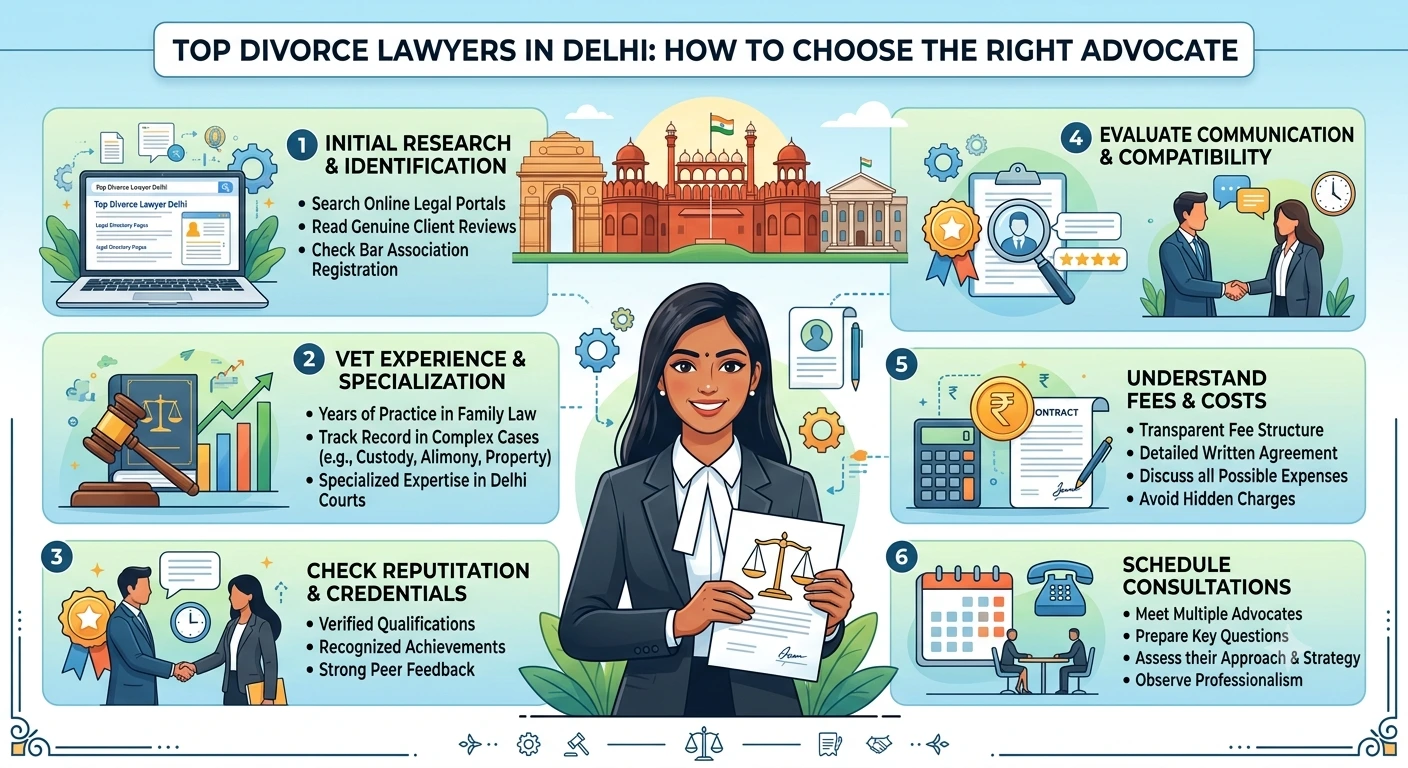
How Do I Choose a Divorce Lawyer in Delhi?
If you are comparing divorce lawyers in Delhi, use a consistent checklist rather than relying only on search-engine rankings or promotional claims.
1. Look for relevant matrimonial-law experience
A lawyer with a regular practice in matrimonial law may have better experience and understanding of the subject matter than a lawyer that does not regularly work with matrimonial matters.
Look for experience relevant to the issues in your case, such as divorce, maintenance, custody, domestic disputes or matrimonial settlements.
2. Consider experience with your type of case
Mutual consent divorce and contested litigation are not identical.
If you are expecting a negotiated separation, you might focus on settlement drafting, negotiation and procedural advice. In cases where a dispute arises, pleadings, evidence, hearings and litigation strategy might be more relevant.
3. Check court and procedural familiarity
Delhi has several court complexes and judicial forums. Your lawyer should be able to advise you on why a specific court/forum may be applicable and whether jurisdiction has been established appropriately.
4. Assess communication
During the first consultation, notice whether the lawyer:
- Listen before giving conclusions.
- Explains legal terminology clearly.
- Distinguishes facts from assumptions.
- Answer questions directly.
- Explains possible risks.
- Avoids unrealistic promises.
Good communication matters because matrimonial proceedings can involve decisions over an extended period.
5. Understand the settlement approach
A strong matrimonial lawyer should not treat every case as a battle.
In some cases, negotiation or mediation may be a more cost-effective approach than litigating issues, where it is legally and practically suitable to do so. A client, on the other hand, should also be able to recognize when contested proceedings might be needed.
6. Ask about fees before engagement
Do not rely on a vague statement that the entire matter will cost a particular amount.
Ask what the professional fee covers and whether drafting, appearances, applications, mediation, evidence or connected proceedings are charged separately.
7. Find out who will handle the matter
In some practices, the advocate you initially meet may not personally conduct every hearing.
Ask who will be responsible for drafting, conferences and court appearances and how you will receive updates.
8. Verify professional information
Professional credentials should be independently verifiable. Be cautious about websites making unsupported claims such as “No. 1 lawyer”, “100% success rate” or guaranteed results.
How Can You Create a Shortlist of Top Divorce Lawyers in Delhi?
Instead of accepting an unverified online “Top 10” list, create your own shortlist.
A practical evaluation framework is:
| Selection Factor | What to Check |
|---|---|
| Matrimonial focus | Does the lawyer regularly handle family-law matters? |
| Relevant experience | Have they handled matters similar to yours? |
| Court practice | Are they familiar with the relevant Delhi court and procedure? |
| Settlement skills | Can they explain negotiation and mediation options? |
| Litigation ability | Can they handle contested proceedings if required? |
| Communication | Are explanations clear and realistic? |
| Fee transparency | Are charges and inclusions explained in advance? |
| Availability | Can you communicate with the legal team when necessary? |
| Professional conduct | Are claims factual and responsible? |
| Credentials | Can professional information be verified? |
This approach is more meaningful than selecting a lawyer simply because a website describes them as “top” or “best”.
Mutual Consent vs Contested Divorce
One of the first distinctions to understand is whether the divorce is mutual or contested.
| Point | Mutual Consent Divorce | Contested Divorce |
|---|---|---|
| Agreement | Both spouses seek divorce on agreed terms | Spouses may disagree about divorce or related issues |
| Settlement | Major terms generally need to be addressed | Disputes may require adjudication |
| Court role | Court considers the statutory requirements and proceedings | Court determines disputed issues according to law and evidence |
| Evidence | Usually less extensive than contested litigation | Evidence and cross-examination may become relevant |
| Negotiation | Often central to the process | May still be attempted through settlement or mediation |
| Time | Can be more streamlined, subject to legal requirements and court procedure | Can take considerably longer depending on disputes and proceedings |
For marriages governed by the Hindu Marriage Act, 1955, mutual consent divorce is addressed under Section 13B, while contested divorce grounds are addressed under Section 13, subject to the applicable statutory requirements.
Other marriage laws can contain different provisions, so the governing law should be identified before applying a particular statutory rule.
Which Delhi Court Handles Divorce Matters?
The correct court is based on the facts of the case and the jurisdictional rules that apply to the parties and the marriage.
Delhi’s family and matrimonial disputes may be heard before the Family Courts set up for the jurisdiction, along with the general Delhi district-court system. Delhi High Court may be engaged in appropriate matters such as appeal, petitions or other proceedings within its jurisdiction.
A person’s residency in Delhi is not enough to resolve all the jurisdictional issues.
Factors such as the parties’ residence, place of marriage and other legally relevant circumstances may need to be examined. Before filing, ask your lawyer to explain why the proposed court has jurisdiction.
How Much Does a Divorce Lawyer Charge in Delhi?
There is no single statutory professional fee applicable to every divorce lawyer in Delhi.
Professional fees can vary according to the lawyer, nature and complexity of the matter, work involved, number of proceedings and whether the case becomes contested.
Possible fee components can include:
| Fee Component | What to Ask |
|---|---|
| Consultation | Is the initial consultation separately charged? |
| Petition drafting | Is drafting included in the quoted fee? |
| Court appearances | Is the charge per appearance or part of an agreed arrangement? |
| Interim applications | Are additional applications charged separately? |
| Evidence stage | Is professional work during evidence included? |
| Mediation | Is representation during mediation included? |
| Connected cases | Will separate proceedings require a separate engagement? |
A mutual consent case is likely to be a different type of work from an extended case where pleadings and evidence are conducted and there are maintenance and custody issues.
Before you get engaged, inquire about the arrangement of the fee in writing, if possible.
What Documents Should You Take to Your First Consultation?
You don’t have to have a flawless file before you meet with the lawyer. However, relevant documents can make the consultation more productive.
Depending on your circumstances, consider taking:
- Marriage certificate, if available.
- Identity and address documents where relevant.
- Previous court orders or legal notices.
- Existing petitions, replies or applications.
- Details of children, if applicable.
- Relevant financial information where maintenance is an issue.
- Important correspondence or communications relevant to the dispute.
- Evidence relating to specific allegations, where applicable.
- Details of any pending matrimonial or related proceedings.
Do not delete potentially relevant records simply because they appear embarrassing or inconvenient. Ask your lawyer how particular material should be handled.
What Questions Should You Ask Before Hiring a Divorce Lawyer?
A first consultation can also be used to assess whether the advocate is appropriate for you.
Consider asking:
- What legal options appear available based on my facts?
- Is my matter likely to be mutual or contested?
- Which court or jurisdiction may apply, and why?
- What documents should I preserve?
- What are the main legal risks in my situation?
- Could mediation or settlement be appropriate?
- How will maintenance or financial issues be addressed?
- If children are involved, how should custody and visitation be approached?
- Who will draft the pleadings?
- Who is likely to appear at hearings?
- How are professional fees calculated?
- Which services are included and which may be additional?
The quality of the answers can tell you a great deal about how the lawyer approaches client communication.
What Are the Red Flags When Hiring a Divorce Lawyer?
Be cautious if a prospective advocate or service provider:
- Guarantees that you will win.
- Promises a guaranteed divorce within a fixed period.
- Guarantees a particular maintenance amount.
- Guarantees custody of a child.
- Claims to be “No. 1” without explaining any objective basis.
- Uses unverifiable awards or success-rate claims.
- Pressures you to file immediately without understanding your circumstances.
- Gives a fee quotation without explaining what it covers.
- Cannot clearly explain who will handle your case.
- Encourages destruction or manipulation of evidence.
A lawyer can explain possible outcomes and strategy, but the final result can depend on facts, evidence, the opposing party and the court’s decisions.
How Long Can Divorce Proceedings Take?
There is no universal divorce timeline in Delhi.
A mutual consent matter and a contested divorce can follow substantially different procedural paths. Contested proceedings may take longer because of pleadings, interim applications, evidence, cross-examination, hearings and other procedural factors.
Court workload, adjournments, settlement discussions, the conduct of both parties and the complexity of connected disputes can also affect duration.
A responsible divorce advocate in Delhi should explain the likely stages of your case rather than promise an exact completion date.
Can the Six-Month Period for Mutual Divorce Be Waived?
For a Hindu Marriage Act mutual consent divorce under Section 13B, the statute provides a period between the first and second motion. However, the Supreme Court has recognised that the statutory six-month period can, in appropriate circumstances, be waived by the court.
In Amardeep Singh v. Harveen Kaur (2017), the Supreme Court discussed the circumstances relevant to considering waiver.
Waiver is not an automatic entitlement in every case. The court considers the circumstances and applicable legal principles.
Therefore, a lawyer should assess the facts rather than promise that the waiting period will definitely be waived.
Child Custody and Visitation in Divorce Cases
Where children are involved, divorce is only one part of the legal and practical discussion.
Parents may need to address:
- Physical custody.
- Legal or decision-making arrangements where relevant.
- Visitation and access.
- School-related decisions.
- Medical expenses.
- Education expenses.
- Travel arrangements.
- Communication with the child.
- Long-term financial responsibilities.
The welfare and best interests of the child are central considerations in custody-related proceedings. Parents should therefore avoid treating custody solely as another bargaining point in the divorce.
A child custody lawyer in Delhi can explain the relevant legal framework and how the particular circumstances may affect the case.
Maintenance and Alimony
Financial support can arise at different stages of matrimonial proceedings and may depend on the governing personal law, facts and applicable statutory provisions.
For marriages governed by the Hindu Marriage Act, Sections 24 and 25 address certain forms of financial relief, including interim maintenance and permanent alimony, subject to their statutory requirements.
Maintenance may also arise under other laws and proceedings depending on the circumstances.
Questions may include:
- Income and financial resources of both parties.
- Reasonable needs.
- Existing responsibilities.
- Children’s expenses.
- Employment and earning capacity.
- Relevant financial documents.
A lawyer should assess the complete financial picture rather than promise a particular maintenance amount.
How Does Mediation Help in Matrimonial Disputes?
Mediation can provide a structured opportunity for spouses to discuss settlement with the assistance of a neutral mediator.
It may be useful where parties are willing to negotiate issues such as:
- Divorce by mutual consent.
- Maintenance or alimony.
- Child custody.
- Visitation.
- Children’s expenses.
- Return of belongings.
- Withdrawal or resolution of connected proceedings.
- Other mutually acceptable settlement terms.
Mediation does not mean that every dispute must be settled. If settlement is not possible, the matter may continue through the appropriate legal process.
Practical Insights From Matrimonial Practice in Delhi
A useful first consultation is usually much more productive when the client brings an organised account of the situation.
Prepare a factual timeline
Write down important dates, including marriage, separation, significant disputes, previous proceedings and major events. A chronological account can help the lawyer identify relevant issues more efficiently.
Separate facts from conclusions
Instead of simply saying “my spouse harassed me”, explain what happened, approximately when it happened and whether there are documents or witnesses relating to it.
Identify your priorities
Think about what you actually want to resolve. Divorce may be the main issue, but custody, finances, residence, belongings or connected proceedings may also require attention.
Do not hide uncomfortable information
Your lawyer needs accurate information to advise you properly. Withholding an important fact can make legal advice less reliable and may create problems later.
Preserve relevant records
Do not alter, manufacture or selectively manipulate documents. Preserve potentially relevant records and ask your advocate what should be submitted or relied upon.
Understand the settlement completely
If a settlement is being discussed, do not focus only on the divorce decree. Clarify financial terms, custody, visitation, children’s expenses, property or belongings and the treatment of connected cases.
Why Consider a Delhi Legal Expert?
Delhi Legal Expert can serve as a starting point for people looking for information about divorce and matrimonial-law services in Delhi.
The most crucial, however, is matching a legal representative with the true case. Prospective clients need to check the lawyer’s experience with the subject of their case, know what the lawyer plans to do, and ask questions about the fees and who will be working on their case.
Any decision to engage a lawyer should be based on the client’s individual requirements and the information that can be independently verified.
Frequently Asked Questions
Who is the best divorce lawyer in Delhi?
There is no such thing as an objectively “best” divorce attorney for any individual or divorce case. It will depend on the type of divorce, applicable law, jurisdiction, complexity, issues of custody and maintenance, and litigation needs and approach. Compare relevant experience, communication, professional transparency and verifiable credentials rather than relying solely on promotional rankings.
How do I choose a good divorce lawyer in Delhi?
The costs of professional services vary from case to case, and there’s no set price that applies to all situations. Costs may vary based on the nature of the case (mutual or contested), drafting and evidentiary requirements, interim applications, mediation, and associated proceedings. Discuss the fee in detail and agree on what this encompasses before entering into any formal agreement with the advocate.
How much does a divorce lawyer charge in Delhi?
The fee for a divorce case is not a standard fee for all professionals. Costs may vary depending on the type of proceedings whether the matter is mutual or contested, the amount of drafting work involved and court work, the need for interim applications, evidence, mediation work and related proceedings. Ask for a clear fee arrangement and confirm what is included before formally engaging the advocate.
Which lawyer is suitable for a mutual consent divorce?
A lawyer experienced in matrimonial settlements and mutual consent divorce can be suitable. In a Hindu Marriage Act marriage, Section 13B will apply to mutual consent divorce. The lawyer may assist with settlement terms, documentation, petitions and court proceedings. The specific needs should be evaluated based on the facts and governing law.
Which lawyer is suitable for a contested divorce?
For a contested matter, look for an advocate with relevant matrimonial litigation experience, including pleadings, interim applications, evidence and court hearings. Experience related to custody or maintenance may be specific if there is also an issue about custody or maintenance. Your lawyer should outline the advantages and disadvantages of your case, but not guarantee that you will win.
Do I need a Delhi-based divorce lawyer?
Not always in all situations. The important issue is whether the advocate is appropriately able to advise and represent you in the court or forum having jurisdiction over your matter. The jurisdiction varies based on the facts and law, therefore, consult the lawyer about where the proposed filing is feasible prior to selection.
What documents should I take to a divorce lawyer?
Take whatever relevant documents you already have, such as marriage records, identification and address documents, court notices, previous orders, financial records and important communications. If children or maintenance are involved, information concerning their circumstances and relevant financial documents may also be useful.
Can the six-month mutual divorce period be waived?
In appropriate cases, the Supreme Court has recognised that the six-month period under Section 13B of the Hindu Marriage Act may be waived. In Amardeep Singh v. Harveen Kaur, the Supreme Court discussed relevant considerations. Waiver is not automatic, so the facts should be assessed by the appropriate court.
How long does a divorce case take in Delhi?
There is no fixed timeline that applies to every divorce case. Mutual consent and contested proceedings can differ considerably. Contested litigation may take longer because of pleadings, interim applications, evidence, hearings and other disputes. Court workload and settlement negotiations can also affect the duration.
Can custody and divorce issues be handled together?
Divorce and child-related issues can arise within the same broader matrimonial dispute, but the applicable proceedings and legal considerations depend on the circumstances. Child welfare is a central consideration in custody decisions. Obtain specific legal advice about the appropriate proceedings and relief available in your situation.
Can a divorce lawyer guarantee the outcome?
No responsible lawyer can guarantee a particular court outcome. An advocate can assess the available facts, explain legal options, identify risks and develop a strategy, but decisions ultimately depend on the applicable law, evidence, opposing party and court. Be cautious of claims guaranteeing divorce, custody, maintenance or a specific result.
Need Clarity About Your Divorce Case in Delhi?
Choosing among top divorce lawyers in Delhi should begin with understanding your own legal requirements rather than selecting a name solely from an online ranking.
You can get information on the relevant law, possible jurisdiction, the documents, settlement options, and what actions are likely to follow, by consulting a suitably qualified matrimonial attorney.
If you are considering divorce or are already involved in a matrimonial dispute, Delhi Legal Expert can be considered as a starting point for seeking information about legal assistance in Delhi.
Author and Legal Review
Written by: Delhi Legal Expert Editorial Team
Legally reviewed by: [REAL ADVOCATE NAME — VERIFY BEFORE PUBLICATION]
Practice area: Matrimonial & Family Law
Last reviewed: 28 August 2026
This article provides general legal information and is not a substitute for advice based on the facts of an individual matter. Matrimonial rights and procedures can differ according to the applicable law and circumstances. Verify the current legal position and court procedure before taking action.
Authoritative Legal Sources
For legal accuracy, readers and editors should verify relevant provisions against authoritative sources, including:
- India Code — statutory texts, including the Hindu Marriage Act, 1955.
- Supreme Court of India — judgments and orders, including Amardeep Singh v. Harveen Kaur.
- Delhi High Court — judgments, orders and procedural information.
- Delhi District Courts — court and case-related procedural information.
- Department of Justice, Government of India — information concerning the judicial system and Family Courts framework.
Final Thoughts
Searching for top divorce lawyers in Delhi is best treated as a comparison exercise, not as a search for an unverified “No. 1” advocate.
The right lawyer should have relevant matrimonial-law knowledge, experience suited to your circumstances, familiarity with the applicable court process, clear communication and transparent professional arrangements. They should also be prepared to discuss settlement and mediation where appropriate while remaining capable of handling contested issues when necessary.
Before making a decision, understand your legal position, verify professional information, ask how fees are structured and make sure you know who will actually handle your matter. Most importantly, choose representation based on suitability for your case rather than a marketing label such as “top” or “best”.