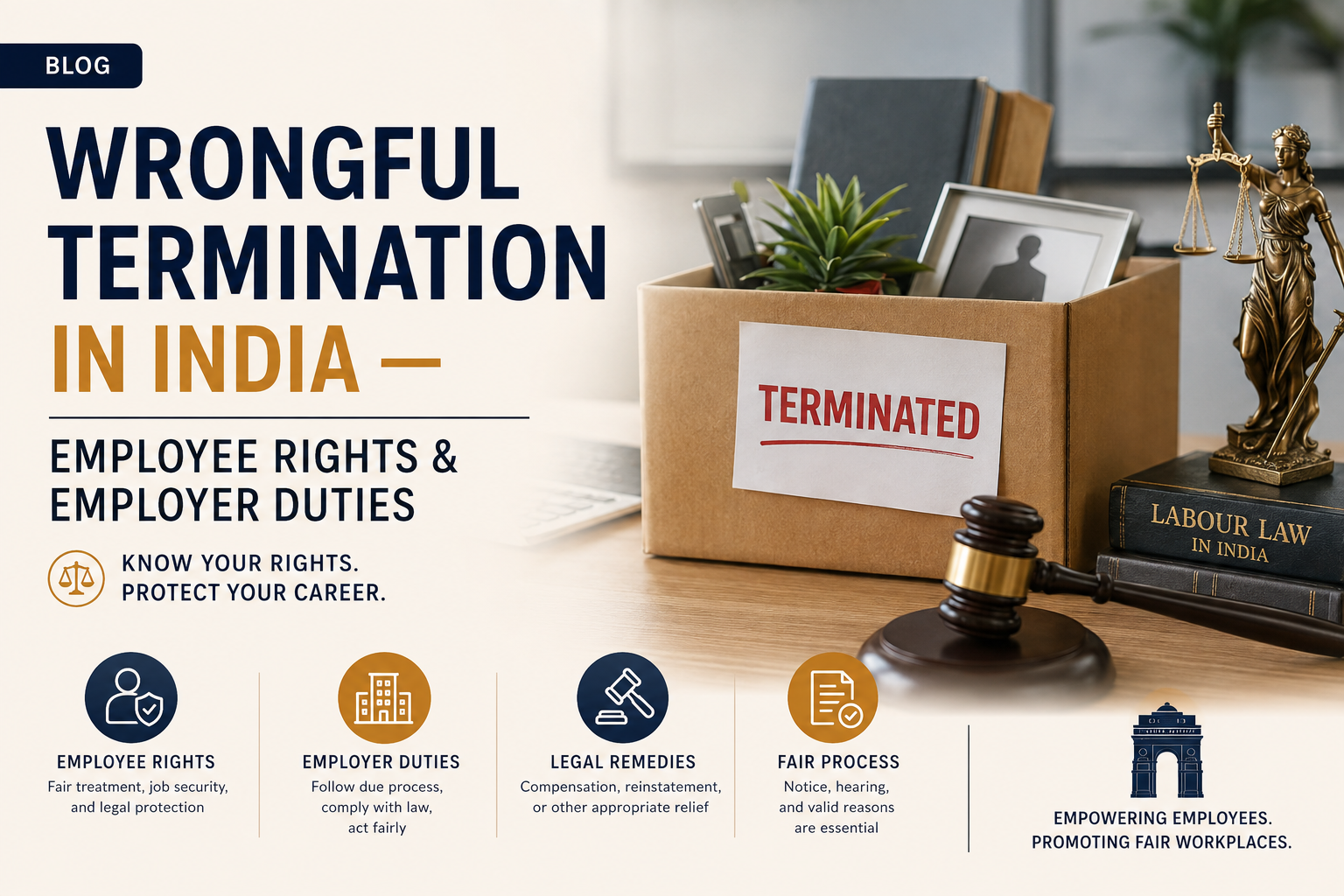
Wrongful Termination in India — Employee Rights & Employer Duties
Expert Labour Law Representation Across Delhi, Noida & Gurgaon
If you’ve been fired without notice, without reason, or in violation of your rights — or if you’re an employer unsure how to terminate staff legally — this guide covers everything you need to know.
At Delhi Advocate Advisor, we represent both sides of wrongful termination disputes. We help employees recover lost wages and reinstatement, and we help employers avoid costly mistakes when ending employment.
Call Now: +91 8130789810 WhatsApp Us
What Is Wrongful Termination? Direct Answer
Wrongful termination is when an employer has terminated your employment illegally or unfairly – either because they have broken your employment agreement, your statutory rights, or your labor law rights.
In India, employment is not at-will. Your employer cannot simply fire you because they feel like it. The law requires:
- Proper notice (unless you’re terminated for proven misconduct)
- Valid reason (unless you’ve committed serious misconduct)
- Following procedure (investigation, natural justice, written order)
- Paying all dues (earned wages, leave, gratuity, notice pay, retrenchment compensation)
If any of these are missing, you may have a wrongful termination case.
Seven Types of Wrongful Termination You Should Know
1. Termination Without Notice or Valid Reason
What it is: You’re fired with no warning and no legitimate ground for dismissal.
Your legal right: If you’ve worked for more than 3 months in Delhi, Noida, or Gurgaon, your employer must give you 1 month’s written notice or pay you 1 month’s salary in place of notice — unless you were terminated for proven misconduct.
Example: You work as a data analyst. After 2 years, your manager calls you into a meeting and says, “We’re letting you go, effective immediately,” with no notice and no reason given. This is wrongful termination.
What you can claim: 1 month’s notice pay, back wages, and compensation for wrongful dismissal.
2. Discrimination-Based Termination (Protected Characteristics)
What it is: You’re fired because of who you are, not because of how you perform.
Indian law prohibits termination based on:
- Gender: Firing a woman because she’s female, or a man because of gender non-conformity.
- Pregnancy & Maternity: The Maternity Benefit Act, 1961, explicitly prohibits termination during pregnancy, maternity leave, or within 3 months after return from maternity leave. This is one of the strongest protections in Indian labor law.
- Disability: Under the Rights of Persons with Disabilities Act, 2016, you cannot be terminated simply because you have a disability. Employers must provide reasonable accommodations instead.
- Transgender Status: The Transgender Persons (Protection of Rights) Act, 2019, prohibits employment discrimination, including wrongful termination.
- HIV/AIDS Status: The HIV/AIDS (Prevention and Control) Act, 1987, and Supreme Court judgments make it clear that HIV status cannot be grounds for termination.
- Caste & Religion: Termination based on caste, religion, or social background is unconstitutional.
Example: A pregnant employee on maternity leave is notified that her position has been “eliminated” while she’s away. This is wrongful termination under the Maternity Benefit Act.
What you can claim: Reinstatement with back wages, compensation for discrimination, and damages for harassment.
3. Retaliation (Revenge Firing)
What it is: Your employer fires you because you raised a complaint or reported wrongdoing.
Common triggers:
- Filing a sexual harassment complaint under the Prevention of Sexual Harassment (POSH) Act
- Reporting wage theft or irregular payments
- Complaining about unsafe working conditions
- Refusing to participate in illegal activities
- Reporting discrimination or breach of contract
- Filing a workers’ compensation claim
Indian law protects you: Section 17 of the POSH Act explicitly prohibits retaliation against employees who file complaints.
Example: You report sexual harassment to HR. Two weeks later, you’re put on a “performance improvement plan” that has no basis in your actual work history, and a month later, you’re fired. This is retaliation.
What you can claim: Reinstatement, back wages, compensation for retaliation, and damages for mental harassment.
4. Victimization for Whistleblowing
What it is: You’re fired for reporting unlawful practices, illegal activities, or unsafe working conditions — also called whistleblowing.
Protected under: The Occupational Safety, Health and Working Conditions Code, 2020, and common law protections for public interest.
Examples:
- Reporting that your company is falsifying safety records
- Disclosing that your employer is underpaying employees below the minimum wage
- Reporting environmental violations or illegal dumping
- Exposing financial fraud or embezzlement
- Complaining about forced overtime without payment
What you can claim: Reinstatement, back wages, compensation for victimization, and damages.
5. Constructive Dismissal (Forced Resignation)
What it is: Your employer makes working conditions so hostile, unfair, or unbearable that you’re forced to resign.
The law recognizes this as wrongful termination — even though you technically resigned, the court may treat it as a dismissal if you can prove the employer deliberately made your position untenable.
Examples:
- You report wage irregularities. Your employer then deliberately assigns you impossible tasks, removes your responsibilities, or excludes you from meetings.
- You refuse to falsify records. Your manager begins public humiliation, assigns you to a desk in a basement, or cuts your salary without notice.
- After reporting safety violations, your employer cuts your overtime, reduces your access, or transfers you to an undesirable location as punishment.
Proof required: Email records, witness statements, or messages showing the deliberate change in working conditions after you raised your complaint.
What you can claim: Back wages, compensation for constructive dismissal, and damages for mental harassment.
6. Breach of Employment Contract
What it is: Your employer terminates you in violation of the terms in your employment agreement.
Common breaches:
- Firing you before the notice period specified in your contract expires
- Terminating you on grounds not mentioned in your appointment letter
- Violating a collective bargaining agreement (if your workplace has a union)
- Ignoring standing orders or company policies on termination procedure
- Terminating you without the severance or notice pay your contract promises
Example: Your employment letter says, “In case of termination, the company will provide 45 days’ notice or pay in lieu.” Your employer fires you with no notice and no payment. This is a breach of contract.
What you can claim: Notice pay, damages for breach of contract, and compensation.
7. Termination Without Following Proper Procedure (Lack of Natural Justice)
What it is: Even if your employer had a valid reason to fire you, the process was unfair or incomplete.
Proper procedure requires:
- Charge sheet: Written notice of the alleged misconduct with specific details
- Opportunity to respond: You get a chance to explain or defend yourself
- Fair investigation: An unbiased inquiry officer hears both sides
- Reasoned decision: A written order explaining why you’re being fired
- Evidence-based findings: The employer must prove the misconduct, not just allege it
Example: Your manager suspects you of stealing office supplies. Instead of issuing a charge sheet and giving you a chance to respond, your manager fires you on the spot and walks you out. Later, the “missing supplies” are found in someone else’s desk. Wrongful termination.
What you can claim: Reinstatement with back wages if the misconduct wasn’t proven; compensation for improper procedure even if the misconduct was proven.
Your Rights Depend on Your Job Classification
If You’re a “Workman”
What this means: Your job is primarily manual, technical, or skilled labour — factory workers, drivers, mechanics, construction workers, support staff, etc.
- Your protections are strongest under the Industrial Disputes Act, 1947.
- If wrongly terminated, you can file a complaint to Labour Commissioner or Industrial Tribunal (usually within 1 year)
- Claim: Reinstatement with back wages, or compensation if reinstatement isn’t possible
- Timeline: Labour cases typically take 1–3 years, but the law heavily favors reinstatement for workmen who prove wrongful termination.
If You’re a “Non-Workman” (Managerial/Supervisory)
What this means: Your job is administrative, managerial, supervisory, or professional — managers, engineers, accountants, executives, etc.
- Your protections are weaker — you must file a civil suit or arbitration in a civil/district court, not labour court.
- If wrongly terminated, you can claim:
- Damages for breach of contract (but usually not reinstatement)
- Lost wages and benefits for the remainder of your contract period
- Compensation for wrongful dismissal
- Damages for mental harassment or discrimination (if applicable)
- Timeline: Civil cases typically take 2–5 years.
- Reality: Non-workmen rarely get their job back — courts usually award monetary compensation instead.
Step-by-Step: What to Do If You’ve Been Wrongly Terminated
Step 1: Collect Everything Immediately
Within 24–48 hours of termination, gather:
- Your termination letter (if provided) — this is crucial evidence
- Full & Final (F&F) statement — shows what dues you’ve been paid
- Relieving letter and experience certificate — proof of employment dates
- Appointment letter — proves the terms of your employment
- Employment contract — shows what your employer promised
- Salary slips from the last 12 months — proof of what you earned
- Leave balance statement — proof of unused leave
- Emails, WhatsApp messages, chat records — anything showing communication with your employer about your job
- Appraisal letters or performance reviews — proof of your work quality
- Any prior warnings or charge sheets — evidence of the process
- Witness contact details — names of colleagues who saw how you were treated
Why this matters: After termination, your employer may delete records or alter documents. Getting copies now protects your case.
Step 2: Determine Your Job Type (Workman vs. Non-Workman)
Ask yourself:
- Is my job mainly manual, technical, or hands-on work? → Workman (labour court)
- Is my job managerial, supervisory, or professional? → Non-workman (civil court)
If unsure, a lawyer can determine this in your first consultation. It drastically changes your remedy and timeline.
Step 3: Calculate What You’re Owed
You may be entitled to:
- Notice Pay: 1 month salary if no notice was given (unless terminated for misconduct) — Immediate
- Earned Wages: Salary for work already done but not yet paid — Immediate
- Leave Encashment: Payment for unused sick leave, casual leave, annual leave — Immediate
- Gratuity: Lump sum if you worked 5+ years (₹4.67 lakhs max, or per contract) — Immediate
- Retrenchment Compensation: If terminated under Section 25F/25N of Industrial Disputes Act (1 month salary × years of service) — Immediate if applicable
- Back Wages: Full salary from termination date until reinstatement (if awarded) — After court judgment
- Compensation for Wrongful Dismissal: Damages for illegal termination — After court judgment
- Damages for Discrimination: Additional compensation if fired based on protected characteristics — After court judgment
Example calculation:
You earned ₹50,000/month
Worked 6 years
Fired without notice, without misconduct
You’re owed: 1 month notice pay (₹50,000) + earned wages + leave encashment + gratuity (~₹2.5L) = minimum ₹3+ lakhs
Step 4: Consult an Employment Lawyer Before Taking Action
This is critical. Do NOT:
- Accept an F&F settlement without legal review
- Sign any “release” or settlement letter your employer sends
- Wait months before seeking help (statutes of limitation exist)
- Post about your termination on social media (can weaken your case)
What a lawyer will do in your first consultation:
- Assess whether your termination was actually wrongful
- Identify which law applies (Labour Act, Civil suit, Discrimination Act, etc.)
- Calculate what you can realistically claim
- Advise you on next steps and likely timeline
- Review any settlement offer your employer has made
Step 5: File Your Complaint to the Right Authority
If you’re a Workman:
- File a complaint at the Labour Commissioner’s office (Delhi, Noida, or Gurgaon, depending on where you worked)
- Or file an application to the Industrial Tribunal
- Timeline: These offices often take 2–4 weeks to register your case
If you’re a Non-Workman:
- File a civil suit in the District Court (Delhi High Court if the claim is very large)
- Timeline: Civil courts take 2–5 years to conclude
If discrimination is involved:
- File a complaint with the National Commission for Women (gender discrimination)
- File with the National Human Rights Commission (if fundamental rights violated)
- These can run parallel to your main case
Step 6: Prepare Your Evidence
Strongest evidence includes:
- Written proof: Termination letter, emails, messages, appointment letter, contract
- Financial proof: Salary slips, bank statements, tax returns, gratuity documents
- Procedural proof: Absence of charge sheet, no opportunity for natural justice, no investigation
- Witness statements: Colleagues who saw how you were treated, signed and dated
- Medical proof: If harassment caused mental/physical harm, doctor’s report
- Comparator evidence: If discriminated against, show how similarly-situated employees were treated differently
Step 7: Negotiate or Go to Court
Many cases settle before trial:
- Labour Commissioner may push for settlement in your first hearing
- Your employer may offer compensation to avoid prolonged litigation
- A good lawyer can negotiate a settlement 30–40% higher than what the employer offers initially
If settlement fails:
- Your case goes to trial
- Evidence phase: You and witnesses testify; employer’s side testifies
- Arguments phase: Lawyers argue why you won or lost
- Judgment: Judge decides and awards damages or reinstatement
If You’re an Employer — How to Terminate Legally
Getting termination right saves you from lawsuits, appeals, and years of paying back wages.
Pre-Termination Checklist
☐ Classify the employee correctly
Is this person a “workman” (manual/technical) or “non-workman” (managerial)?
This determines the entire process and what you owe.
☐ Is this a valid grounds for termination?
- Misconduct: Theft, repeated violation of rules, insubordination, chronic absenteeism
- Retrenchment: Business closure or layoff (requires strict compliance with Section 25F/25N)
- Retirement: Reached mandatory retirement age
- Incapacity: Long-term illness making the employee unable to work
- Redundancy: Position eliminated due to technological change (rare, requires compliance)
Avoid terminating without grounds — it’s almost always wrongful termination.
☐ Follow the proper procedure
For misconduct termination:
Issue a Charge Sheet
- In writing
- Specific allegations (dates, times, what happened)
- Reference to which rule/policy was violated
- Give employee 5–7 days to respond
Conduct an Enquiry
- Appoint an impartial inquiry officer (not the person who filed the complaint)
- Allow employee to present their side
- Allow employee to call witnesses
- Take written statement from both sides
- Document everything
Issue a Decision
- In writing
- Based only on evidence presented in the inquiry
- State reasons clearly
- If terminating: Issue termination order with effective date
- If not terminating: Drop the charges formally
Provide Notice or Notice Pay
- Unless you’ve proven severe misconduct, provide 1 month notice or 1 month’s salary in lieu
- Hand-deliver the termination order; don’t email or phone
Settle All Dues
- Earned wages up to termination date
- Leave encashment (calculate per your company policy and applicable state law)
- Gratuity (if employee worked 5+ years)
- Retrenchment compensation (if applicable under Section 25F/25N)
- Any bonuses or incentives earned
- Provide a final Full & Final statement signed by both parties
Issue Relieving & Experience Letters
- Relieving letter: Confirms employment dates and that all dues are settled
- Experience letter: Confirms job title, dates, and (optionally) performance
Common Mistakes Employers Make (Avoid These)
- ❌ Mistake 1: Firing without a charge sheet or investigation — Consequence: Wrongful termination lawsuit; employee likely wins and gets reinstated with back wages.
- ❌ Mistake 2: Unfair inquiry (biased inquiry officer, no opportunity to respond) — Consequence: Procedure is invalid; court may overturn the termination.
- ❌ Mistake 3: Terminating a pregnant employee — Consequence: Violates Maternity Benefit Act; employer faces significant penalties and reinstatement order.
- ❌ Mistake 4: Retaliating against an employee who filed a complaint — Consequence: Retaliation claims; punitive damages; possible criminal referral.
- ❌ Mistake 5: Not paying notice pay or full & final dues — Consequence: Wage theft claim; legal action by labour department; employee can recover dues + damages.
- ❌ Mistake 6: Terminating without documenting the grounds — Consequence: No proof of misconduct; burden falls on employer to prove in court (very difficult).
- ❌ Mistake 7: Verbal termination only (“You’re fired, clean out your desk”) — Consequence: No evidence of what grounds were used; employee disputes the termination entirely.
Retrenchment Under Section 25F/25N (Mass Layoffs)
If you need to eliminate multiple positions or close part of your business:
- 1 month notice (or pay in lieu) to each affected employee
- Consultation with workers or unions (if applicable)
- Compensation: 15 days’ wages × years of service (minimum)
- Priority for re-engagement: If positions open again within 6 months, retrenched employees have priority
- Notification to labour department (required in some states)
Skip any of these steps, and it’s wrongful termination.
POSH Compliance and Whistleblower Protection
Prevention of Sexual Harassment (POSH):
- Must have a formal complaint mechanism
- Cannot retaliate against complainants
- Must investigate complaints within specified timelines
- Ensure no termination of anyone who filed a POSH complaint (strong retaliation protection)
Whistleblower Protection:
- Employees reporting illegal or unsafe practices are protected
- Cannot terminate for reporting to authorities or internally
- Document any protected disclosure to defend against retaliation claims
Why Delhi Advocate Advisor — Employment & Termination Law
For Employees — Our Approach
- ✓ Free initial consultation — We assess your wrongful termination case at no cost
- ✓ Clear fee structure — No surprise charges; we explain costs upfront
- ✓ Evidence-focused strategy — We organize your documents and build a strong case
- ✓ Labour court & civil court experience — We handle both workman and non-workman cases
- ✓ Settlement-first approach — We try to negotiate a fair settlement before trial
- ✓ Full representation — We appear for you at every hearing in Delhi, Noida, or Gurgaon courts
- ✓ Realistic timelines — We tell you upfront: 1–3 years for labour cases, 2–5 years for civil suits
For Employers — Our Approach
- ✓ Preventive guidance — We help you terminate staff legally and fairly the first time
- ✓ Termination procedure design — We draft charge sheets, conduct inquiries, and issue proper orders
- ✓ Compliance review — We audit your POSH, whistleblower, and termination policies
- ✓ Dispute management — If an employee sues, we defend your termination in labour or civil court
- ✓ Full documentation — We ensure every step is documented to protect you in court
How We Help — Step by Step
Phase 1: Assessment (Week 1)
- Understand what happened and review all documents
- Determine if termination was actually wrongful
- Identify applicable laws and relevant authorities
- Calculate potential claims and realistic outcomes
Phase 2: Strategy (Week 2–3)
- Advise on settlement vs. litigation
- Organize evidence and prepare witness statements
- Draft demand letter (if pursuing settlement)
- Prepare filing documents if litigation is necessary
Phase 3: Action (Week 4+)
- File complaint with labour commissioner, industrial tribunal, or civil court
- Represent you at every hearing and evidence phase
- Negotiate settlements when possible
- Argue your case before the judge
Phase 4: Resolution
- Obtain judgment or settlement order
- Enforce the award (recover money, reinstatement, etc.)
- Handle appeals if necessary
Fee Structure for Employment Disputes
Fees depend on:
- Whether you’re a workman or non-workman
- Complexity of the case (evidence, discrimination angle, etc.)
- Duration (1–3 years for labour, 2–5 years for civil)
- Your claim amount
Typical ranges:
- Labour tribunal (wrongful termination): ₹30,000–₹1,50,000 — Workman cases; shorter duration
- Civil suit (breach of contract): ₹75,000–₹3,00,000+ — Non-workman; longer timeline
- Discrimination case: ₹50,000–₹2,00,000 — If POSH, gender, caste, disability angle
- Settlement negotiation: ₹20,000–₹60,000 — If resolved before filing
We provide a fixed fee estimate after your first consultation — no surprises mid-case.
Jurisdiction: Where to File in Delhi NCR
- Delhi (workman case): Labour Commissioner, Delhi — Delhi Labour Department
- Delhi (non-workman case): District Court, Delhi — Civil court jurisdiction
- Noida (workman case): Labour Commissioner, UP (Noida) — Uttar Pradesh Labour Department
- Noida (non-workman case): Civil Court, Noida — Noida District Court
- Gurgaon (workman case): Labour Commissioner, Haryana — Haryana Labour Department
- Gurgaon (non-workman case): Civil Court, Gurgaon — Gurgaon District Court
Filing in the wrong authority can delay your case by months. We determine the correct jurisdiction in your first consultation.
FAQ: Wrongful Termination Questions Answered
Q: My employer fired me with no notice and no reason. Can I get my job back?
A: Yes, if you are working in a manual/technical position, the labor tribunal may have you reinstated along with back wages. Non-workman (managerial) reinstatement is very unlikely; courts will typically award damages. In either case, you might have a point if no notice or reason was provided.
Q: How long does a wrongful termination case take?
A: Labour cases (workman): 1-3 years. Civil cases (non-workman): 2-5 years. If negotiations are conducted by both sides, many of the cases settle in 6-12 months.
Q: What if my employer says I resigned, but I was actually forced to resign?
A: This is “constructive dismissal.” The court might consider it a wrongful termination if you can establish that your employer’s actions made it impossible to work there. Emails, hostile environment witness statements, and records of the hostile environment are essential proof.
Q: I was fired for reporting safety violations. Is that wrongful?
A: Yes, absolutely. Whistleblower retaliation is a legal wrongful termination claim and is among the strongest. There are robust protections in the Occupational Safety Code, and there are common law protections.
Q: My employer didn’t pay my notice pay or leave encashment. Can I recover it?
A: Yes. The unpaid wages claim is a different claim that can be made with the labor commissioner under the Payment of Wages Act, Section 4-D. Wages + penalties + interest are recoverable. This is a quicker procedure than a complete wrongful termination claim.
Q: Is my pregnancy a reason they can fire me?
A: Absolutely not. The Maternity Benefit Act is one of the best labour laws in India. It is illegal to terminate your employment during a pregnancy and/or maternity leave, and you are entitled to be reinstated straight away with compensation. If this should happen to you, please reach out to us immediately.
Q: My employer wants me to sign a settlement. Should I?
A: No, not without legal review. Most settlement deals are not as high as what you can obtain in court. Show it to us first — often we can get 30-40% more for the injured party after the employer looks at our evaluation.
Q: How much can I realistically claim?
A: This will depend on the amount of salary, years of service, and nature of the wrongful termination. An employee on a salary of ₹50,000/month, with 5 years of service, could claim a gratuity of ₹3-5+ lakhs (notice pay + leave + gratuity + back wages/compensation). Your specific claim is calculated in the first consultation.
Q: Do I need a lawyer, or can I file alone?
A: You can file the claim without an attorney, but wrongful termination cases are complex. The filing, procedure, and evidence mistakes can cost you the case or decrease your award. A lawyer will save you time and can typically earn you much extra cash. When you are dealing with the vast majority of clients, they will recover the costs of their lawyer in the first settlement offer.
Get Expert Help Today
Don’t accept wrongful termination without a fight. We help you with every step – from the employee’s perspective seeking reinstatement and back wages to the employer’s side wanting to terminate fairly.
Contact Delhi Advocate Advisor
📞 Call Now: +91 8130789810
💬 WhatsApp Us
Email: advocatesourabhsingh@gmail.com
Website: www.delhilegalexpert.com
Our Offices
Delhi/Janakpuri:
Office No. 428, West End Mall, Janakpuri West, New Delhi – 110058
Serving: Delhi • Noida • Gurgaon • Faridabad • Greater Noida • All Delhi NCR
Why Choose Delhi Advocate Advisor for Employment Law
- ✓ 14+ years handling employment disputes — Since 2010
- ✓ 500+ wrongful termination & labour cases resolved — Both sides
- ✓ Local experience in Delhi, Noida & Gurgaon courts — Know the judges, procedures, pace
- ✓ Free first consultation — Assess your case with no obligation
- ✓ Upfront, transparent pricing — No hidden charges
- ✓ Settlement-focused approach — Get you the best deal without unnecessary delay
- ✓ Full court representation — We appear at every hearing
- ✓ Same-day urgent filings — If you need interim relief or urgent protection
Advocate Arun Varma and Advocate Saurabh Singh personally handle employment cases — your matter isn’t handed off to a junior.
Next Steps
- Call us for a free consultation
Bring your termination letter, appointment letter, and salary slips. - We assess your case
Within 24 hours, we’ll tell you if you have a winning case and what you can realistically claim. - We create a strategy
Settlement, litigation, or hybrid approach — we decide based on your specific situation. - We represent you
From filing to final judgment, we handle everything.
Call Now: +91 8130789810 | WhatsApp: Click Here
This guide is educational and does not constitute legal advice. Every employment case is unique. Consult a qualified employment lawyer for advice specific to your situation.
Delhi Advocate Advisor does not solicit clients through this guide. Its purpose is to provide general information about wrongful termination and employment rights in India.