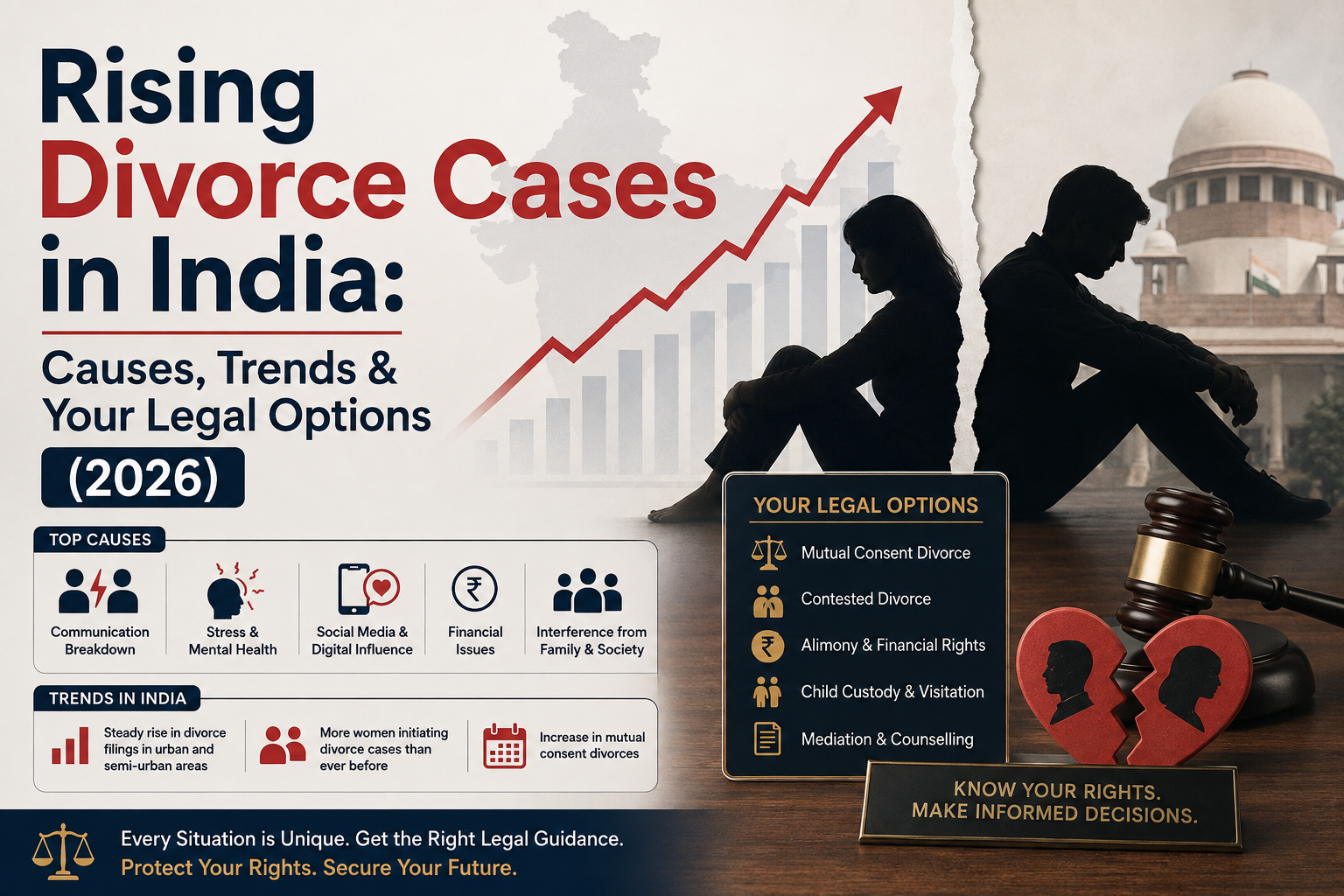
Rising Divorce Cases in India: Causes, Trends & Your Legal Options (2026)
By Delhi Advocate Advisor | Divorce & Family Law Specialists Published: August 2026 | Last Updated: August 2026
Divorce cases in India are rising, with urban areas seeing a 30–40% increase in divorce rates across metros such as Delhi, Mumbai, and Bengaluru over the past decade. Several factors are driving this change, including women’s growing financial independence, changing social attitudes, career pressures, and greater awareness of legal rights. India’s divorce rate remains low by global standards, but family courts in major cities receive more divorce filings than they did a decade ago.
When a marriage reaches a difficult point, knowing why divorce cases are rising in India and understanding your legal options can help you choose the right path. At Delhi Advocate Advisor, we handle different forms of divorce in India, including mutual consent and contested divorce, and provide clients with a clear legal approach and strong representation before the court.
📞 Call for a free consultation: +91 8130789810 WhatsApp Us
Why Are Divorce Cases Rising in India?
Several social and economic changes are driving the rise in divorce cases in India. These include women’s financial independence, changing gender roles, urbanisation, greater legal awareness, and a stronger focus on personal happiness. Metropolitan cities show this shift most clearly, with divorce filings recording a marked increase over the past decade.
The most significant drivers include:
- Financial independence of women — With more women in the workforce, many are no longer economically dependent on an unhappy marriage. Reports indicate women now initiate the majority of divorce proceedings in urban India.
- Changing gender roles — As women build careers and men take on more household responsibilities, couples sometimes struggle to navigate the new dynamics.
- Urbanisation and mobility — Young adults relocating for work encounter new expectations and pressures that test marriages.
- Greater legal awareness — More people know their legal rights and available remedies, making them willing to seek divorce rather than endure a broken marriage.
- Shifting social attitudes — Younger generations increasingly value personal happiness and autonomy, reducing the stigma once attached to divorce.
- Career and lifestyle stress — Long working hours, relocation, and long-distance arrangements create emotional distance.
What Do the Divorce Trends in India Show?
India’s divorce rate remains among the world’s lowest at about 1%, while urban divorce filings have risen by 30–40% over the past decade. The contrast between the low national rate and the rise in urban filings reflects the continued influence of cultural stigma alongside major social changes in Indian cities.
Key divorce trends in India:
- Urban surge — Metros like Delhi, Mumbai & Bengaluru saw a 30–40% rise in the past decade
- Who files — Women reportedly initiate the majority of urban divorces
- When marriages end — Most urban divorces happen within the first 5–10 years
- Regional gaps — Higher in metros and the Northeast; lower in patriarchal northern states
- Court capacity — Over 930+ family courts now functional across India
Note: National figures likely understate reality, since cultural stigma and informal separations keep many cases out of the courts, especially in rural areas.
What Are the Most Common Causes of Divorce in India Today?
Incompatibility, financial conflicts, infidelity, cruelty, interference from extended family, and lifestyle differences are among the leading causes of divorce in India. Modern life has introduced new sources of pressure that can place greater strain on a marriage.
Frequent grounds and causes include:
- Incompatibility and communication breakdown — differing values, goals, or expectations.
- Financial disputes — money conflicts, debt, or differing spending habits.
- Infidelity and adultery — a recognized ground for divorce.
- Cruelty — physical or mental cruelty (a common legal ground).
- Interference from in-laws or family — a frequent source of marital tension.
- Career and relocation stress — long-distance marriages and work pressure.
- Domestic violence or dowry harassment — serious grounds with strong legal remedies.
What Are Your Legal Options for Divorce in India?
Indian law provides three main options when a marriage breaks down: mutual consent divorce, contested divorce, and judicial separation. The choice depends on whether both spouses agree to end the marriage and on the circumstances of the relationship.
1. Mutual Consent Divorce:
Best when both spouses agree to end the marriage and settle terms on maintenance, custody, and property. It is the fastest and least expensive route, typically taking 6 to 18 months (or 3–6 months if the court waives the cooling-off period).
2. Contested Divorce:
Necessary when one spouse contests the divorce or when you must prove specific grounds like cruelty, adultery, or desertion. Contested cases take longer — usually 2 to 5 years — and require strong evidence and skilled representation.
3. Judicial Separation:
Allows spouses to live apart and resolve disputes without immediately dissolving the marriage. It can later be converted into a full divorce.
Divorce in India is filed under various personal laws, including the Hindu Marriage Act, 1955, the Special Marriage Act, 1954, the Indian Divorce Act, 1869, and Muslim personal law.
How Long Does a Divorce Take in India?
A mutual consent divorce in India can take 6 to 18 months, while a contested divorce may take 2 to 5 years. The timeline depends on the type of divorce, court backlog, and the complexity of disputes involving custody, maintenance, and property.
- Mutual consent divorce: 6–18 months (3–6 months with a cooling-off waiver).
- Contested divorce: 2–5 years, depending on evidence and disputes.
- Cooling-off period: A 6-month waiting period applies to mutual consent, though the Supreme Court has allowed courts to waive it where the marriage is irretrievably broken.
How Does Mediation Help in Rising Divorce Cases?
Mediation can help couples resolve disputes with less conflict and greater privacy than a contested court battle. Indian family courts encourage mediation and counselling before they finalise a divorce, giving these options greater emphasis when children are involved.
Benefits of mediation in divorce:
- Faster resolution than prolonged litigation.
- Lower cost and reduced emotional stress.
- Better co-parenting outcomes — arrangements like joint custody or structured visitation.
- Privacy — matters stay out of open court.
- Control — spouses shape their own settlement rather than a judge imposing one.
What Should You Do If You’re Considering Divorce?
If you’re considering divorce, begin by learning about your legal options, getting your finances and documents in order, and speaking with an experienced divorce lawyer. Good preparation can protect your rights and make the process easier to manage.
Practical first steps:
- Understand your options — mutual consent, contested, or judicial separation.
- Organize documents — financial records, property papers, and your marriage certificate.
- Plan your finances — open a separate account and budget for legal and living costs.
- Prepare for custody — if children are involved, document your caregiving role.
- Consult a divorce lawyer — get a realistic picture of timeline, cost, and outcome.
Why Choose Delhi Advocate Advisor for Your Divorce
At Delhi Advocate Advisor, our experienced divorce and family law lawyers in Delhi NCR handle mutual consent and contested divorce matters, along with child custody, maintenance, and alimony cases. We follow a mediation-first approach to help reduce conflict and legal costs. Clients can begin with a free first consultation at no cost and receive transparent fees with the charges explained upfront. Our services extend to NRI divorce support with Power of Attorney representation.
Frequently Asked Questions About Rising Divorce Cases in India
Why are divorce rates rising in India?
Rising divorce rates in India reflect several changes in society and family life, including the growing financial independence of women, changing gender roles, urbanisation, greater legal awareness, and shifting social attitudes toward personal happiness. Metropolitan cities such as Delhi, Mumbai, and Bengaluru show these changes through rising divorce rates.
What is the divorce rate in India?
India’s overall divorce rate stands at about 1%, among the lowest in the world, while urban divorce filings have risen 30–40% over the past decade. National figures may not capture the full picture because cultural stigma and informal separations keep many marital breakdowns outside the courts.
What are the most common reasons for divorce in India?
Incompatibility, financial conflicts, infidelity, cruelty, interference from extended family, and career or relocation stress rank among the common reasons for divorce in India. Under divorce law, cruelty and adultery remain among the grounds that spouses cite in their cases.
What are the legal options for divorce in India?
Indian law provides three main options: mutual consent divorce, contested divorce, and judicial separation. Mutual consent divorce works when both spouses agree to end the marriage. A contested divorce applies when the spouses disagree, or one spouse must establish a legal ground such as cruelty or adultery.
How long does a divorce take in India?
A mutual consent divorce can take 6 to 18 months, while a contested divorce can take 2 to 5 years. Court backlog and disputes over custody, maintenance, and property can affect the time needed to complete the case.
Who initiates most divorces in India?
Women initiate most divorce proceedings in urban India, according to reported data. Their growing financial independence, higher education levels, and greater awareness of legal rights have contributed to this trend.
Does mediation help in divorce cases?
Yes. Mediation gives couples a way to resolve disputes with greater privacy and less conflict than contested litigation. Indian family courts encourage mediation and counselling, with particular focus on cases involving children.
Speak to a Divorce Lawyer in Delhi Today
Rising divorce cases reflect changes in society, but no two marriages or divorce cases are the same. Whether you are seeking a mutual consent divorce or facing a contested one, Delhi Advocate Advisor helps you understand your options and protect your rights through practical, confidential legal guidance.
📞 Call now for a free consultation: +91 8130789810 💬 WhatsApp us: +91 8130789810
Disclaimer: This article is for informational purposes only and does not constitute legal advice. Statistics cited are drawn from publicly available reports and studies and may vary by source. Every divorce case is unique. Consult a qualified family law lawyer for guidance specific to your situation. In accordance with Bar Council of India rules, this content is not an advertisement or solicitation of work.
Saptak Chattopadhyay
Kolkata, West Bengal
18.08.2026