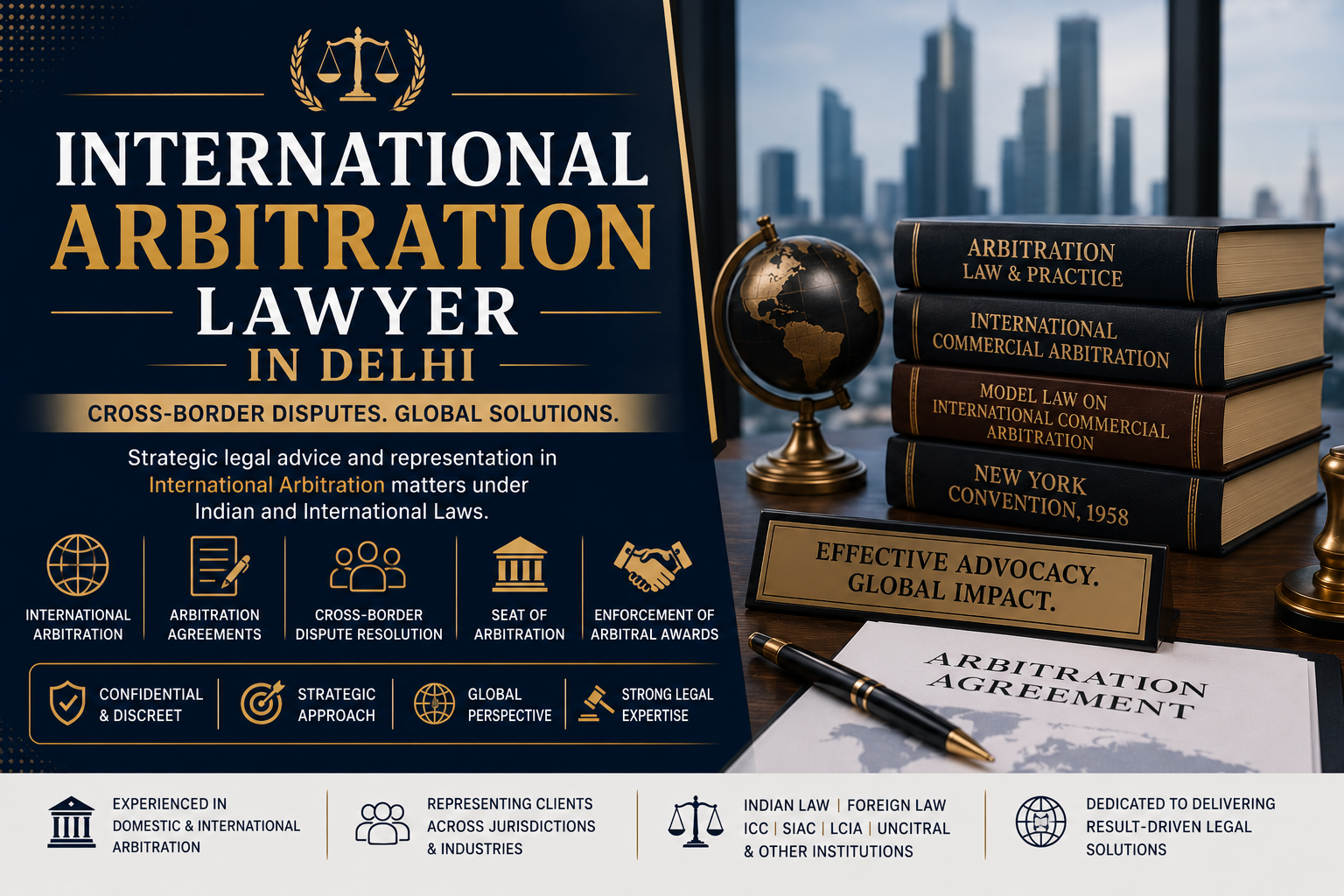
International Arbitration Lawyer in Delhi
International Arbitration Lawyer in Delhi | Cross-Border Dispute Resolution
Delhi Advocate Advisor Representing Indian Businesses in SIAC, ICC, LCIA & Award Enforcement Since 2010.
Call Now: +91 8130789810 WhatsApp Us
International Arbitration Lawyer in Delhi — A Faster Path Through Cross-Border Disputes
When a dispute arises with a foreign business partner — a broken contract with a supplier abroad, a payment default from an overseas buyer, a quality dispute with a manufacturing partner in another country — court litigation is rarely the right answer. It’s slow, the jurisdiction is often unclear, and enforcing a foreign court’s judgment can turn into a second legal battle entirely.
As your international arbitration lawyer in Delhi, we represent Indian businesses in cross-border disputes resolved through arbitration instead — a process that’s typically faster, more confidential, and far easier to enforce across borders than a national court judgment.
Why Arbitration Is the Better Path for International Disputes
International contract disputes come with a specific problem: whose courts even have jurisdiction? A contract with a German supplier, a Chinese manufacturer, or a UAE-based partner can leave both sides disputing which country’s courts apply — and even a win in your home court often means starting over in the other party’s country just to enforce it.
Arbitration avoids this entirely:
- Both parties agree in advance on a neutral seat — not either party’s home country
- A neutral, expert arbitrator is chosen by the parties themselves, rather than a judge assigned by a national court
- Proceedings remain confidential, unlike public court records
- The resulting award is final and binding, with essentially no appeal process
- Under the New York Convention, the award is enforceable in over 170 countries — including India, which is a signatory
For a cross-border dispute, this generally means resolution in 12 to 24 months, compared to 3 to 7 years or more through national court litigation.
Arbitration vs. Court Litigation
| Factor | Court Litigation | International Arbitration |
|---|---|---|
| Jurisdiction | Often unclear or disputed | Agreed in advance by both parties |
| Seat | A party’s home country (potential bias) | Neutral location, mutually agreed |
| Duration | 3–7+ years | 12–24 months |
| Cost structure | Lower hourly rates, but years of proceedings | Higher hourly rates, faster overall resolution |
| Confidentiality | Public record | Private and confidential |
| Decision-maker | Court-assigned judge | Expert arbitrator chosen by the parties |
| Applicable law | The court’s own national law | Law agreed upon by the parties |
| Appeal | Available, often for years | Generally none — award is final |
| Enforcement | Requires separate litigation abroad | Enforceable in 170+ countries under the New York Convention |
Institutional vs. Ad Hoc Arbitration
Institutional Arbitration (SIAC, ICC, LCIA, HKIAC, MCIA): Administered by an established arbitration institution that provides procedural rules, appoints arbitrators where parties can’t agree, and manages the proceedings professionally — reducing disputes over process itself. Awards also carry the institution’s credibility.
Ad Hoc Arbitration: Parties design their own rules and procedure without an institutional framework. This generally costs less, since there are no institutional administration fees, and offers more flexibility — well suited to smaller disputes or parties with an existing working relationship.
Common arbitral seats include Singapore (SIAC), Paris (ICC), London (LCIA), Hong Kong (HKIAC), and Mumbai (MCIA).
Our International Arbitration Lawyer in Delhi
Arbitration Clause Drafting
A well-drafted arbitration clause prevents disputes about arbitration itself — vague wording leads to fights over whether a dispute is even arbitrable, where it should be seated, and which rules apply, defeating the entire purpose. Our drafting covers the seat, applicable rules, number of arbitrators, language, and appointment procedure clearly upfront.
Section 9 Applications — Interim Relief
Arbitration takes months to conclude, and if the other party is moving assets, destroying evidence, or continuing harmful conduct in the meantime, urgent court intervention may be necessary — including asset attachment, injunctions, or orders for document disclosure.
Section 11 Applications — Arbitrator Appointment
Where parties can’t agree on an arbitrator, either side can apply to the court under Section 11 of the Arbitration Act to have an arbitrator appointed, so the process isn’t held up indefinitely by a deadlock.
Full Arbitration Representation
From drafting statements of claim and defense through witness preparation, cross-examination, oral argument, and final written submissions — complete representation through to the award.
Foreign Award Enforcement
Once an award is issued abroad — in Singapore, London, Paris, or elsewhere — it still needs to be enforced in India if the other party doesn’t comply voluntarily. Under the New York Convention, Indian courts are generally required to enforce such awards unless narrow grounds for refusal (like fraud or corruption) apply.
Cross-Border Dispute Strategy
For disputes involving multiple jurisdictions, we advise on award enforcement across countries, coordination of multi-country contracts, interim relief sought in more than one jurisdiction, and cross-border asset tracing.
How the Arbitration Process Works
- Dispute Arises: A contract dispute emerges with your international partner, and the underlying contract’s arbitration clause specifies the seat and applicable rules.
- Notice of Arbitration: A formal notice is sent to the other party, initiating the process — similar to filing a lawsuit.
- Respondent’s Reply: The other party typically has 30 days to respond with their defense.
- Arbitrator Selection: Each party may appoint one arbitrator, who then jointly select a presiding arbitrator, or the parties agree on a sole arbitrator. If there’s no agreement, the relevant institution appoints one.
- Terms of Reference: The arbitrator(s) formally document the dispute, applicable law, seat, and procedure.
- Pleadings: The claimant files a Statement of Claim, the respondent files a Statement of Defense, and both sides exchange documents and witness lists.
- Evidence and Hearing: A hearing is held for both sides to present witnesses, documents, and oral arguments — generally more focused and shorter than a court trial.
- Closing Arguments: Final written submissions are filed summarizing each side’s case.
- Arbitral Award: The arbitrator issues a final, binding decision on liability and damages.
- Enforcement: If the losing party doesn’t comply, the award is enforced in the relevant country under the New York Convention.
Typical timeline: 12–24 months from notice to award, compared to 3–7+ years for equivalent court litigation.
Why Businesses Choose Us for International Arbitration
- Deep Commercial Litigation Experience: Advocate Arun Varma has represented clients in SIAC, ICC, LCIA, and HKIAC proceedings, bringing genuine familiarity with how international arbitrators approach contract disputes.
- India’s Pro-Arbitration Courts: Indian courts have generally taken a strong, supportive stance toward enforcing foreign awards under the New York Convention — we know how to work with Delhi’s arbitration-friendly judicial approach.
- Institutional Familiarity: Handling proceedings across multiple institutions means understanding each one’s specific rules and timelines, which saves both time and cost during the process.
- Efficient, Focused Representation: Arbitration’s per-hour costs run higher than court litigation, so we focus on tight, well-prepared pleadings and arguments rather than drawn-out proceedings that inflate costs unnecessarily.
- Multilingual Coordination: International arbitration often involves parties from multiple countries — we work in English and Hindi, and coordinate with local counsel elsewhere where needed.
- Section 9 & 11 Track Record: Experience securing interim relief and arbitrator appointments through Indian courts to support arbitration proceedings while they’re ongoing.
Frequently Asked Questions
What’s the real difference between arbitration and litigation?
Arbitration is a private process where a neutral arbitrator chosen by both parties decides the dispute, with a final, binding award — while litigation goes through public national courts with the possibility of years of appeals.
How is an award enforced if the other party refuses to comply?
Under the New York Convention, the award can be enforced in courts across more than 170 signatory countries, including wherever the losing party’s assets are located.
Why does the “seat” of arbitration matter so much?
The seat determines which country’s arbitration law governs the proceedings and which courts have supervisory jurisdiction — it’s a foundational choice that shapes how the entire process unfolds.
Can an arbitration award be appealed?
Generally, no — arbitral awards are final and binding, with only very narrow grounds (like fraud or a serious procedural violation) available to challenge them.
How long does international arbitration typically take?
Usually 12 to 24 months from the notice of arbitration to the final award, substantially faster than equivalent court litigation.
Are all disputes eligible for arbitration?
Most commercial disputes are arbitrable, but certain matters — such as some criminal issues or specific statutory matters — generally aren’t. This is assessed case by case.
What if the other party ignores our arbitration clause and sues in court instead?
Courts in India and most arbitration-friendly jurisdictions will typically refer the matter back to arbitration where a valid arbitration clause exists, rather than proceeding with the litigation.
Can a dispute be settled mid-arbitration?
Yes — settlement remains possible at any stage, and where reached, the arbitrator can often record it as a consent award.
Facing a Cross-Border Business Dispute? Talk to Us
Whether you’re dealing with a breached contract from an overseas supplier, need to enforce a foreign arbitration award in India, or want a properly drafted arbitration clause before signing your next international contract, a consultation will clarify your options and the fastest realistic path to resolution.
10+ years of commercial litigation experience. SIAC, ICC, LCIA, and HKIAC proceedings. Pro-arbitration familiarity with Delhi’s courts.
Call Us +91 8130789810 +91 7678506717 +91 9999030021
Email Us advocatesourabhsingh@gmail.com arunverma2014@gmail.com
Office Address Office No. 428, West End Mall, Janakpuri West, New Delhi – 110058
Hours Monday–Saturday, 10am–10pm | Sunday, 10am–5pm
📞 Call Now | 💬 WhatsApp Us | 📅 Book Consultation
This page is for general informational purposes only and does not constitute legal advice. Arbitration outcomes depend on the specific contract terms, applicable rules, and facts of each dispute. Please consult Delhi Advocate Advisor directly for advice specific to your situation. Last reviewed: June 2026.
Saptak Chattopadhyay
Kolkata, West Bengal
23.07.2026