Wife Maintenance Rights After Divorce in Delhi
Quick Answer
A divorced wife may be entitled to maintenance or permanent alimony in Delhi depending on the law applicable to the marriage, her financial circumstances, the former husband’s financial position, existing settlements or maintenance orders, and other facts considered by the court. There is no universal fixed percentage of salary that automatically becomes payable in every divorce.
Under the Hindu Marriage Act, 1955, Section 25 permits a court exercising jurisdiction under the Act to order permanent alimony and maintenance at the time of the decree or subsequently. Section 144 of the Bharatiya Nagarik Suraksha Sanhita, 2023 (BNSS) also provides a statutory maintenance mechanism and, for that provision, includes a woman who has been divorced by or has obtained divorce from her husband and has not remarried.
Divorce may legally end a marriage, but it does not necessarily resolve every financial issue between former spouses. Questions about wife maintenance after divorce in Delhi can continue after the divorce decree, particularly where one spouse lacks sufficient financial resources or where maintenance and alimony were not finally resolved.
You may be wondering:
- Can I claim maintenance after my divorce?
- Does an earning wife qualify for maintenance?
- How much maintenance can a divorced wife receive?
- What happens if my former husband stops paying?
- Does remarriage affect maintenance?
- Can an existing maintenance amount be changed?
The answer depends on the facts of your marriage, applicable personal law, financial circumstances and any existing court order or settlement.
Delhi Legal Expert assists clients in Delhi with divorce, maintenance, alimony and related matrimonial proceedings. This guide explains the legal framework in straightforward language so that you can better understand the options that may be available in your situation.
About Delhi Legal Expert
Delhi Legal Expert provides professional legal assistance in Delhi for individuals dealing with divorce, maintenance, alimony and other matrimonial disputes.
Our advocates help clients understand their legal rights, review financial circumstances, prepare necessary applications and supporting documents, respond to maintenance claims, participate in settlement discussions and represent clients before the appropriate courts.
The objective is not simply to file a case. Proper legal advice should help you understand which law applies, what evidence matters, what relief can reasonably be requested, and what procedural steps come next.
What Is Wife Maintenance After Divorce?
Maintenance is financial support that may be ordered or agreed upon to help a spouse meet reasonable living expenses.
Depending on the applicable law and circumstances, maintenance can arise:
- While matrimonial proceedings are pending;
- At the time divorce is granted;
- After the divorce decree;
- Through a matrimonial settlement; or
- Through another statutory maintenance remedy.
You may also hear the words maintenance and alimony used together. Although people commonly use these terms interchangeably, the legal basis and nature of a particular payment can differ.
A payment may be monthly or periodic, while in appropriate cases permanent alimony may also be structured as a lump sum.
Which Laws Govern Wife Maintenance After Divorce in Delhi?
There is no single maintenance provision governing every matrimonial situation. The correct legal route depends on the parties, their marriage, applicable personal law and existing proceedings.
Section 25 of the Hindu Marriage Act, 1955
For marriages governed by the Hindu Marriage Act, Section 25 deals with permanent alimony and maintenance.
The provision permits the court, at the time of passing a decree or subsequently, to order the respondent to pay the applicant a gross sum or monthly/periodical amount, after considering relevant circumstances. Section 24 separately addresses maintenance and litigation expenses while proceedings under the Act are pending.
Importantly, Section 24 is not exclusively a wife’s remedy: its wording applies to either wife or husband who lacks sufficient independent income for support and necessary litigation expenses.
Section 144 of the BNSS
Older articles frequently refer to Section 125 of the Code of Criminal Procedure (CrPC). Since India’s new criminal procedural framework came into force, the corresponding maintenance provision is found in Section 144 of the Bharatiya Nagarik Suraksha Sanhita, 2023.
For Section 144, “wife” includes a woman who has been divorced by, or has obtained divorce from, her husband and has not remarried. The BNSS also contains provisions dealing with alteration and enforcement of maintenance orders.
This distinction is important when reading older online advice about maintenance law.
Other Legal Remedies
Depending on the circumstances, maintenance or monetary relief may also arise under other applicable matrimonial, personal or domestic-violence laws.
Because multiple remedies can sometimes overlap, your lawyer should review all existing proceedings and orders before deciding which application to file.
The Supreme Court addressed overlapping maintenance jurisdictions in Rajnesh v. Neha and laid down broader guidelines concerning financial disclosure, interim maintenance, quantum, commencement of maintenance and enforcement.
Can a Wife Claim Maintenance After Divorce in Delhi?
Potentially, yes.
A divorce decree does not automatically mean that every claim to financial support disappears.
Whether a divorced wife can obtain maintenance depends on factors including:
- Applicable matrimonial or personal law;
- Her income and financial resources;
- Former husband’s income and resources;
- Existing maintenance or alimony order;
- Terms of any divorce settlement;
- Whether a lump-sum settlement has already been made;
- Remarriage;
- Needs and liabilities of the parties; and
- Other circumstances relevant under the applicable law.
Therefore, neither “every divorced wife automatically gets maintenance” nor “divorce permanently ends maintenance” is an accurate general rule.
Your particular decree and settlement documents should be reviewed before reaching a conclusion.
How Is Maintenance Amount Decided?
One of the most common searches is:
“How much maintenance can a wife claim after divorce?”
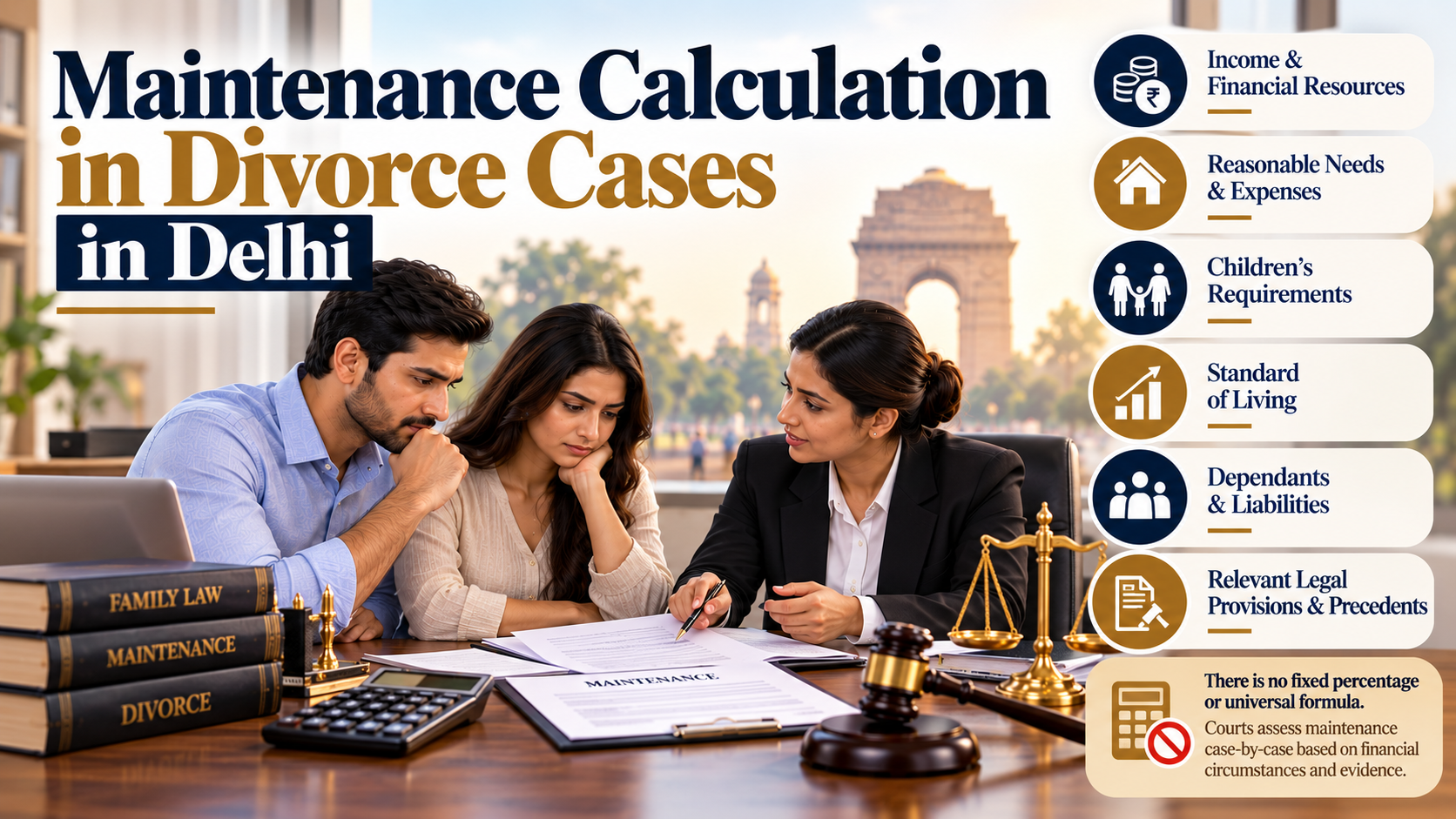
There is no universal formula that automatically awards every wife a particular percentage of her former husband’s salary.
Courts assess the facts of the individual case.
Wife’s Income and Financial Position
The court may consider whether the wife:
- Is employed;
- Has regular income;
- Owns income-generating assets;
- Has significant investments or savings;
- Can reasonably meet her expenses independently.
Employment by itself should not be treated as a substitute for analysing the parties’ actual financial circumstances.
Husband’s Income and Financial Resources
Relevant evidence can include:
- Salary;
- Business income;
- Professional income;
- Investments;
- Assets;
- Regular financial obligations; and
- Other reliable indicators of financial capacity.
Standard of Living
The lifestyle and standard of living during the marriage may be relevant to the assessment, along with the parties’ current circumstances.
Reasonable Expenses and Liabilities
Courts may consider genuine expenses and responsibilities rather than focusing solely on gross income.
Children and Dependants
Child-related financial responsibilities can affect the overall financial picture. However, child maintenance and spousal maintenance are legally distinct issues, even when considered in related proceedings.
Financial Disclosure
The Supreme Court’s decision in Rajnesh v. Neha established guidelines designed to bring greater consistency to maintenance proceedings, including disclosure of assets and liabilities. The Supreme Court has continued to direct parties in subsequent matters to file financial disclosures in terms of Rajnesh v. Neha.
For you, this means proper financial documentation can be extremely important in a maintenance case.
Is There a Fixed Percentage for Wife Maintenance in India?
No single statutory percentage automatically applies to every case.
Online claims such as “a wife always gets 25% of the husband’s salary” can be misleading when presented as a universal rule.
Courts consider the particular circumstances of the parties and the applicable statutory criteria.
If you are trying to estimate likely maintenance, a better approach is to prepare an accurate picture of:
- Both spouses’ incomes;
- Monthly expenses;
- Assets and liabilities;
- Dependants;
- Existing maintenance orders;
- Previous settlements; and
- Standard of living during marriage.
A maintenance lawyer can then assess these facts against the applicable law and relevant judicial principles.
Does an Earning Wife Have a Right to Maintenance?
An earning wife is not necessarily excluded from seeking maintenance merely because she has a job.
The important question is broader: what are the parties’ actual financial circumstances, and what does the applicable law require the court to consider?
For example, a court may need to examine:
- Actual monthly income;
- Reasonable living expenses;
- Financial responsibilities;
- Income disparity;
- Dependants;
- Assets and liabilities; and
- Other relevant circumstances.
Similarly, being professionally qualified does not by itself tell the court what a person’s actual present income or financial needs are.
Each case requires an evidence-based assessment.
Maintenance After Mutual Consent Divorce
Maintenance should be addressed carefully when spouses negotiate a mutual consent divorce.
A settlement may deal with:
- One-time alimony;
- Monthly maintenance;
- Child maintenance;
- Education expenses;
- Medical expenses;
- Stridhan;
- Property-related arrangements; and
- Future financial claims.
The wording of the settlement matters.
If you are agreeing to a full-and-final financial settlement, understand precisely which rights are being settled or waived before signing.
A divorce lawyer should review the terms carefully so that there is no unnecessary ambiguity later.
Maintenance After Contested Divorce
Financial issues may also continue in a contested divorce.
Depending on the applicable statute and stage of proceedings, the court may deal with interim support during litigation and permanent maintenance or alimony in connection with the decree or thereafter.
A contested maintenance claim can involve detailed examination of:
- Income affidavits;
- Bank statements;
- Salary records;
- Tax records;
- Business documents;
- Assets;
- Liabilities; and
- Evidence concerning actual expenses.
This is one reason maintenance litigation should be prepared with the same care as the main divorce case.
Step-by-Step Process for Claiming Maintenance in Delhi
The exact procedure depends on the legal provision being invoked, but a maintenance matter generally involves the following stages.
Step 1: Legal Assessment
Your lawyer first reviews:
- Marriage and divorce documents;
- Existing maintenance orders;
- Settlement agreements;
- Income details;
- Dependants;
- Previous matrimonial proceedings; and
- Applicable law.
This is particularly important where more than one maintenance proceeding has existed.
Step 2: Collect Financial Documents
Prepare documents showing your financial position and, where lawfully available, information relevant to the other spouse’s financial capacity.
Step 3: Prepare the Appropriate Application
Your lawyer identifies the appropriate statutory remedy and prepares the maintenance or alimony application.
The application should accurately explain:
- Relationship and divorce history;
- Existing orders;
- Income and expenses;
- Financial requirements; and
- Relief requested.
Step 4: Filing Before the Appropriate Court
The application is filed before the court having jurisdiction under the applicable law.
Step 5: Financial Disclosure and Reply
The other party may file a response and financial disclosures.
Both parties’ financial assertions may be examined.
Step 6: Arguments and Evidence
The court considers the pleadings, financial information, documents and arguments before determining the claim.
Step 7: Maintenance Order
If maintenance is awarded, the order will specify the amount and relevant payment terms.
Step 8: Enforcement Where Necessary
If an enforceable maintenance order is not followed, legal enforcement mechanisms may be available.
Section 147 BNSS specifically addresses enforcement of maintenance orders made under that statutory framework.
Documents Commonly Required for a Maintenance Case
Your exact document list will depend on the case, but useful records may include:
- Marriage certificate or marriage proof;
- Divorce decree;
- Settlement agreement, if any;
- Previous maintenance orders;
- Aadhaar or other identity documents;
- Address proof;
- Bank statements;
- Income-tax returns;
- Salary slips;
- Employment records;
- Evidence of regular household expenses;
- Rent or housing documents;
- Medical expenses where relevant;
- Children’s education and medical expenses where relevant;
- Loan or liability documents; and
- Relevant financial records.
Do not conceal material financial information. Accurate disclosure helps your lawyer present your case consistently and reduces the risk of contradictions later.
How Long Does a Wife Maintenance Case Take in Delhi?
There is no single guaranteed timeline.
The duration can depend on:
- Court workload;
- Completeness of financial disclosure;
- Disputes over income;
- Number of connected proceedings;
- Service of notice;
- Interim applications;
- Evidence required; and
- Conduct of the parties.
For proceedings under Section 24 of the Hindu Marriage Act, the statute says an application for litigation expenses and monthly support should, as far as possible, be disposed of within 60 days from service of notice. That wording should not be read as a guarantee that every Delhi case will conclude within 60 days.
Can Maintenance Be Increased or Reduced Later?
Depending on the legal basis of the original order and subsequent circumstances, modification may be possible.
For example, significant changes could involve:
- Change in income;
- Loss of employment;
- Major change in financial circumstances;
- Change in dependants or liabilities; or
- Other legally relevant developments.
The BNSS expressly provides for alteration of allowance when circumstances change, subject to the statutory requirements.
A change is not necessarily automatic. The appropriate application generally needs to be made before the competent court.
What Happens to Maintenance If the Divorced Wife Remarries?
Remarriage can have important consequences.
Under the BNSS maintenance framework, where an order under Section 144 has been made in favour of a divorced woman, the statute provides for cancellation from the date of her remarriage when the relevant requirements are established.
Other forms of permanent alimony can be governed by their own statutory provisions and the terms of the relevant order.
Therefore, you should have the actual maintenance order and applicable law reviewed rather than assuming that every form of maintenance operates identically.
What If the Husband Does Not Pay Court-Ordered Maintenance?
Ignoring a maintenance order does not simply make the obligation disappear.
Depending on the provision under which the order was passed, enforcement proceedings may be available.
Under the BNSS framework, Section 147 addresses enforcement of maintenance and interim-maintenance orders.
If payments stop, preserve:
- Copy of the maintenance order;
- Payment records;
- Bank statements;
- Details of unpaid months;
- Communications relating to non-payment; and
- Calculation of arrears.
A lawyer can then identify the appropriate enforcement procedure for your order.
Wife Maintenance Cases in Delhi Family Courts
Maintenance and matrimonial matters in Delhi can arise before the appropriate Family Court or other competent court depending on the statute and proceedings involved.
Delhi Legal Expert’s matrimonial practice states that it handles divorce, maintenance, alimony and related family-law proceedings and appears across Delhi courts.
Relevant Delhi court complexes for matrimonial matters can include:
- Saket Courts
- Tis Hazari Courts
- Rohini Courts
- Dwarka Courts
- Karkardooma Courts
The Delhi High Court may become relevant in appeals, challenges, transfers and other proceedings falling within its jurisdiction.
Your residential area alone should not be used to guess jurisdiction. The correct forum depends on the statute and jurisdictional facts of the particular case.
Common Mistakes to Avoid in Maintenance Cases
1. Assuming There Is a Fixed Maintenance Formula
There is no universal percentage that determines every maintenance award.
2. Hiding Income or Assets
Financial disclosure is an important part of modern maintenance litigation. Inconsistent information can damage credibility.
3. Ignoring Existing Maintenance Proceedings
If maintenance has already been claimed or awarded under another statute, tell your lawyer immediately.
The Supreme Court’s Rajnesh v. Neha guidelines specifically address overlapping maintenance jurisdictions.
4. Signing a Divorce Settlement Without Understanding Maintenance Terms
Words such as “full and final settlement” can have significant consequences. Obtain legal advice before signing.
5. Mixing Child Maintenance With Spousal Maintenance
Both may involve the same family, but they are not identical legal claims.
6. Relying on Old Internet Articles
Articles that refer only to Section 125 CrPC without explaining the transition to Section 144 BNSS may be outdated for current procedural guidance.
7. Waiting Too Long to Address Non-Payment
If a court order is being violated, obtain advice about enforcement rather than allowing arrears and documentation problems to accumulate.
Why Consult a Maintenance Lawyer in Delhi?
Maintenance disputes are often financial-document cases as much as matrimonial cases.
An experienced lawyer can help you:
- Identify the correct legal provision;
- Review your divorce decree and settlement;
- Prepare financial disclosures;
- Organise income and expense evidence;
- Draft the maintenance application or reply;
- Address overlapping proceedings;
- Negotiate settlement terms;
- Represent you before the relevant court; and
- Pursue enforcement or modification where legally available.
Professional advice is particularly useful before signing any settlement that purports to resolve future maintenance rights.
How Delhi Legal Expert Can Assist
Delhi Legal Expert provides legal assistance for maintenance, divorce and matrimonial disputes in Delhi.
Depending on your circumstances, assistance may include:
- Legal consultation — Understanding maintenance and alimony rights under the applicable law.
- Case assessment — Reviewing divorce decrees, previous orders and settlements.
- Financial-document preparation — Organising income, expenses, assets and liabilities.
- Maintenance applications — Preparing and filing appropriate claims.
- Reply to maintenance claims — Representing respondents where a maintenance demand is disputed.
- Court representation — Assistance before the appropriate Delhi courts.
- Settlement assistance — Negotiating maintenance and alimony terms in matrimonial settlements.
- Modification proceedings — Assessing whether changed circumstances justify seeking alteration of an existing order.
- Enforcement assistance — Advising on remedies where ordered maintenance remains unpaid.
The appropriate strategy depends on your documents and individual financial circumstances rather than a standard formula.
Frequently Asked Questions
Q1. Can a wife claim maintenance after divorce in Delhi?
Yes, a divorced wife may be able to claim maintenance depending on the applicable law and facts. Under Section 144 BNSS, the statutory definition of “wife” includes a woman who has been divorced by, or has obtained divorce from, her husband and has not remarried.
For marriages governed by the Hindu Marriage Act, Section 25 separately provides for permanent alimony and maintenance in connection with decrees under that Act.
Q2. How much maintenance can a wife get after divorce in Delhi?
There is no fixed amount applicable to every divorced wife.
The court considers the applicable statutory criteria and facts such as income, financial resources, needs, liabilities and other relevant circumstances. Financial disclosure can therefore be central to the outcome.
Q3. Is a working wife entitled to maintenance after divorce?
Employment does not, by itself, provide a universal yes-or-no answer.
The court may consider the wife’s actual income alongside the parties’ overall financial circumstances and the requirements of the applicable maintenance provision.
Q4. Is maintenance always 25% of the husband’s salary?
No. There is no statute providing that every wife automatically receives exactly 25% of her husband’s salary.
Maintenance is fact-specific. Treat online percentage calculators as general information rather than a reliable prediction of what a Delhi court will order.
Q5. Can a wife claim maintenance after mutual consent divorce?
This depends heavily on the settlement and decree.
Mutual consent divorce settlements often expressly resolve permanent alimony and future maintenance claims. If the settlement contains a full-and-final waiver or lump-sum arrangement, its terms need careful legal examination before determining whether any further claim is available.
Q6. Can a wife claim maintenance after a contested divorce?
Potentially, yes.
For example, Section 25 of the Hindu Marriage Act allows an application for permanent alimony at the time of passing a decree or subsequently, subject to its requirements.
Q7. Does maintenance stop if a divorced wife remarries?
Under the Section 144 BNSS framework, the law provides for cancellation of an order in favour of a divorced woman from the date of remarriage when the statutory conditions are satisfied.
The actual legal position should still be checked against the provision under which your particular maintenance or alimony order was made.
Q8. Can maintenance be increased after divorce?
A change may be sought in appropriate circumstances where the governing law permits alteration and relevant circumstances have changed.
The court will consider the evidence rather than automatically increasing maintenance because a request has been filed.
Q9. What can I do if my former husband does not pay maintenance?
If there is already an enforceable court order and payments are not being made, enforcement remedies may be available.
Keep accurate records of payments received, unpaid instalments and arrears, and take the order to a lawyer who can identify the appropriate enforcement mechanism.
Q10. Which court handles wife maintenance cases in Delhi?
The appropriate court depends on the legal provision, the underlying matrimonial proceedings and jurisdictional facts.
Family Courts handle many matrimonial maintenance matters, while other competent courts may deal with maintenance under different statutory frameworks. The Delhi High Court may become relevant at the appellate or supervisory stage in appropriate cases.