Divorce Lawyer in Delhi NCR: How to Choose the Right Legal Help
Quick Answer
A divorce lawyer in Delhi NCR can advise you on the appropriate legal route, jurisdiction, documentation, settlement terms, court proceedings and related issues such as maintenance or child custody. There is no single “best” lawyer for every case. A sensible choice depends on the lawyer’s matrimonial-law experience, familiarity with the relevant court, communication, fee transparency, settlement approach and experience with cases similar to yours.
Key Takeaways
- A divorce lawyer can assist with both mutual consent and contested divorce, depending on the facts and applicable marriage law.
- Before filing, jurisdiction should be checked carefully because the appropriate court depends on factors such as residence, place of marriage and where the parties last lived together, subject to the applicable law.
- A mutual divorce generally depends on a genuine agreement between spouses regarding issues such as maintenance, children and other outstanding matters.
- Professional fees vary according to the lawyer, case complexity, number of proceedings and services required. There is no universal statutory divorce-lawyer fee.
- Documents relating to marriage, identity, residence, children, finances and existing legal proceedings can make the first consultation more productive.
- Maintenance, custody and related proceedings may require separate legal consideration even when divorce itself appears straightforward.
- No ethical lawyer can guarantee a particular divorce outcome, custody decision, maintenance amount or court timeline.
What Does a Divorce Lawyer in Delhi NCR Do?
A divorce lawyer is a legal professional who advises and represents a person in matrimonial and family-law matters. The work can extend well beyond preparing a divorce petition.
Depending on the circumstances, a lawyer may help with:
- Assessing whether divorce is legally available and under which law.
- Determining the appropriate court or jurisdiction.
- Preparing and reviewing pleadings and supporting documents.
- Advising on mutual consent divorce or contested proceedings.
- Negotiating settlement terms.
- Addressing maintenance or alimony issues.
- Advising on child custody and visitation.
- Assisting with mediation.
- Representing a client during hearings and other procedural stages.
- Advising on connected proceedings or appeals where appropriate.
The precise role depends on the engagement agreed between the client and lawyer.
When Do You Need a Divorce or Matrimonial Lawyer?
Legal advice can be useful before filing anything, particularly when the marriage involves financial assets, children, allegations of cruelty, maintenance disputes or other proceedings.
You should consider obtaining professional advice if:
- You and your spouse are considering divorce.
- Your spouse has already filed a case.
- You are considering a mutual-consent divorce.
- You anticipate a contested divorce.
- There are disagreements about maintenance or alimony.
- You have children and need advice about custody or visitation.
- Domestic violence or other serious allegations are involved.
- There are substantial financial or property issues.
- You have received a legal notice.
- Divorce proceedings are already pending in another court.
Early advice can help you understand your options before positions become unnecessarily difficult to change.
How Do I Choose a Divorce Lawyer in Delhi?
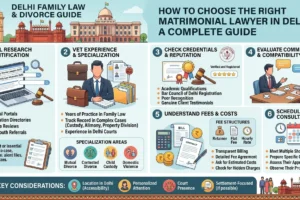
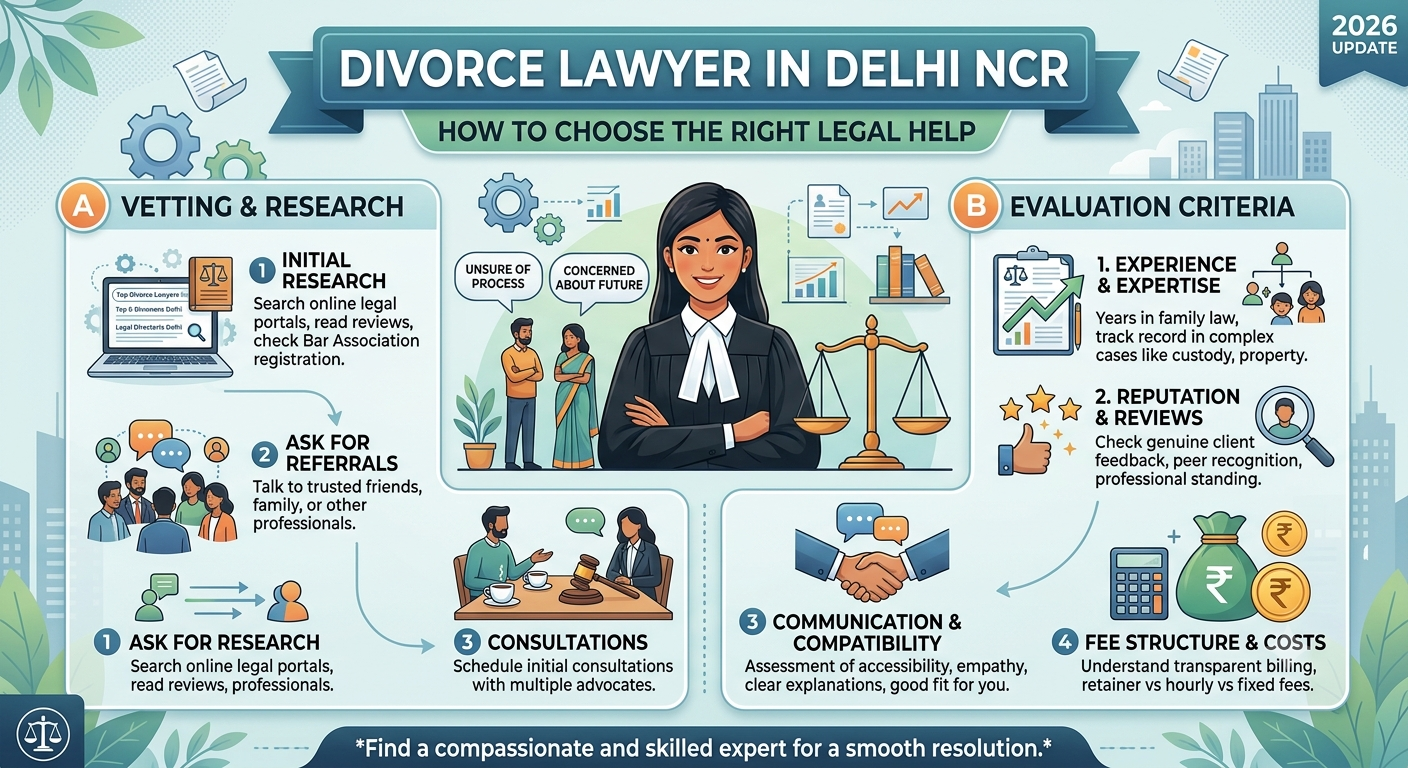
Choosing a divorce lawyer in Delhi NCR should involve more than searching for the most visible name online. Consider the following criteria.
Relevant matrimonial-law experience
Look for a lawyer whose practice includes matrimonial and family-law matters. Divorce cases can involve statutory interpretation, evidence, interim applications, settlement negotiations and procedural issues.
Experience with your type of case
A lawyer who regularly handles mutual-consent matters may have a different practice profile from one who spends substantial time on contested matrimonial litigation.
Ask whether the lawyer regularly handles matters similar to yours, without expecting a guaranteed result.
Court and procedural experience
Delhi has several district court complexes and a separate Delhi High Court jurisdiction. The appropriate forum depends on the case and applicable law.
Practical familiarity with the relevant court can be useful because filing requirements, listings and procedural steps matter in addition to substantive legal knowledge.
Communication
You should understand:
- Who will be your primary point of contact?
- How will important developments be communicated?
- How quickly can you generally expect responses?
- Who will attend hearings?
- Will you receive copies of important filings and orders?
Good communication is particularly important in matrimonial disputes because cases can involve sensitive personal and financial information.
Settlement approach
Not every divorce needs to become a prolonged adversarial dispute.
If settlement is realistic, ask how the lawyer approaches negotiation and mediation. If settlement is not realistic, you should understand the proposed litigation strategy and the issues that may need to be proved.
Fee transparency
Ask for clarity about professional fees before formally engaging the lawyer.
Confirm whether the quoted arrangement covers drafting, appearances, conferences, mediation and applications, or whether these are charged separately.
Who actually handles the case?
A consultation may be conducted by one lawyer while another advocate handles subsequent hearings.
There is nothing inherently wrong with a legal team structure, but you should know who is responsible for your matter and who will ordinarily appear in court.
Mutual Consent vs Contested Divorce
The choice between mutual and contested divorce depends on the circumstances and applicable personal law.
| Issue | Mutual Consent Divorce | Contested Divorce |
|---|---|---|
| Agreement | Both spouses agree to seek divorce and settle relevant issues | Spouses do not have complete agreement |
| Court’s role | Court considers the statutory requirements and consent | Court determines disputed issues according to law and evidence |
| Dispute level | Usually lower if settlement is genuine and complete | Can involve substantial disagreement |
| Evidence | Generally different from a fully contested trial | Evidence and cross-examination may become relevant |
| Settlement | Central to the process | May occur before or during proceedings |
| Maintenance/custody | Can be addressed through settlement | May require adjudication if disputed |
| Timeline | Depends on statutory requirements, court process and circumstances | Often more difficult to predict |
A mutual process is not simply a faster version of contested divorce. It requires genuine consent and compliance with the requirements of the applicable law.
What Is Mutual Consent Divorce Under Section 13B?
For marriages governed by the Hindu Marriage Act, 1955, Section 13B provides for divorce by mutual consent subject to its statutory conditions.
The process commonly involves two motions, although the precise procedural position can depend on the circumstances and court orders.
A settlement may address:
- Permanent alimony or maintenance.
- Child custody.
- Visitation rights.
- Children’s education and other expenses.
- Return of personal belongings.
- Property or financial arrangements.
- Withdrawal or resolution of connected proceedings.
- Any other legally appropriate terms agreed between the parties.
The agreement should be carefully reviewed before consent is given.
Can the six-month period be waived?
The Hindu Marriage Act contains a six-month period between the first and second motion in the ordinary statutory framework. However, the Supreme Court in Amardeep Singh v. Harveen Kaur recognised circumstances in which the period may be waived, subject to the applicable principles and the court’s consideration.
Waiver is not automatic. A lawyer should assess the facts and current legal position before advising that a waiver application is appropriate.
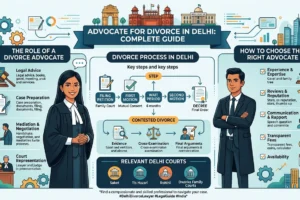
What Happens in a Contested Divorce?
In a contested divorce, one spouse seeks divorce and the other does not agree to the relief sought, or disputes relevant allegations or issues.
For marriages governed by the Hindu Marriage Act, Section 13 sets out statutory grounds for divorce. The exact ground and evidentiary requirements depend on the facts.
A contested matter may involve:
- Initial legal consultation.
- Assessment of documents and facts.
- Preparation of pleadings.
- Filing before the appropriate court.
- Service of the other party.
- Response and subsequent pleadings.
- Interim applications where necessary.
- Evidence.
- Cross-examination where applicable.
- Final arguments.
- Judgment and possible subsequent remedies.
Not every case follows an identical sequence, and procedural developments can alter the course of litigation.
Which Court Handles Divorce Matters in Delhi?
There is no single court that automatically handles every matrimonial matter simply because someone lives in Delhi NCR.
Jurisdiction must be assessed under the applicable matrimonial statute and the facts of the case.
Depending on the circumstances, relevant considerations can include:
- Where the marriage took place.
- Where the parties reside.
- Where the parties last resided together.
- Whether a statutory provision provides a particular jurisdictional basis.
- Where an existing proceeding is pending.
Delhi’s district courts include major court complexes such as Tis Hazari, Karkardooma, Rohini, Dwarka, Saket and Patiala House. The appropriate court within the Delhi court system depends on the case and applicable jurisdictional rules.
The Delhi High Court is a separate superior court with jurisdiction over matters falling within its statutory and constitutional powers, including appropriate matrimonial appeals and other proceedings.
If you live in the wider NCR—such as Noida, Ghaziabad, Gurugram or Faridabad—do not assume that a Delhi court is automatically the correct forum. Jurisdiction should be checked from the facts before filing.
How Much Does a Divorce Lawyer Charge in Delhi?
There is no single standard professional fee for a divorce lawyer in Delhi NCR.
The amount can depend on:
- Mutual or contested proceedings.
- Complexity of the dispute.
- Number of hearings expected.
- Drafting requirements.
- Interim applications.
- Maintenance disputes.
- Custody proceedings.
- Mediation and negotiation.
- Evidence and cross-examination.
- Connected litigation.
- Appeals or other subsequent proceedings.
- The individual lawyer’s professional fee structure.
Fee clarification checklist
| Fee Component | What to Ask |
|---|---|
| Consultation | Is it separately charged? |
| Petition drafting | Is drafting included? |
| Court appearances | Per appearance or another arrangement? |
| Interim applications | Included or separately charged? |
| Evidence stage | Is additional professional work involved? |
| Mediation | Is representation included? |
| Connected cases | Will these require a separate engagement? |
| Out-of-pocket expenses | Which expenses are payable separately? |
Do not select a lawyer solely because the quoted fee is the lowest. At the same time, a higher fee does not automatically establish that a lawyer is better suited to your case.
Get the proposed scope of work and payment terms clearly understood before engagement.
Documents to Take to Your First Consultation
You do not necessarily need a perfect file before speaking with a lawyer. However, organised information can save time.
Consider taking or securely sharing, where relevant:
- Marriage certificate or marriage-related records.
- Identity and address documents.
- Details of both spouses.
- Children’s birth certificates and relevant records.
- Previous court orders.
- Legal notices received or sent.
- Existing petitions or case documents.
- Relevant financial documents.
- Salary or income information where maintenance is an issue.
- Bank or investment records where financially relevant.
- Property documents where relevant.
- Important correspondence or communications.
- Evidence relevant to disputed allegations.
- Details of any existing criminal, domestic-violence or other connected proceedings.
Do not edit, delete or manufacture evidence simply to strengthen a case. Ask a lawyer how relevant material should be preserved and presented.
What Questions Should You Ask Before Hiring a Divorce Lawyer?
A first consultation should also help you evaluate whether the lawyer is suitable for your needs.
Ask:
- What legal options appear available based on my facts?
- Which matrimonial law applies to my marriage?
- Which court is likely to have jurisdiction?
- Is mutual consent realistically possible?
- If the case is contested, what issues will need to be established?
- What documents should I preserve?
- Are maintenance or custody issues likely to arise?
- Would mediation be worth considering?
- Who will draft and file the pleadings?
- Who will ordinarily appear at hearings?
- What does the proposed fee cover?
- Which expenses are additional?
- What are the main risks or uncertainties in my case?
A good consultation should help you understand both the possible strengths and limitations of your position.
Red Flags When Selecting a Divorce Lawyer
Be cautious if a prospective lawyer:
- Guarantees that you will definitely get a divorce.
- Promises a guaranteed custody outcome.
- Claims to know exactly how quickly the court will decide your case.
- Uses unsupported “No. 1” or “100% success” claims.
- Refuses to explain fees or the scope of engagement.
- Encourages unnecessary litigation without explaining alternatives.
- Asks you to exaggerate or fabricate facts.
- Makes sweeping promises based on very limited information.
- Cannot clearly explain who will handle your matter.
- Pressures you into signing immediately without reasonable explanation.
A responsible legal professional should explain uncertainty rather than hide it.
How Long Can Divorce Proceedings Take?
There is no universal timeline for divorce proceedings in Delhi.
A mutual-consent matter may proceed differently from a contested case, while even two contested matters can have very different timelines.
Factors can include:
- Whether the parties genuinely agree.
- Whether settlement terms are complete.
- Court scheduling and workload.
- Service of notices.
- Interim applications.
- Disputes over documents or evidence.
- Adjournments.
- Mediation.
- Whether children or maintenance issues are disputed.
- Appeals or connected litigation.
For this reason, be wary of anyone promising that your divorce will definitely be completed within a particular number of days.
Child Custody: What Should Parents Consider?
Divorce and child-related disputes should not be treated as purely financial issues.
Depending on the case, parents may need advice concerning:
- Physical custody.
- Legal decision-making.
- Visitation.
- Holidays and travel.
- Schooling.
- Medical decisions.
- Communication with the child.
- Educational expenses.
- Day-to-day care.
The child’s welfare is a central consideration in custody decisions. Parents should therefore approach custody discussions with the child’s interests in mind rather than treating access as simply a bargaining tool in the divorce.
Maintenance and Alimony
Financial support can become an important part of matrimonial proceedings.
Under the Hindu Marriage Act, 1955, Sections 24 and 25 deal with particular forms of financial relief during proceedings and permanent alimony/maintenance, respectively, subject to the statutory requirements.
Other laws may also provide maintenance-related remedies depending on the circumstances.
The amount and availability of financial relief cannot be predicted from marital status alone. Factors such as income, financial circumstances, needs, liabilities and the applicable legal provision may be relevant.
A lawyer should assess the specific facts before advising on a maintenance claim or defence.
Can Mediation Help With a Divorce Dispute?
Mediation can be useful where spouses are willing to discuss practical solutions.
It may help parties address matters such as:
- Maintenance.
- Custody and visitation.
- Children’s expenses.
- Property-related arrangements.
- Return of belongings.
- Withdrawal or resolution of connected proceedings.
- Other settlement terms.
Mediation does not mean that a party must accept an unfair settlement. A lawyer can help a client understand the legal implications of proposed terms before consent is recorded.
Where settlement is impossible, the matter may continue through the appropriate legal process.
Practical Insights From Matrimonial Practice in Delhi
Prepare facts, not just emotions
A lawyer needs a clear factual chronology. Before the consultation, write down important dates, major events, periods of separation, children-related developments and existing proceedings.
Preserve relevant records
Messages, emails, financial records, medical documents, notices and court papers may become relevant depending on the dispute.
Keep original documents safely and avoid altering potentially relevant electronic material.
Discuss settlement issues early
If mutual divorce or settlement may be possible, identify major unresolved issues early. A divorce agreement that leaves custody, finances or connected proceedings unclear may create further disputes.
Check jurisdiction before filing
Filing in the wrong forum can create avoidable procedural complications. Your lawyer should establish the jurisdictional basis before proceeding.
Understand the complete fee arrangement
Ask whether the quoted professional fee relates only to drafting or includes appearances and other stages. A clear engagement reduces later misunderstandings.
Do not confuse advice with a guarantee
A lawyer can explain legal options, risks and strategy. The final outcome remains dependent on the facts, evidence, applicable law and decisions of the competent court.
Why Consider a Delhi Legal Expert?
Delhi Legal Expert can be considered by people seeking information and professional assistance regarding matrimonial and family-law matters in Delhi NCR.
Before engaging in any legal service, prospective clients should discuss their facts directly with the relevant advocate, understand the proposed scope of work and clarify professional fees.
The objective should be to obtain advice suited to the individual circumstances rather than simply choosing a lawyer based on a “best” or “top” label.
Frequently Asked Questions
Who is the best divorce lawyer in Delhi NCR?
There is no true best divorce lawyer for any individual or divorce. Considerations include experience with relevant matrimonial law, experience dealing with cases of that nature, court experience, communication, settlement strategy, availability and fee structure. Check credentials of professionals before hiring.
How do I choose a good divorce lawyer?
The first step is to find out who are the lawyers that specialize in matrimonial issues like yours. At the consultation, ask what your legal options are, what jurisdiction the case will fall under, what the likely procedure will be, if you’ll have a settlement, the documentation that will be involved, who will be responsible for the case, and fees. Don’t hire lawyers who claim guarantees or unrealistic time frames.
How much does a divorce lawyer charge in Delhi?
The fees charged by lawyers with private divorce cases vary and there is no statutory fee for private divorce lawyers. Costs may be dependent on the type of matter (including whether it is a mutual or contested matter), drafting, court appearances, interim applications, mediation, evidence, custody and maintenance matters and connected matters. When meeting prospective partners, inquire about the subject fees and extra costs.
Is a mutual divorce faster than a contested divorce?
A mutual-consent divorce can follow a more streamlined process when both spouses agree and statutory requirements are satisfied. The time frame, however, is still determined by the applicable law, court procedure and circumstances. A contested divorce can have pleadings, arguments and evidence and can take a lot more time to determine.
Do I need a Delhi-based divorce lawyer if I live in NCR?
Not necessarily. The key question is whether the lawyer can give you the advice and representation you need in the court where your case is pending. Where the preferred location is not the relevant facts, jurisdiction should be determined accordingly where you live in different NCR cities.
Which court handles my divorce?
The jurisdiction of the court will depend on the set of facts and the matrimonial laws applicable, such as the spouses’ place of marriage and their last common residence. There are several court complexes in the Delhi district courts, but they should be determined before filing a case.
What documents should I take to a divorce lawyer?
Marriage certificates, identifying documents, residence documents, child documents, court documents, notices, financial information and records in relation to significant allegations or claims. After considering your circumstances a lawyer can inform you of any supplementary documents that might be pertinent.
Can the six-month period for mutual divorce be waived?
In the case of Amardeep Singh v. Harveen Kaur, the Supreme Court interpreted Section 13B of the Hindu Marriage Act and acknowledged that in some cases the six-month time limit may be waived. Waiver does not happen on its own, the court must take into account the facts and the legal requirements that apply.
Can custody and divorce issues be dealt with together?
They may be dealt with in the course of the marriage proceedings or in other suitable proceedings as the case may be and in accordance with the law involved. Custody issues are based on the child’s best interests. Where custody, visitation or education or costs of children are in dispute parents should seek specific advice.
Can a divorce lawyer guarantee the outcome?
“A lawyer under any circumstances ought not to promise any specific result in court.” A lawyer can evaluate the facts, make sure he is aware of the applicable law, identify risks and create a legal strategy. Ultimately, this will be determined by the evidence, relevant law, and court process and rulings of the competent court.
How long will my divorce case take?
It is not possible to find a universal time line. There are several different paths for mutual and contested proceedings, and considerations like settlement, court scheduling, service, evidence, interim applications, and appeals may impact length of time. Any time-frame provided by a lawyer is subject to interpretation, but not a promise.
Authoritative Legal Sources
For legal information, readers and content editors should prioritise primary sources, including:
- India Code — official repository for Central legislation and statutory texts.
- Supreme Court of India — judgments and authoritative decisions.
- Delhi High Court — judgments, orders and court information.
- Delhi District Courts — court information, case-related services and procedural resources.
- Hindu Marriage Act, 1955 — particularly Sections 13, 13B, 24 and 25 where applicable.
- Amardeep Singh v. Harveen Kaur — Supreme Court authority relevant to waiver of the six-month period under Section 13B in appropriate circumstances.
The Hindu Marriage Act should not be treated as applying to every marriage. The applicable personal law or other governing legislation must be identified from the circumstances.
Need Clarity About Your Divorce Case in Delhi NCR?
If you are considering divorce or are already involved in a matrimonial dispute, a consultation with an appropriate family-law professional can help clarify the legal position before you take the next step.
A consultation may help you understand:
- Which legal options may apply.
- Whether the proposed court has jurisdiction.
- Which documents are relevant.
- Whether settlement or mediation may be practical.
- How maintenance or custody issues may affect the matter.
- What procedural steps may follow.
For Delhi and NCR matters, Delhi Legal Expert can provide a starting point for seeking appropriate matrimonial-law assistance, subject to the individual facts of the case.