Advocate for Divorce in Delhi: Role, Process and How to Choose One
Quick Answer
An advocate for divorce in Delhi is a qualified legal professional who can advise on matrimonial rights, assess the appropriate legal route, prepare and file divorce proceedings, represent a client before the relevant court, and assist with settlement, maintenance, custody and related issues. The right advocate depends on the facts of the marriage, applicable personal law, jurisdiction, whether the divorce is mutual or contested, and the issues that need to be resolved.
Key Takeaways
- A divorce advocate can advise on mutual consent or contested divorce, depending on the circumstances and applicable marriage law.
- The advocate should first assess jurisdiction, because not every matrimonial dispute can automatically be filed in any Delhi court.
- Under the Hindu Marriage Act, 1955, Section 13 deals with specified grounds for divorce, while Section 13B provides for divorce by mutual consent where its requirements are satisfied.
- Divorce proceedings may involve more than the dissolution of marriage, including maintenance, alimony, child custody, visitation and property or belongings-related issues.
- There is no universally “best” divorce advocate for every case. Relevant experience, communication, strategy and fee transparency are more useful selection criteria.
- A lawyer cannot ethically guarantee that a court will grant a divorce, award a particular amount of maintenance or decide custody in a particular way.
- Before engaging an advocate, ask exactly what professional services are covered by the proposed fee and which proceedings may require separate representation.
What Does an Advocate for Divorce in Delhi Do?
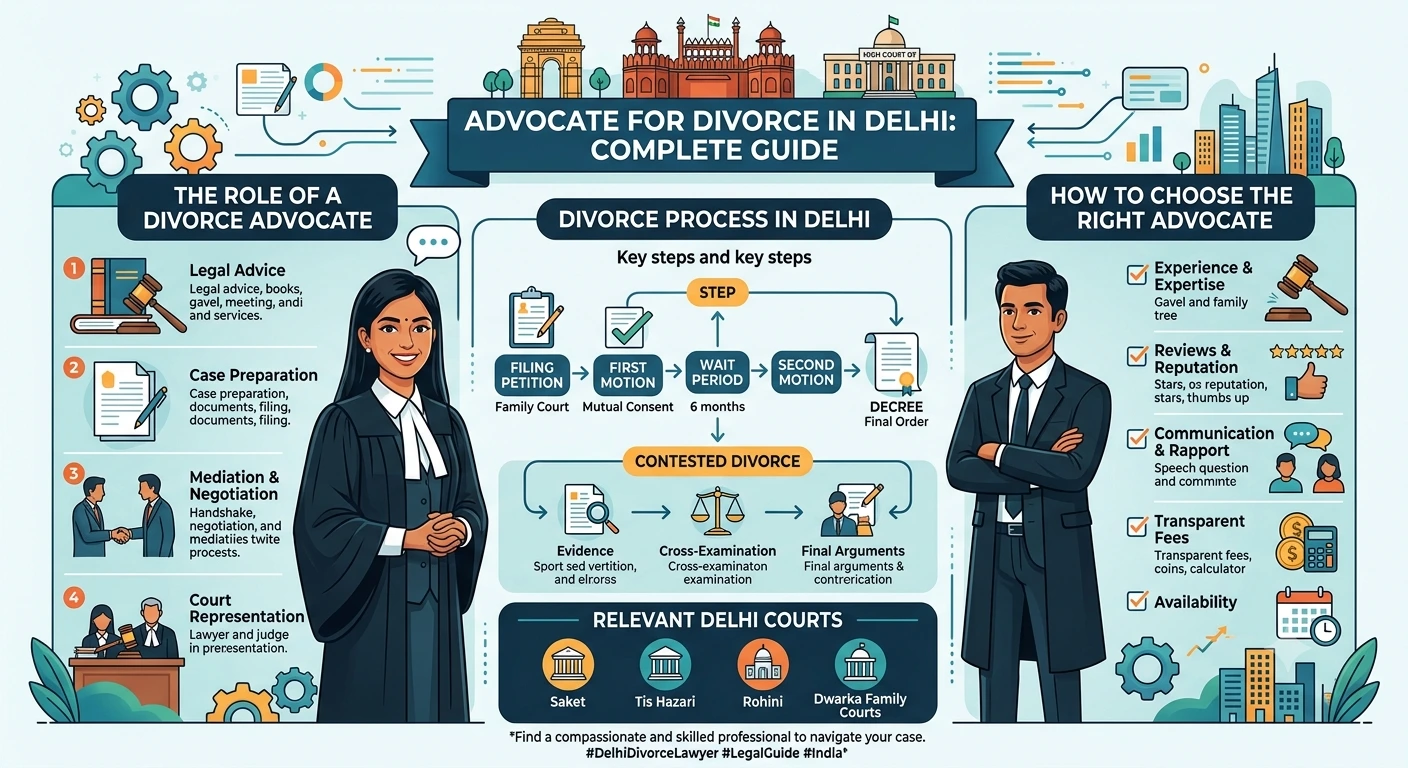
A divorce advocate does considerably more than prepare a divorce petition.
The advocate’s role normally begins with understanding the marriage, the parties’ circumstances, previous legal proceedings, children, financial issues and the client’s desired outcome.
Depending on the case, the advocate may assist with:
- Assessing whether divorce proceedings are legally available.
- Identifying the law applicable to marriage.
- Checking whether a Delhi court has jurisdiction.
- Advising on mutual consent or contested proceedings.
- Preparing pleadings, applications and supporting documents.
- Filing proceedings before the appropriate court.
- Representing the client at hearings.
- Responding to applications filed by the other spouse.
- Assisting with mediation and settlement discussions.
- Addressing maintenance and financial claims.
- Advising on child custody and visitation issues.
- Helping resolve ancillary matrimonial disputes.
- Advising on appeals or connected proceedings where necessary.
The exact scope of work depends on the case and the advocate’s engagement terms.
When Do You Need a Divorce Advocate?
There is no single rule that every person contemplating separation must immediately file a case. However, obtaining legal advice early can help prevent avoidable procedural and strategic mistakes.
You may particularly benefit from an advocate if:
You are considering contested divorce
If your spouse does not agree to divorce, the legal strategy is different from a mutual consent matter. The advocate can assess the facts against the legally recognised grounds applicable to your marriage.
You and your spouse agree to separate
Even an apparently straightforward mutual divorce can involve detailed settlement issues. Legal advice can help identify matters that should be recorded clearly before the parties proceed.
There are children
Custody, visitation, education, healthcare and children’s expenses can become significant parts of matrimonial proceedings.
Maintenance is disputed
Financial support may need to be considered alongside the divorce proceedings. The applicable legal provisions depend on the circumstances and the law governing the marriage.
Other proceedings already exist
Domestic violence proceedings, maintenance cases, criminal complaints or other connected litigation can affect how a matrimonial dispute should be approached.
You are unsure where to file
Jurisdiction is an important preliminary issue. A Delhi address alone does not necessarily mean that every matrimonial proceeding can be filed at every Delhi court complex.
What Should a Divorce Advocate Assess First?
A good initial consultation should not begin with paperwork alone.
The advocate should first establish the legal and factual framework of the dispute.
Important questions can include:
- What law governs the marriage?
- Where and when was the marriage solemnised?
- Where have the spouses lived together?
- Where are the spouses currently residing?
- Are there children?
- Is either party seeking maintenance or financial relief?
- Has either spouse already initiated proceedings?
- Are there allegations of cruelty, desertion or other legally relevant grounds?
- Is the other spouse willing to pursue mutual consent divorce?
- Are there existing criminal, domestic violence or maintenance proceedings?
This assessment helps determine the appropriate legal route rather than treating every divorce matter as identical.
How Do I Choose a Divorce Advocate in Delhi?
There is no objective basis for declaring one individual the “best” divorce advocate for every person.
Instead, compare prospective advocates against criteria that are relevant to your case.
1. Relevant matrimonial-law experience
Look for an advocate who regularly handles matrimonial and family-law matters rather than someone whose practice is unrelated to divorce.
Experience should be relevant to the type of problem you actually have.
2. Experience with your type of case
An advocate experienced in mutual consent matters may approach a heavily contested matrimonial dispute differently from a lawyer who regularly conducts contested litigation.
Ask specifically about experience with matters involving:
- Mutual consent divorce
- Contested divorce
- Maintenance
- Child custody
- Mediation
- Domestic violence-related proceedings
- Appeals or connected matrimonial litigation
You do not need to rely on unverified claims about case numbers or success rates.
3. Understanding of jurisdiction
Delhi has multiple district court complexes and a separate High Court. Your advocate should explain why a particular court or forum is appropriate based on the facts.
Do not select a lawyer merely because their office is physically close to you.
4. Communication
Divorce cases can involve sensitive personal and financial information.
Before engagement, find out:
- Who will be your primary contact?
- Who will draft important documents?
- Who will appear at hearings?
- How will hearing updates be communicated?
- How quickly can you normally expect responses?
5. Settlement approach
A strong matrimonial advocate should understand both litigation and settlement.
Settlement does not mean that a client must accept unfair terms. It means understanding when negotiation or mediation may provide a practical resolution and when contested litigation may be necessary.
6. Fee transparency
Ask for a clear explanation of professional charges before engagement.
Do not assume that an initial quoted amount automatically covers every application, hearing, mediation session, evidence stage or appeal.
7. Who actually handles your case?
If you consult a senior advocate or law firm, clarify whether that person will personally conduct hearings or whether another advocate will handle routine appearances.
This is a practical question that can prevent misunderstandings later.
What Is the Difference Between a Divorce Lawyer and a Divorce Advocate?
In everyday usage, “divorce lawyer” and “divorce advocate” are often used interchangeably.
In the Indian legal context, an advocate is a legal professional entitled to practise law subject to the applicable professional and regulatory framework.
For a person searching online, the more important question is not the label but whether the professional is appropriately qualified and experienced for the matrimonial matter involved.
A prospective client should verify professional credentials rather than relying solely on website descriptions such as “top”, “leading” or “best”.
Mutual Consent vs Contested Divorce
The distinction is central when choosing an advocate.
| Factor | Mutual Consent Divorce | Contested Divorce |
|---|---|---|
| Agreement | Both spouses seek divorce on mutually agreed terms | Parties may disagree about divorce or related issues |
| Settlement | Usually central to the process | May be negotiated but can remain disputed |
| Legal basis | Section 13B of the Hindu Marriage Act applies to marriages governed by that Act, subject to its requirements | Applicable statutory grounds depend on the law governing the marriage |
| Evidence | Usually less adversarial if settlement remains intact | Evidence and cross-examination may become relevant |
| Mediation | May assist in resolving outstanding terms | May be used to explore settlement |
| Complexity | Can be comparatively straightforward, but depends on settlement issues | Often more procedurally and factually demanding |
| Advocate’s role | Drafting, settlement, filing and procedural representation | Strategy, pleadings, evidence, applications, negotiation and court representation |
The applicable process can differ for marriages governed by laws other than the Hindu Marriage Act.
What Is the Advocate’s Role in Mutual Consent Divorce?
For a Hindu marriage, Section 13B of the Hindu Marriage Act, 1955 provides the statutory framework for divorce by mutual consent, subject to its conditions.
A mutual divorce advocate may assist with:
- Reviewing whether the statutory requirements are satisfied.
- Preparing the necessary pleadings.
- Recording the terms agreed between the spouses.
- Addressing maintenance or alimony.
- Recording arrangements concerning children.
- Addressing return of belongings or other agreed matters.
- Filing the proceedings before the appropriate court.
- Representing the client during the relevant stages.
- Advising on the second motion and subsequent steps.
- Explaining whether an application concerning the statutory waiting period may be appropriate.
A settlement should be sufficiently clear to minimise future disagreement.
What Is the Advocate’s Role in Contested Divorce?
A contested divorce can require considerably more litigation strategy.
The advocate may need to:
- Assess the facts and potential legal grounds.
- Gather relevant documentary material.
- Prepare the divorce petition.
- Respond to the other party’s pleadings.
- Deal with interim applications.
- Represent the client at hearings.
- Prepare for evidence.
- Conduct or respond to cross-examination.
- Participate in mediation or settlement negotiations.
- Address final arguments and subsequent procedural steps.
The strength of a case cannot be determined from one fact or allegation alone. The legal significance of the evidence depends on the applicable law and the complete circumstances.
Which Court Handles Divorce Matters in Delhi?
A divorce case is generally filed before the competent Family Court or other competent court having jurisdiction, depending on the applicable law and facts.
Delhi has Family Courts functioning within the district court system. The appropriate forum depends on statutory jurisdictional requirements, including relevant connections between the parties, their residence and the marriage.
Delhi District Courts
Delhi’s district judiciary operates through different court complexes, including courts associated with districts such as:
- Tis Hazari
- Karkardooma
- Rohini
- Dwarka
- Saket
- Patiala House
However, the existence of these court complexes does not mean a person can freely choose whichever one is most convenient.
Your advocate should determine the appropriate court based on the facts and applicable jurisdictional provisions.
The Delhi High Court may become relevant in appropriate appellate, supervisory or other proceedings, but it is not simply an alternative first-instance forum that can be selected at will for an ordinary divorce petition.
How Much Does a Divorce Advocate Charge in Delhi?
There is no universal statutory professional fee for a divorce advocate in Delhi.
Professional charges can vary according to factors such as:
- Mutual or contested proceedings
- Complexity of the dispute
- Number and nature of applications
- Number of hearings
- Evidence and cross-examination
- Maintenance claims
- Custody proceedings
- Mediation and settlement work
- Connected litigation
- Appeals
- Seniority and professional practice
- Scope of the engagement
A low initial quotation may not necessarily represent the total cost of a lengthy contested case.
Fee Clarification Checklist
| Fee Component | What to Ask |
|---|---|
| Consultation | Is the initial consultation separately charged? |
| Petition drafting | Is drafting included in the quoted fee? |
| Court appearances | Is the charge per appearance or part of a package? |
| Interim applications | Are applications charged separately? |
| Evidence stage | Is evidence/cross-examination included? |
| Mediation | Are mediation appearances covered? |
| Connected cases | Will separate proceedings require a separate fee? |
| Appeal | Is appellate work outside the existing engagement? |
Also ask about applicable court fees, documentation, notarisation, photocopying and other out-of-pocket expenses where relevant.
What Documents Should You Take to Your First Consultation?
You do not necessarily need a perfect file before speaking to an advocate.
Take whatever relevant material is available, preferably organised chronologically.
Basic documents
- Marriage certificate, if available
- Wedding photographs or other marriage-related records where relevant
- Identity and address documents
- Details of the spouse’s current address, if known
- Children’s birth certificates, where applicable
- Previous court orders
- Existing legal notices
- Copies of petitions or complaints already filed
Financial documents
Where maintenance or financial issues may arise, relevant material can include:
- Salary records
- Bank statements
- Tax documents
- Employment information
- Details of major assets or liabilities
Case-specific evidence
Depending on the circumstances, preserve relevant communications and records without altering or fabricating them.
Examples may include:
- Emails
- Messages
- Relevant photographs
- Medical records
- Travel records
- Financial transactions
- Previous correspondence
Ask the advocate which documents are legally relevant before submitting large quantities of material.
Questions to Ask Before Hiring a Divorce Advocate
A consultation should also be an opportunity for you to evaluate the advocate.
Ask:
- What legal route appears applicable to my circumstances?
- Which court is likely to have jurisdiction and why?
- Is mutual consent realistically available?
- If the matter is contested, what issues are likely to require evidence?
- What documents should I preserve?
- Could maintenance or custody proceedings be relevant?
- What are the foreseeable stages of the case?
- What professional work is included in the quoted fee?
- What expenses are separate?
- Who will appear on my behalf at hearings?
- How will I receive updates?
- What risks or uncertainties should I understand before proceeding?
A trustworthy advocate should be willing to explain uncertainties rather than promise an outcome.
Red Flags When Hiring a Divorce Advocate
Be cautious if a prospective lawyer:
- Guarantees that you will definitely obtain a divorce.
- Guarantees a particular custody outcome.
- Promises a specific maintenance amount without assessing the facts.
- Claims to be “No. 1” without independently verifiable evidence.
- Uses fabricated testimonials, awards or success statistics.
- Pressures you to file immediately without understanding your circumstances.
- Cannot clearly explain their fee structure.
- Avoids explaining who will actually conduct the matter.
- Encourages exaggeration or fabrication of evidence.
- Makes unrealistic promises about completing a contested case within a fixed period.
Good legal advice includes discussing risk and uncertainty.
How Long Can Divorce Proceedings Take?
There is no single timeline that applies to every divorce case in Delhi.
The duration can depend on:
- Whether the divorce is mutual or contested
- Whether the statutory requirements are satisfied
- Court scheduling
- Service of notices
- Settlement negotiations
- Interim applications
- Evidence and cross-examination
- Conduct of the parties
- Appeals or connected proceedings
A mutual consent case and a heavily contested matrimonial dispute should not be expected to follow the same timetable.
Can the Six-Month Period Be Waived?
Where Section 13B of the Hindu Marriage Act applies, the statutory framework includes the period between the relevant motions. The Supreme Court in Amardeep Singh v. Harveen Kaur recognised circumstances in which the six-month period contemplated under Section 13B(2) may be waived, subject to the court being satisfied that the applicable principles are met.
A waiver is not automatic merely because both spouses want a faster divorce.
The facts of the individual case and the court’s assessment remain important.
Child Custody Considerations
Divorce and child-related arrangements can overlap, but they are not simply questions of which parent “wins”.
Courts consider the welfare and best interests of the child under the applicable legal framework.
Issues may include:
- Physical custody
- Parenting arrangements
- Visitation
- Education
- Healthcare
- Children’s living expenses
- Travel
- Communication with the non-custodial parent
Parents should avoid treating children as bargaining tools during settlement discussions.
A divorce advocate can explain the legal position and help formulate arrangements that are workable and properly recorded.
Maintenance and Alimony
Financial relief can arise in matrimonial proceedings, but there is no universal amount that every spouse is entitled to receive.
For marriages governed by the Hindu Marriage Act, Sections 24 and 25 contain provisions concerning maintenance and permanent alimony in specified circumstances.
The assessment can depend on factors such as:
- Income and earning capacity
- Financial resources
- Needs and obligations
- Standard of living
- Existing responsibilities
- Children’s expenses
- Other relevant circumstances
Other statutory provisions may apply depending on the facts and the law governing the marriage.
An advocate should therefore assess the complete financial picture rather than promise a particular figure.
Can Mediation Help in a Divorce Case?
Mediation can provide an opportunity for spouses to negotiate issues without leaving every matter to contested adjudication.
It may be particularly useful where the parties need to resolve:
- Divorce by mutual consent
- Maintenance or alimony
- Child custody
- Visitation
- Children’s expenses
- Return of belongings
- Withdrawal or resolution of connected proceedings
- Other settlement terms
Mediation does not mean that a party must accept terms they consider legally or practically unacceptable.
Your advocate can help you understand the implications of proposed settlement terms before you agree to them.
Practical Insights From Matrimonial Practice in Delhi
A useful first consultation is rarely just a question of “Can I get divorced?”
The more useful questions are often:
What legal route is available? What court has jurisdiction? What issues need to be resolved? What evidence should be preserved? What risks exist if the matter becomes contested?
Prepare a factual timeline
Write down major events in chronological order, including:
- Marriage
- Periods of living together or separately
- Birth of children
- Significant disputes
- Attempts at reconciliation
- Previous notices or proceedings
- Major financial events
A clear timeline helps the advocate distinguish important facts from peripheral disagreements.
Do not delete relevant evidence
If a dispute is developing, preserve potentially relevant records in their original form.
Do not manufacture, edit or selectively manipulate evidence to make a case appear stronger.
Identify settlement issues early
People often focus only on obtaining the divorce and overlook practical matters such as:
- Jewellery and personal belongings
- Bank accounts
- Loans
- Child-related expenses
- Visitation arrangements
- Insurance
- Pending litigation
- Future financial claims
A comprehensive settlement should address the issues that genuinely matter to the parties.
Understand the difference between advice and prediction
An advocate can assess the legal position, explain risks and recommend a strategy.
That is different from predicting exactly what a judge will decide.
Why Consider a Delhi Legal Expert?
The first step in selecting a matrimonial-law service is to determine whether the legal services provided are suitable for them, not whether it’s a marketing label.
Delhi Legal Expert will use this page to give prospective clients a brief overview of what legal options they have regarding divorce in Delhi, and issues arising from it such as jurisdiction, mutual or contested proceedings, documentation, settlement and related matrimonial issues.
Potential clients should consult any legal professional before hiring them, and need to understand the circumstances, the nature of the representation and what they will need to pay for services and fees.
Frequently Asked Questions
Who is the best divorce advocate in Delhi?
There is no such thing as a “best” divorce advocate in every situation. This will depend on the Marriage law to be followed, nature of the dispute, the jurisdiction, custody and maintenance concerns, legal processes of litigation, communication and fee requirements. Seek advice from someone with experience in matrimonial law and who possesses professional credentials that can be verified, as opposed to looking for someone who has a top ranking on the web or boasts a self-promoting website.
How do I choose a good divorce advocate?
Start by checking relevant matrimonial-law experience and whether the advocate handles cases similar to yours. At a consultation, inquire about jurisdiction, the legal avenues, documentation, settlement options, communication, who will hold the hearings and what is included in the quoted price. Beware of promises of a specific outcome.
How much does a divorce advocate charge in Delhi?
It is important to note that there isn’t any one standard professional charge for any divorce advocate in Delhi. Charges can be on the basis of mutual or contested cases, complexity, hearings, applications, evidence, mediation, custody, maintenance and associated proceedings. Request a detailed or written fee schedule prior to hiring.
Which advocate is suitable for mutual divorce?
A matrimonial attorney who has experience in the field of mutual consent will be able to help you determine your eligibility, help draft the documents, negotiate the terms of settlement, and file the documents and court process. The statutory provisions for a divorce where both parties consent, as per Hindu Marriage Act are in Section 13B.
Which advocate is suitable for contested divorce?
If the divorce is contested, seek someone who has the experience in matrimonial law, pleadings, interim applications, evidence, cross-examination, settlement negotiations and court hearings. The relevant law basis will depend on the law of the marriage and the facts.
Do I need a Delhi-based divorce advocate?
Not always in all cases. Much more important is whether the advocate can represent you in court before the competent court and knows the procedure that will be followed. The jurisdiction should be determined on the basis of the facts of the case and not because the lawyer’s office is located in Delhi.
Which court handles my divorce in Delhi?
Competent Family Court or other appropriate court, as per applicable law and jurisdictional facts. There are various district court buildings in Delhi and the party cannot always choose the court just for convenience. It is important to have a divorce lawyer review the applicable statute of jurisdiction prior to filing.
What documents should I take to a divorce advocate?
If you have a marriage certificate, identity and address documents, any relevant court papers, legal notices, children’s documents (if applicable) and financial records (if it is a maintenance case). Other evidence (such as relevant communications) may also be helpful. Never tamper with or make up documents.
Can the six-month mutual divorce period be waived?
In appropriate cases, the Supreme Court, in Amardeep Singh v. Harveen Kaur, held that the six-month period provided under Section 13B(2) of the Hindu Marriage Act can be waived off when the aforesaid conditions are fulfilled. Waiver is a privilege that is not automatic and depends on the circumstances and judicial evaluation.
How long does a divorce case take in Delhi?
No specific time frame is guaranteed. There are two different paths for mutual consent and contested proceedings. Duration may be impacted by court scheduling, service, settlement, interim applications, evidence, cross-examination and appeals. An advocate can make a more meaningful evaluation after becoming acquainted with all of the facts.
Can custody and divorce issues be dealt with together?
Child custody and visitation matters may also come up during a marriage case, but the means and place to pursue the matter will be determined by the facts and the applicable law. Child welfare is always taken into account. Parents should get the advice of a lawyer rather than take it on faith that their custody will be the same as the divorce is successful.
Can a divorce advocate guarantee the outcome?
This is not a responsible advocate should promise a court that it will grant a divorce, give a specific amount of maintenance or order a specific custody arrangement. Legal counsel should be able to state the applicable laws, evidence, options and risks. The final decision is up to the competent court that may be required to make an adjudication.
Need Clarity About Your Divorce Case in Delhi?
If you are considering divorce or have already received matrimonial legal papers, an initial consultation can help you understand the issues that need attention before taking the next step.
Depending on your circumstances, this may include:
- The legal options available to you
- Whether a Delhi court has jurisdiction
- Whether mutual consent is possible
- What documents and evidence may be relevant
- Potential maintenance or custody issues
- Settlement possibilities
- The likely procedural stages
- Questions to clarify before formally engaging an advocate
Legal advice should be based on your individual circumstances, because matrimonial disputes can differ significantly even when the broad facts appear similar.
Authoritative Legal Sources
For legal verification and further reading, the following primary sources should be preferred:
- India Code — official repository of Central Acts and statutory provisions.
- Supreme Court of India — judgments and orders, including decisions concerning matrimonial law and Section 13B.
- Delhi High Court — judgments, orders and court information.
- Delhi District Courts — information concerning Delhi’s district judiciary and court administration.
- Hindu Marriage Act, 1955 — particularly Sections 13, 13B, 24 and 25 where applicable.
Important: The Hindu Marriage Act does not govern every marriage in India. The applicable statute should be identified before applying a particular provision to an individual case.
Author & Legal Review
Written by: Delhi Legal Expert Editorial Team
Legally reviewed by: [REAL ADVOCATE NAME]
Practice area: Matrimonial & Family Law
Last reviewed: 28 August 2026
The legal reviewer details should be completed only after verification of the advocate’s identity, professional credentials and consent to publication.
Final Thoughts
Choosing an advocate for divorce in Delhi is not simply about finding the person with the most prominent online profile. The more useful approach is to identify an advocate whose matrimonial-law experience, litigation or settlement skills, communication style, jurisdictional knowledge and fee structure fit the circumstances of your case.
Before filing anything, establish which law applies to the marriage, which court has jurisdiction, whether the matter can proceed by mutual consent, and whether issues such as maintenance, custody or connected proceedings need to be addressed. A properly informed consultation can help you understand those choices without relying on unrealistic promises about the final outcome.