Best Matrimonial Lawyer in Delhi: How to Choose the Right Advocate
Quick Answer
No matrimonial lawyer in Delhi is best for all matrimonial issues. The right advocate is for your case, be it divorce, maintenance, child custody, domestic controversy, settlement, or more. Check out lawyers in terms of their experience in matrimonial law, knowledge of the proper court in Delhi, ability to communicate, settlement and litigation strategy, fee transparency, credentials, and who will take care of your case.
Key Takeaways
- Choose a matrimonial lawyer according to your specific legal issue, not simply online popularity.
- Check whether the advocate regularly handles matters similar to yours, such as mutual consent divorce, contested divorce, custody, or maintenance.
- Jurisdiction should be established before deciding where a matrimonial proceeding can be filed.
- Ask for a clear explanation of professional fees and what the engagement covers.
- A good lawyer should explain realistic options without promising a particular result.
- Mediation and negotiated settlement can be important in appropriate matrimonial disputes.
- Verify the advocate’s professional identity and credentials independently before engagement.
What Does a Matrimonial Lawyer Do?
A matrimonial lawyer is an advocate who helps with legal issues pertaining to marriage and family relationships. The work can be much more than just getting a divorce.
Depending on the circumstances, a matrimonial lawyer in Delhi may advise on:
- Mutual consent divorce
- Contested divorce
- Maintenance and financial relief
- Alimony
- Child custody and visitation
- Matrimonial disputes
- Domestic violence-related proceedings
- Restitution of conjugal rights
- Judicial separation
- Settlement agreements
- Mediation
- Recovery or return of belongings
- Related appeals or connected proceedings
The law to be applied is the same as the facts of the marriage and the rules of law governing the marriage. For instance, the Hindu Marriage Act, 1955, provisions of which apply to the marriages that are governed by the Act, cannot automatically be deemed to be applicable to all marriages in India.
When Do You Need a Divorce or Matrimonial Lawyer?
In the event that there is a difference in the facts, a dispute in the financial claims, a child involved, or several proceedings and/or a settlement that needs to be meticulously drafted, legal representation is particularly advantageous.
You may want professional advice if:
- You are considering divorce and are unsure whether mutual consent or contested proceedings are appropriate.
- Your spouse has initiated proceedings against you, and you need to understand the response required.
- Maintenance or alimony is disputed.
- There are children involved, particularly where custody, visitation, or education expenses are contested.
- You are negotiating a settlement and need its legal consequences explained.
- More than one case is pending, potentially requiring a coordinated strategy.
- Jurisdiction is unclear, particularly where spouses live or work in different places.
- You are considering mediation before or during litigation.
On the surface, a legal process may seem straightforward, but there are documents and terms of settlement that have long-term consequences. It may be useful to consult to negotiate issues before drafting a petition or an agreement.
What Does a Matrimonial Lawyer Actually Do?
A lawyer’s duty does not just involve being in court in front of a judge.
Case assessment
The advocate provides information about you, the paperwork, and legal issues. This may help decide the proper legal avenue to take.
Drafting and documentation
The lawyer may draft and/or review petitions, replies, applications, affidavits, settlement papers, and pleadings as may be required by the case.
Court representation
In the event of a lawsuit, the advocate can represent you in the proper procedures and argue your case.
Negotiation and settlement
Financial issues, children, property, belongings, or withdrawal of joint proceedings are many of the issues discussed in matrimonial cases. The attorney can help decide what conditions to take into consideration when negotiating a settlement.
Mediation
A lawyer could be present at mediation sessions and clarify the terms of the settlement that is being proposed.
Ongoing legal strategy
In a marriage dispute, things can get complicated as things evolve. There may be new applications in the context of maintenance, custody, or other considerations that have emerged, and it is essential to have continuous legal counsel.
How Do I Choose the Right Matrimonial Lawyer in Delhi?
Searching for the best matrimonial lawyer in Delhi should be treated as a comparison exercise rather than a popularity contest.
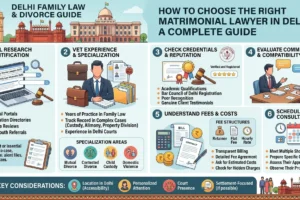
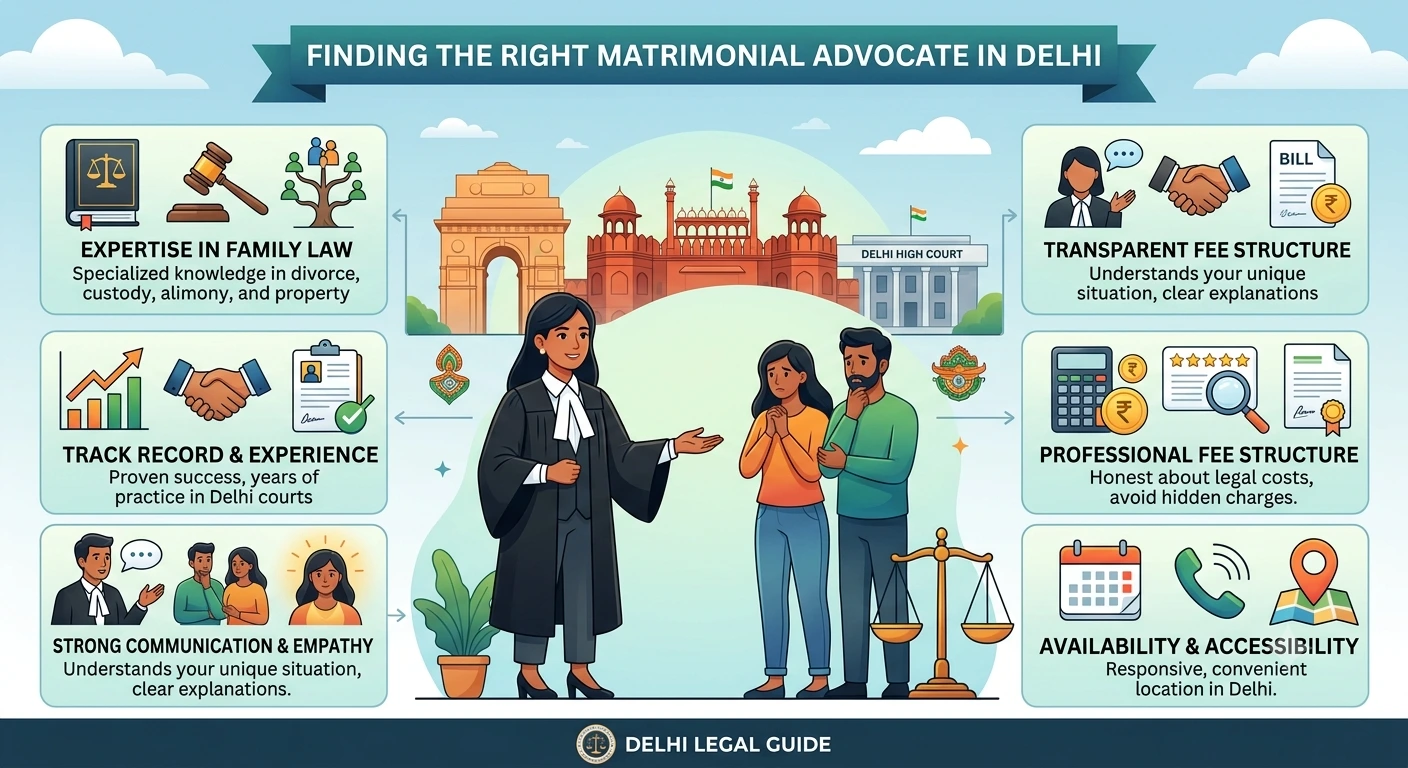
1. Look for relevant matrimonial-law experience
Start with the type of case you actually have.
An advocate who frequently handles family-law matters may be more relevant to your needs than someone whose practice is primarily commercial, property or criminal litigation.
Ask:
“How regularly do you handle cases similar to mine?”
You do not need a lawyer who claims to handle every possible legal matter. You need someone whose practice is relevant to your problem.
2. Check experience with your type of case
“Matrimonial case” is a broad description.
Your requirements may involve:
- Mutual consent divorce
- Contested divorce
- Maintenance
- Child custody
- Domestic violence proceedings
- Property or financial disputes connected with matrimonial proceedings
- Mediation and settlement
- Appeals
Ask whether the lawyer has handled matters involving the particular issue you are facing.
3. Consider Delhi court and procedural familiarity
An appropriate divorce lawyer in Delhi ought to be able to tell you where your case could be properly filed and why.
Legal relevance may rely on factors like residence, place of marriage, and other factors as provided by the law.
It is important not to take the office location as an indicator of the proper court.
4. Assess communication
During the first consultation, notice whether the lawyer:
- Listens before giving an opinion
- Explains legal terms clearly
- Identifies missing information
- Distinguishes facts from assumptions
- Explains possible risks
- Gives you an opportunity to ask questions
You should leave the consultation with a clearer understanding of your options, even if the final legal strategy requires further documents or investigation.
5. Understand the lawyer’s settlement approach
Don’t assume that your matrimonial lawyer has to be aggressive in all aspects.
In some cases, negotiation or mediation might be helpful, but in other cases, a strong case for litigation must be made.
Inquire about the way the advocate settles matters, and what factors they’d use for deciding to advocate for or against a contested matter.
6. Ask about fees before engagement
Professional fees can differ considerably depending on the lawyer, matter and complexity.
Ask for clarity about:
- Consultation charges
- Petition drafting
- Court appearances
- Interim applications
- Evidence
- Mediation
- Settlement drafting
- Connected proceedings
- Appeals
Do not select a lawyer solely because they quote the lowest fee.
7. Find out who will handle your case
At some law offices, the advocate you initially meet may not personally handle every hearing.
Ask:
“Who will appear in court and who will be responsible for my matter?”
Knowing the actual point of contact can prevent misunderstandings later.
How Should You Compare Matrimonial Lawyers in Delhi?
A simple comparison framework can make your shortlist more objective.
| Factor | What to Check |
|---|---|
| Matrimonial focus | Does the advocate regularly handle family-law matters? |
| Case relevance | Have they dealt with issues similar to yours? |
| Court experience | Are they familiar with the relevant Delhi court process? |
| Settlement skills | Can they negotiate as well as litigate where appropriate? |
| Communication | Do they explain your options clearly? |
| Fee transparency | Are charges and inclusions explained before engagement? |
| Availability | Can you communicate with the legal team when necessary? |
| Professional credentials | Can their identity and professional status be independently verified? |
| Strategy | Are advice and risks explained realistically? |
| Ethics | Do they avoid guaranteed outcomes and exaggerated claims? |
This approach is more reliable than relying on an unverified “top 10 matrimonial lawyers” list.
Best Matrimonial Lawyer in Delhi: What Makes a Lawyer Suitable?
The best matrimonial lawyer in Delhi is not a ranking per se.
A particular lawyer might be excellent for one individual and terrible for another.
For instance, if someone is looking for an uncontested settlement, they may place a greater focus on negotiation and streamlined documentation. He or she may be needed in someone’s case where he or she is involved in a very litigious custody or financial dispute.
Your shortlist should therefore be based on case fit.
Before hiring, consider whether the lawyer can clearly answer:
- What legal options may be available?
- What information is still required?
- What court or jurisdictional issue needs to be considered?
- What documents should be preserved?
- Which issues need immediate attention?
- Is settlement realistic in the circumstances?
- What could make the matter more complicated?
- How will professional fees be calculated?
If the lawyer promises you a definite result, he or she must be approached with caution. No one who advocates for a divorce or custody order or a specific monetary award can reasonably assure that such an order will be granted by a court.
Mutual Consent vs Contested Divorce
The difference between mutual and contested divorce is fundamental when choosing a matrimonial advocate.
| Issue | Mutual Consent Divorce | Contested Divorce |
|---|---|---|
| Basic position | Both spouses agree to seek divorce | Spouses do not agree on divorce and/or relevant issues |
| Settlement | Usually central to the process | May or may not be reached |
| Dispute level | Generally lower if agreement is genuine | Potentially extensive |
| Evidence | Depends on the proceedings and issues involved | May become important where facts are disputed |
| Negotiation | Often significant | May be necessary before or during litigation |
| Lawyer’s role | Documentation, advice, settlement and procedural representation | Pleadings, evidence, hearings, strategy and representation |
| Time | Cannot be guaranteed | Cannot be predicted universally |
| Relevant law | Depends on the marriage and applicable statute | Depends on the marriage and applicable statute |
For a Hindu marriage, Section 13B of the Hindu Marriage Act, 1955 provides the statutory framework for divorce by mutual consent, subject to its requirements.
The procedure and applicable law can differ where a marriage is governed by another statute.
What Is the Lawyer’s Role in Mutual Consent Divorce?
A mutual divorce lawyer in Delhi may assist with much more than preparing a petition.
Before filing, spouses may need to resolve issues such as:
- Permanent alimony or maintenance
- Return of belongings
- Child custody
- Visitation arrangements
- Children’s education and other expenses
- Bank accounts or financial obligations
- Property-related arrangements
- Withdrawal or resolution of connected proceedings
- Other agreed terms
The settlement must be carefully formulated since seemingly simple agreements can have significant implications in the future.
The statutory framework outlines a first motion and a second motion requirement. The time of six months has been cited frequently but is not a strict requirement and has been recognized by the Supreme Court in some cases to be abandoned, e.g., Amardeep Singh v. Harveen Kaur (2017).
A waiver ought to be considered depending on the facts and the appropriate law for a specific scenario.
Which Court Handles Divorce Matters in Delhi?
The jurisdiction of the appropriate court will be determined by territorial and statutory jurisdiction, not the office location of the lawyer.
Delhi has a district-court system of Family Courts for matrimonial and family matters. The forum that’s appropriate may be based on conditions set forth by the relevant laws, such as those that relate to the parties and marriage.
Before filing, confirm:
- The law governing your marriage.
- The statutory jurisdictional requirements.
- Relevant places of residence.
- Where the marriage took place, where relevant.
- Whether another matrimonial proceeding is already pending.
- Whether transfer or connected proceedings create additional considerations.
The divorce lawyer in Delhi or elsewhere in Delhi ought not to arbitrarily choose the court where the divorce is to be filed without explaining the reasons for choosing the court.
How Much Does a Divorce Lawyer Charge in Delhi?
There is no single statutory professional fee applicable to every divorce lawyer in Delhi.
The total professional cost can depend on factors such as:
- Type of matrimonial matter
- Mutual versus contested proceedings
- Number of hearings
- Complexity of evidence
- Maintenance applications
- Custody disputes
- Mediation and settlement work
- Number of connected proceedings
- Drafting requirements
- Appeals or other later proceedings
Therefore, searches for divorce lawyer in Delhi fees should not be answered with one supposedly universal figure.
Fee clarification checklist
| Fee Component | What to Ask |
|---|---|
| Consultation | Is it separately charged? |
| Petition drafting | Included or additional? |
| Court appearances | Per appearance or package? |
| Interim applications | Included or separate? |
| Evidence stage | Is additional professional fee applicable? |
| Mediation | Is mediation work included? |
| Settlement | Is settlement drafting covered? |
| Connected cases | Is a separate engagement required? |
| Appeals | Are they outside the original arrangement? |
Also ask whether court fees, process fees, documentation, photocopying or other out-of-pocket expenses are separate from professional fees.
Get the agreed commercial terms in writing where possible.
Documents to Take to Your First Consultation
You do not necessarily need every document before speaking to a lawyer, but relevant records can make the first consultation more productive.
Depending on your circumstances, consider taking:
- Marriage certificate, if available
- Wedding-related documents or photographs where legally relevant
- Identity and address documents
- Previous court notices or petitions
- Existing orders
- Previous settlement documents
- Relevant correspondence
- Financial records where maintenance is an issue
- Children’s school or expense information where relevant
- Evidence you believe may be legally significant
- Details of existing or threatened proceedings
Do not delete potentially relevant messages, emails, photographs or documents simply because they appear embarrassing or inconvenient. Ask a lawyer how such material should be preserved and whether it is legally relevant.
Questions to Ask Before Hiring a Matrimonial Lawyer
A first consultation is also an opportunity to evaluate the lawyer.
Consider asking:
- What legal route may apply to my circumstances?
- Which law governs my marriage?
- Which court or jurisdiction may be relevant?
- What documents do you need from me?
- What are the major issues in my case?
- Is settlement or mediation worth considering?
- What could make the case more complicated?
- Who will draft my pleadings?
- Who will appear at hearings?
- How are your professional fees structured?
- Which expenses are separate?
- How will I receive updates about my case?
You should not expect a lawyer to predict the judge’s decision. You should expect a reasoned explanation of the legal possibilities and risks based on the information available.
Red Flags When Choosing a Matrimonial Lawyer
Be cautious if a prospective representative:
- Guarantees that you will definitely obtain a divorce
- Promises a guaranteed custody result
- Claims to be “No. 1” without verifiable evidence
- Uses fabricated awards or testimonials
- Gives an unrealistically precise case timeline
- Cannot clearly explain the fee arrangement
- Discourages you from asking questions
- Does not explain who will actually conduct hearings
- Encourages destruction or manipulation of evidence
- Makes dramatic claims without reviewing the relevant facts
A professional legal consultation should help you understand your position—not create unrealistic expectations.
How Long Can Divorce Proceedings Take?
There is no universally guaranteed divorce timeline in Delhi.
There are significant differences between a mutual consent divorce and a contested matrimonial action. Plaintiff and defendant pleadings, interim applications, evidence, cross-examination, arguments, and other stages may be contested.
The duration can be influenced by:
- Nature of the dispute
- Court schedule
- Settlement efforts
- Number of applications
- Evidence and witnesses
- Conduct of the proceedings
- Appeals or connected litigation
In the case of consent divorce (Section 13B of the Hindu Marriage Act), there are provisions regarding the motion and the time mentioned in the provision. In the case of Amardeep Singh v. Harveen Kaur, the Supreme Court observed that the six months could, in special cases, be dispensed with by the Court.
That does not mean every mutual divorce can be completed in a particular number of days.
Child Custody Requires a Separate Focus
Where children are involved, divorce is only one part of the legal picture.
Parents may need to address:
- Physical custody
- Legal decision-making
- Visitation
- Schooling
- Medical decisions
- Travel
- Children’s expenses
- Communication arrangements
Under the appropriate law, the welfare and best interests of the child are taken into account by courts. A lawyer should therefore not make any specific claims as to the outcome of custody based on the account of one parent alone.
If custody is a big concern, then look for an attorney who specializes in family law, as that is the type of case in which they would have the most experience.
Maintenance and Alimony
Financial issues can arise during and after matrimonial proceedings.
The Hindu Marriage Act, 1955, provides for certain types of financial relief under Sections 24 and 25 of the Act in certain situations provided in these sections. Other laws may also offer appropriate remedies as the circumstances dictate.
Only an informed assessment of factors that affect parties and the law can responsibly determine the amount and availability of financial relief.
A lawyer assessing a maintenance issue may need information concerning:
- Income
- Employment
- Financial liabilities
- Assets
- Dependants
- Children’s expenses
- Existing financial arrangements
- Relevant court proceedings
This is another reason to take appropriate financial documentation to your consultation.
Mediation and Settlement in Matrimonial Matters
Mediation can be useful where both sides are willing to explore a negotiated resolution.
Possible settlement subjects can include:
- Divorce by mutual consent
- Maintenance or alimony
- Child custody
- Visitation
- Children’s expenses
- Return of belongings
- Property-related arrangements
- Withdrawal or resolution of connected proceedings
Mediation is not appropriate for every dispute, and participating in mediation does not mean you must accept a settlement that you do not agree with.
Your lawyer can explain the proposed terms and their legal implications before you make a decision.
Practical Insights From Matrimonial Practice in Delhi
A first consultation that is useful typically benefits when the client tells the history of the issue and not just the last argument.
Prepare a short timeline covering:
- Date and place of marriage
- Where the parties have lived
- Major relevant events
- Children and their current arrangements
- Financial issues
- Previous attempts at settlement
- Notices or proceedings already initiated
- Any upcoming court dates
Also separate what you personally know from what you have heard from someone else.
Also, identify the challenges that must be addressed together cooperatively. For example, if a divorce settlement does not discuss children’s issues or any other proceedings that have not been resolved, then there are issues that are left unanswered.
Finally, don’t hesitate to ask questions before signing. The form of a settlement is not the only thing that matters; it can have consequences for future rights and obligations.
Why Consider Delhi Legal Expert?
Delhi Legal Expert can provide you with information and assistance with matrimonial and family law matters in Delhi.
The information provided to prospective clients prior to entering into a consultation with the website’s attorney(s) contains the attorney’s name, credentials, practice areas, and fees. The appropriate legal actions will vary from case to case.
An initial consultation should help you become familiar with your legal options and jurisdiction, what the documentation will look like, what your likely next steps will be, and what you’re likely to be guaranteed when you meet with a lawyer.
Frequently Asked Questions
Who is the best matrimonial lawyer in Delhi?
No marriage law firm is the “best” in every situation. This varies depending on the legal issue, relevant experience, jurisdiction, communication, settlement and litigation strategies, availability, and fee transparency. Look at the advocates, not just at their ratings, ads, or reviews, but at the real professional information.
How do I choose a good matrimonial lawyer?
Firstly, identify your primary problem (divorce, custody, maintenance, or settlement). Then compare lawyers regarding the experience they have in the specific areas of matrimonial law, other cases involving similar facts, familiarity with the court system, ability to communicate, fees, and who will actually be handling your matters. During the consultation, you can ask questions, and you should steer clear of any lawyer who promises a result.
How much does a divorce lawyer charge in Delhi?
There is no fixed fee for divorce attorneys in Delhi. Costs may also differ based on the lawyer, the nature of the case, whether the case is contested or not, the number of hearings, drafting, evidence, mediation, custody or maintenance applications, and related cases. Request a written estimate of any professional fees and other charges prior to being engaged.
Which lawyer is suitable for mutual divorce?
A matrimonial and mutual consent divorce lawyer will be able to assist with eligibility, documentation, settlement terms, petitions, and court procedures. In respect of marriages under the Hindu Marriage Act, Section 13B lays out the legal process for mutual consent divorce. The applicable law should be confirmed for the particular marriage.
Which lawyer is suitable for contested divorce?
In contested divorce cases, seek an advocate who has experience in pleadings, evidence, cross-examination, interim applications, and/or final arguments, depending on the case. If there are multiple proceedings or custody or maintenance matters, ask if the attorney regularly represents clients in those areas, too.
Do I need a Delhi-based divorce lawyer?
Not always in all situations. The important thing is whether the advocate can represent you in the proceeding at issue and whether he or she is aware of the applicable jurisdiction and procedure. When comparing advocates in the matter, if it is before a court in Delhi, it is important to have a good understanding of the process of a court in Delhi.
Which court handles my divorce in Delhi?
The jurisdiction of the court will be determined by the law and the territorial jurisdiction. Family courts have been established in the District Court in Delhi for dealing with matrimonial and family disputes. The forum that should be determined should be based on the legally relevant facts and not on where either party or the lawyer may be located.
Can the six-month period for mutual divorce be waived?
In certain cases, the Supreme Court has held that the limitation of 6 months as mentioned in Section 13B(2) of the Hindu Marriage Act can be waived. Amardeep Singh v. Harveen Kaur lays down relevant principles. A waiver is not automatic and is only appropriate when the facts and legal requirements dictate.
How long does a divorce case take in Delhi?
A universal timeline cannot be relied on. There are different processes for mutually consented and contested proceedings, and contested proceedings may involve evidence, applications, and multiple hearings. The length of time can be influenced by court schedules and the complexity of the litigation. A lawyer can make a more valuable evaluation after looking at the circumstances.
Can custody and divorce issues be dealt with together?
They may occur in related matrimonial and family cases, and the applicable procedure and laws will vary based on the facts and circumstances. Custody decisions are a major issue involving child welfare. A parent should not take it for granted that a divorce will automatically result in custody, visitation, or other arrangements about a child.
Can a matrimonial lawyer guarantee the outcome?
Never make any promises about a court outcome that are not warranted by a lawyer. An advocate can clarify the law, options, strengths, risks, and procedural aspects, but only in the proper court, or where a lawful settlement is achieved, can decisions be made.
Need Clarity About Your Divorce Case in Delhi?
Choosing a matrimonial advocate is easier when you first understand what your case actually requires.
A consultation can help you clarify:
- Which legal options may apply
- Whether Delhi is the appropriate jurisdiction
- What documents should be collected
- Whether settlement or mediation may be appropriate
- Whether custody or maintenance issues need separate attention
- What the next procedural step may be
- How professional fees and representation will be structured
If you are comparing the best matrimonial lawyer in Delhi, focus on suitability, transparency, and relevant experience rather than an unsupported “No. 1” claim.
Authoritative Legal Sources
For legal content on matrimonial proceedings, the following primary sources should be consulted and verified against the current statutory or judicial position:
- India Code — official repository of Central legislation: https://www.indiacode.nic.in/
- Supreme Court of India — judgments and official court information: https://www.sci.gov.in/
- Delhi High Court — official court information and judgments: https://delhihighcourt.nic.in/
- Delhi District Courts — official information concerning Delhi district courts: https://delhidistrictcourts.nic.in/
- The Hindu Marriage Act, 1955 — including relevant provisions such as Sections 13, 13B, 24 and 25, where applicable.
Important: The law can change through legislation and judicial decisions. This article should be reviewed against current official sources before publication and should not be treated as individual legal advice.
Final Thoughts
As it is, hiring the best matrimonial lawyer in Delhi is simply about choosing the lawyer that will fit your legal circumstances. A lawyer who has previously worked on a mutual divorce may be able to do something different in the case of a long ongoing divorce with contested custody and/or complicated financial matters.
Don’t pay attention to rankings & marketing claims. Discuss experience, jurisdiction, communication, settlement strategy, and attorney’s fees for your representation. Most importantly, hire legal counsel who gives you realistic options, rather than a sure thing.
Editorial / Legal Review Information
Written by: Delhi Legal Expert Editorial Team
Legally reviewed by: [REAL ADVOCATE NAME — TO BE VERIFIED BEFORE PUBLICATION]
Practice area: Matrimonial & Family Law
Last reviewed: 28 August 2026