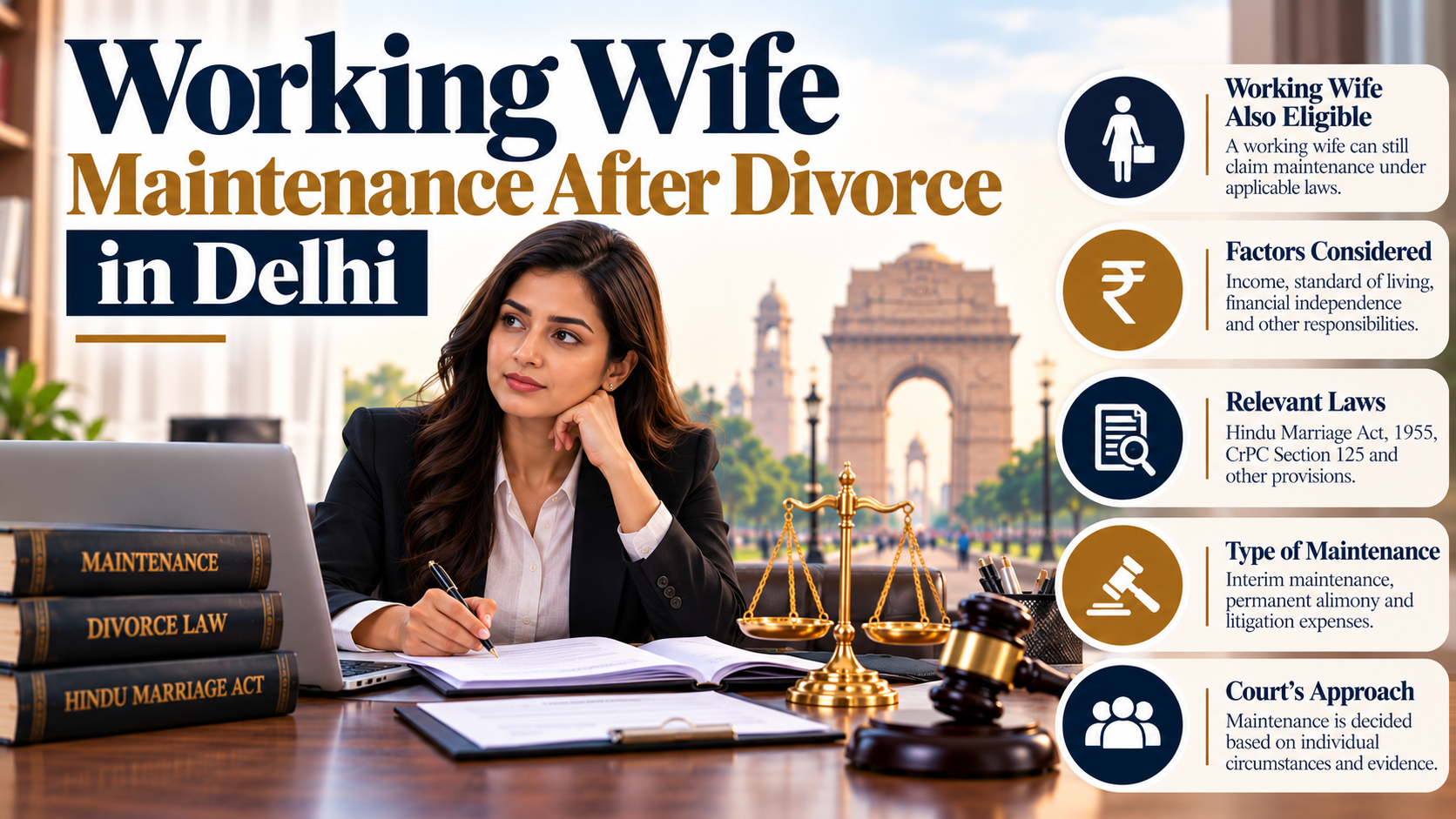
Can Working Wife Claim Maintenance After Divorce in Delhi?
One of the most common questions during divorce proceedings is: “If my wife is working, can she still claim maintenance after divorce?”
The short answer is: potentially, yes.
A wife does not automatically lose her right to seek maintenance merely because she has a job or earns an income. At the same time, being employed does not mean that maintenance must automatically be awarded.
The court considers the financial circumstances of both spouses, including their actual income, reasonable expenses, standard of living during the marriage, dependants, liabilities and other relevant circumstances.
The Delhi High Court has reiterated that the important consideration is not simply whether the wife is educated or capable of earning, but whether her actual income is sufficient in the circumstances of the case.
If you are facing a maintenance dispute during or after divorce, Delhi Legal Expert can help you understand the applicable law, evaluate financial documents and prepare your case before the appropriate court.
This guide explains how maintenance for a working wife is considered in Delhi, what factors courts examine, what documents may be required and how the legal process works.
Can a Working Wife Claim Maintenance After Divorce in Delhi?
Yes, a working wife can seek maintenance after divorce in appropriate circumstances.
Employment and maintenance are not mutually exclusive.
For example, suppose the wife earns ₹35,000 per month while the husband earns substantially more. The court would not decide the case merely by looking at the fact that the wife receives a salary.
Instead, it may consider the overall financial circumstances, including the wife’s actual income and reasonable needs, the husband’s income and liabilities, the standard of living during the marriage and other case-specific considerations.
Similarly, a high-earning wife who is financially self-sufficient may face a very different assessment.
There is therefore no automatic rule that every working wife receives maintenance or that every working wife is denied maintenance.
What Does “Maintenance” Mean After Divorce?
Maintenance is financial support that may be ordered by a court in accordance with the applicable matrimonial or maintenance law.
Depending on the proceeding, financial relief can arise at different stages.
Interim Maintenance
Interim maintenance is financial support sought while matrimonial or maintenance proceedings are pending.
Its purpose is different from the final determination of permanent alimony.
Permanent Alimony or Maintenance
Permanent alimony may be considered when matrimonial proceedings are finally decided or subsequently, depending on the applicable law.
For marriages governed by the Hindu Marriage Act, Section 25 permits the court to award a gross sum or monthly/periodical amount and expressly requires consideration of matters including the respondent’s income/property, the applicant’s income/property, conduct of the parties and other circumstances of the case.
The precise remedy available to you depends on your marriage, proceedings and applicable personal law.
Does a Wife’s Salary Stop Her From Claiming Maintenance?
Not necessarily.
This is one of the biggest misconceptions surrounding working wife maintenance after divorce in Delhi.
The question is not simply:
“Does the wife earn?”
The more meaningful question is:
“What does she actually earn, and what are the financial circumstances of both parties?”
In a 2025 decision, the Delhi High Court observed that actual stable income matters and that educational qualifications or a theoretical capacity to earn cannot, by themselves, justify denying interim maintenance. The court emphasised examining whether actual income is sufficient in light of the relevant circumstances.
The Supreme Court has likewise stated that maintenance cannot be determined solely from the husband’s income. The wife’s income, reasonable needs, residential rights and other relevant factors must also be considered.
Working Wife vs Wife Capable of Working: Important Difference
There is an important distinction between:
- a wife who is actually earning, and
- a wife who is merely qualified or capable of earning.
A postgraduate degree, professional qualification or previous employment does not necessarily establish that a woman currently has sufficient income.
In February 2026, the Delhi High Court again discussed this distinction, observing that capacity to earn and actual earning are different concepts.
Therefore, courts generally examine the actual financial evidence rather than relying only on assumptions about what either spouse could theoretically earn.
Which Factors Does the Court Consider?
There is no single mathematical formula applicable to every maintenance case.
Courts consider the circumstances of the parties.
Important factors may include:
- Wife’s actual monthly income
- Husband’s actual monthly income
- Other sources of income
- Property and financial assets
- Reasonable monthly expenses
- Standard of living during marriage
- Duration of marriage
- Age and circumstances of the parties
- Financial liabilities
- Dependent children
- Childcare responsibilities
- Medical expenses where relevant
- Residential requirements
- Other relevant circumstances
The Supreme Court has specifically recognised the relevance of the applicant’s income and reasonable needs, rather than assessing maintenance solely by reference to the other spouse’s income.
Is There a Fixed Percentage for Wife Maintenance in Delhi?
You may come across claims online such as:
“Wife always receives 25% of husband’s salary.”
That should not be treated as an automatic formula for every divorce or maintenance case.
Maintenance is fact-specific.
A Family Court may need to examine salaries, business income, assets, expenses, liabilities and the needs of dependants before determining an appropriate amount.
Therefore, you should avoid calculating your likely maintenance entitlement or liability solely through an online percentage.
What If the Wife Earns Less Than the Husband?
A lower salary does not automatically establish entitlement, but the income difference can be relevant.
Consider a hypothetical situation:
- Husband’s monthly income: ₹2,00,000
- Wife’s monthly income: ₹40,000
The court would not necessarily stop its analysis after discovering that the wife earns ₹40,000.
It may examine her reasonable expenses, financial responsibilities, the family’s previous standard of living, the husband’s financial position and other circumstances.
The final decision depends on evidence, not merely the difference between two salary figures.
What If the Wife Earns More Than the Husband?
This can materially affect the maintenance analysis.
If a wife has sufficient independent income and is financially self-sufficient, the court can take that fact into account while determining whether maintenance should be awarded and, if so, the appropriate amount.
Section 25 of the Hindu Marriage Act expressly requires consideration of the applicant’s own income and property alongside the respondent’s financial circumstances and other relevant factors.
Again, there is no universal rule based solely on which spouse earns more.
Can a Working Wife Claim Permanent Alimony?
A working wife may seek permanent alimony where the applicable law permits it.
Under Section 25 of the Hindu Marriage Act, the court can consider both parties’ income and property and other circumstances while deciding permanent alimony and maintenance. The provision also allows an order to be varied, modified or rescinded if circumstances subsequently change.
Therefore, employment is one factor in the assessment rather than an automatic statutory bar.
How Is Maintenance Decided in Delhi?
Step 1: Consult a Family or Divorce Lawyer
The first step should be understanding which legal remedy applies to your situation.
Your lawyer may ask about:
- Marriage and divorce status
- Employment
- Income of both spouses
- Children
- Existing court proceedings
- Assets
- Loans and liabilities
- Monthly expenditure
Full financial disclosure is important.
Step 2: Prepare the Maintenance Application
The application should clearly explain the relevant facts and financial circumstances.
Supporting documents may be attached wherever appropriate.
Step 3: Financial Disclosure
Income and asset disclosure plays an important role in maintenance litigation.
The Supreme Court’s decision in Rajnesh v. Neha established guidelines concerning financial disclosure and maintenance proceedings. Supreme Court records in 2026 continue to reflect directions requiring parties to file affidavits of assets and income in accordance with Rajnesh v. Neha.
Step 4: Response From the Other Party
The other spouse may contest:
- Claimed income
- Expenses
- Assets
- Liabilities
- Employment details
- Other financial assertions
Step 5: Court Considers Financial Circumstances
The court considers the material produced by both parties and the applicable law.
Step 6: Maintenance Order
After considering the relevant circumstances, the court may grant, decline or determine the appropriate financial relief.
Documents Required for a Maintenance Case
Documents vary from case to case, but commonly relevant material may include:
Identity and Marriage Documents
- Aadhaar or other identity proof
- Address proof
- Marriage certificate, where available
- Divorce decree, if divorce has already been granted
Employment and Income Documents
- Salary slips
- Employment letters
- Bank statements
- Income-tax returns
- Form 16
- Business income records, where applicable
Expense Documents
- Rent documents
- School fee records
- Medical bills
- Loan statements
- Household expenses
- Other recurring financial commitments
Property and Asset Information
Depending on the dispute, details relating to investments, property, bank accounts and other assets may also become relevant.
Your lawyer can identify which documents are material to your particular maintenance application.
How Long Does a Maintenance Case Take in Delhi?
There is no single timeline applicable to every maintenance proceeding.
The duration can depend on:
- Court workload
- Financial disclosure
- Disputes over income
- Documents filed by the parties
- Connected matrimonial proceedings
- Interim applications
- Complexity of assets or businesses
Your advocate should explain the likely procedural stages rather than promise a fixed date for the outcome.
How Much Does a Maintenance Lawyer Cost in Delhi?
Legal fees vary depending on factors such as:
- Complexity of the case
- Nature of proceedings
- Documents involved
- Number of hearings
- Experience of the advocate
- Whether connected divorce, custody or domestic violence proceedings exist
Before engaging an advocate, ask about the professional fee structure and scope of representation.
Can Maintenance Change If the Wife Gets a Better Job?
Potentially, yes.
A substantial change in financial circumstances may be relevant to an existing maintenance arrangement, depending on the law under which the order was passed.
For example, Section 25(2) of the Hindu Marriage Act allows the court, upon an application, to vary, modify or rescind a permanent maintenance order when circumstances change.
This does not mean that obtaining a salary increase automatically terminates maintenance.
The effect depends on the nature of the original order, applicable law and overall circumstances.
Does Remarriage Affect Maintenance After Divorce?
Remarriage can have significant legal consequences.
For permanent maintenance under Section 25 of the Hindu Marriage Act, remarriage of the person receiving maintenance is specifically recognised as a circumstance upon which the other party may seek variation, modification or rescission of the order.
If remarriage is relevant to your case, obtain advice about the specific maintenance order rather than assuming payments automatically continue or automatically stop.
Child Maintenance Is a Separate Issue
A wife’s personal maintenance and a child’s maintenance should not be treated as the same question.
Even where the mother is employed, financial responsibility for a child’s maintenance, education and welfare may still need separate consideration.
Under the Hindu Marriage Act, Section 26 permits courts to make orders regarding the custody, maintenance and education of minor children during matrimonial proceedings and after the decree where appropriate.
Therefore, a dispute about the wife’s maintenance does not by itself resolve child-support issues.
Common Mistakes in Working-Wife Maintenance Cases
Hiding Income or Assets
Trying to conceal salary, bank accounts, property or other income can damage credibility and complicate proceedings.
Assuming Employment Automatically Ends Maintenance
Employment is relevant, but actual financial sufficiency and the broader circumstances matter.
Relying on Salary Alone
Salary is only one part of the financial picture. Assets, liabilities, dependants and reasonable expenses may also be relevant.
Not Keeping Financial Records
Bank statements, salary records, tax returns and expense documents can become important evidence.
Using Online Maintenance Calculators as Legal Advice
There is no universal calculator that can accurately predict what a Delhi court will award in every case.
Ignoring Changes in Circumstances
A significant subsequent change in income or circumstances may have legal consequences for an existing order.
Maintenance Cases and Family Courts in Delhi
Maintenance and matrimonial disputes in Delhi may arise before the appropriate Family Court or other competent court depending on the nature of the proceeding and territorial jurisdiction.
Relevant Family Court jurisdictions may be associated with court complexes such as:
- Saket Courts
- Dwarka Courts
- Rohini Courts
- Tis Hazari Courts
- Karkardooma Courts
Appeals or other appropriate proceedings may reach the Delhi High Court depending on the statutory route and the order involved. The Delhi High Court itself categorises divorce, child custody and maintenance-related matters within its family-law jurisdiction.
Your case should be filed before the court having proper jurisdiction; the nearest court is not necessarily the legally appropriate court.
Why Hiring a Maintenance Lawyer Can Help
Maintenance litigation often involves more than making a simple income comparison.
A family lawyer can help you:
- Identify the appropriate legal remedy
- Understand your rights and obligations
- Prepare financial disclosures
- Examine income and expense records
- Draft the maintenance application or reply
- Respond to disputed financial claims
- Prepare supporting evidence
- Represent you during hearings
- Address connected divorce or child-maintenance issues
- Seek modification where legally available
Professional guidance can be particularly useful where one spouse has business income, irregular earnings, substantial assets or disputed financial disclosures.
How Delhi Legal Expert Can Assist
Delhi Legal Expert provides professional legal assistance in Delhi for individuals dealing with divorce, maintenance and other family-law matters. Our advocates help clients understand their legal rights, prepare necessary documents, handle court procedures and receive practical legal guidance according to their specific circumstances.
For working wife maintenance after divorce in Delhi, assistance may include:
- Maintenance eligibility consultation
- Income and asset document review
- Maintenance application preparation
- Reply to maintenance claims
- Financial disclosure assistance
- Family Court representation
- Divorce and permanent alimony guidance
- Child-maintenance guidance
- Settlement and negotiation assistance
- Guidance concerning modification of existing maintenance orders
Every maintenance dispute is different. Advice should therefore be based on the actual financial and matrimonial circumstances rather than a general online formula.
Frequently Asked Questions
Q1. Can a working wife claim maintenance after divorce in Delhi?
Yes, a working wife may seek maintenance after divorce where the applicable law and circumstances support the claim.
Having employment does not by itself automatically disqualify a wife. The court can examine her actual income, reasonable needs, assets and other circumstances along with the husband’s financial position.
Q2. Can an earning wife get maintenance from her husband?
Potentially, yes. The fact that a wife earns some income does not automatically decide the maintenance application.
The Delhi High Court has emphasised examining actual income and whether it is sufficient in the circumstances rather than relying only on qualifications or earning capacity.
Q3. Can a wife claim maintenance if she earns ₹50,000 per month?
There is no automatic yes-or-no answer based on a ₹50,000 salary.
The court may examine both spouses’ income, expenses, assets, liabilities, dependants, standard of living and other relevant circumstances before deciding entitlement and quantum.
Q4. Can maintenance be denied if the wife earns more than the husband?
The wife’s higher income can be an important factor in determining maintenance, but the outcome depends on the applicable law and full financial circumstances.
For permanent alimony under the Hindu Marriage Act, the court expressly considers the income and property of both the applicant and respondent.
Q5. Is there a fixed percentage of the husband’s salary for maintenance?
No single fixed percentage should be treated as an automatic formula applicable to every Delhi maintenance case.
Courts determine maintenance according to the circumstances and evidence before them.
Q6. Can an educated wife claim maintenance if she is unemployed?
Educational qualification and actual income are different issues.
The Delhi High Court has stated that mere earning capacity cannot substitute for actual earnings when assessing maintenance.
Q7. Can maintenance continue after divorce?
Maintenance or permanent alimony may continue or be awarded after divorce where permitted under the applicable law and court order.
For example, Section 25 of the Hindu Marriage Act provides for permanent alimony and maintenance and also contains provisions concerning subsequent modification.
Q8. Can maintenance be reduced if the wife starts earning?
A significant change in financial circumstances may justify seeking modification in appropriate cases.
Under Section 25(2) of the Hindu Marriage Act, a court may vary, modify or rescind an order where it is satisfied that circumstances have changed.
Q9. Does a working mother still have the right to seek child maintenance?
The mother’s employment does not automatically determine the child’s maintenance rights.
Child maintenance and the wife’s personal maintenance involve separate considerations. The court may examine the child’s needs and the financial circumstances of the parents.
Q10. Which lawyer should I consult for a maintenance case in Delhi?
You should consider consulting a divorce or family-law advocate experienced in maintenance proceedings and financial disclosure.
Delhi Legal Expert can assist with maintenance applications, responses, divorce proceedings, documentation and representation before the appropriate courts in Delhi.