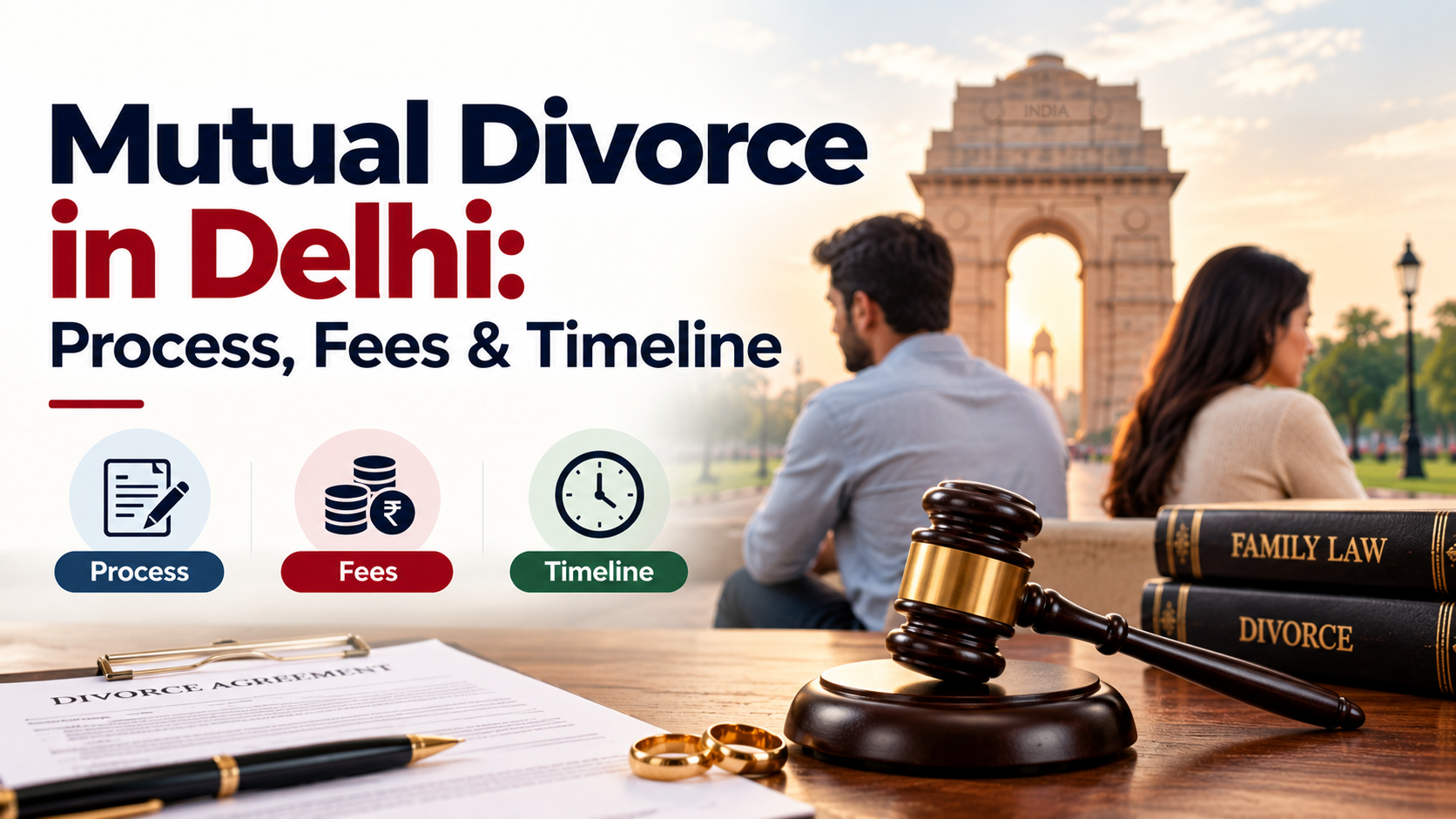
Mutual Divorce in Delhi: Procedure, Documents, Fees & Timeline
When both spouses agree that continuing their marriage is no longer possible, mutual consent divorce can provide a structured legal route to end the marriage without having to litigate allegations against each other.
But agreeing to divorce is only the beginning. You may still have several questions: Where should we file the petition? What documents are required? What happens to child custody and maintenance? Is there always a six-month waiting period? How much will a mutual divorce cost?
If these questions sound familiar, this guide will help you understand the divorce process in Delhi in straightforward language.
At Delhi Legal Expert, we assist individuals and couples with mutual divorce petitions, settlement terms, documentation and Family Court proceedings. The objective is to help you understand what you are agreeing to before the petition reaches the court.
What Is Mutual Divorce?
Mutual divorce means that both spouses jointly agree to legally dissolve their marriage.
For marriages governed by the Hindu Marriage Act, 1955, Section 13B provides for divorce by mutual consent. It states, among other requirements, that the parties must have been living separately for one year or more, have been unable to live together and mutually agree that the marriage should be dissolved.
Importantly, “living separately” in this context is a legal concept and should not automatically be understood as requiring different physical addresses in every situation. Your particular facts should be discussed with a matrimonial lawyer before filing.
Mutual divorce is different from a contested divorce. In a contested case, one spouse seeks divorce against the other on a legally recognised ground and the dispute may require pleadings, evidence and adjudication. In a mutual consent case, both spouses approach the court jointly.
Is Mutual Divorce the Right Option for You?
Mutual divorce may be appropriate when both spouses have independently and voluntarily decided to end the marriage and can reach an agreement on the important consequences of separation.
Before filing, it is useful to discuss issues such as:
- Permanent alimony or maintenance, if any
- Child custody and parenting arrangements
- Visitation rights
- Child-related expenses
- Return of jewellery, belongings or other articles
- Financial settlements
- Pending matrimonial or connected proceedings
- Any other agreed obligations between the parties
Do not treat the settlement agreement as a mere formality. It can determine important financial and parental rights after the divorce.
mutual divorce process in Delhi: Step by Step
If you are searching for how to file mutual divorce in Delhi, the process can broadly be understood through the following stages.
Step 1: Discuss and Finalise the Settlement
Before filing the petition, both spouses should clearly understand what has been agreed.
For example, if you have children, the settlement should address custody, access and financial responsibilities. If maintenance or a lump-sum settlement is involved, the amount and payment stages should be clearly recorded.
Ambiguous settlement terms can create disputes later.
Step 2: Consult a Mutual Divorce Lawyer in Delhi
A matrimonial lawyer can review the circumstances of the marriage and determine the law applicable to your case.
The lawyer can also help with:
- Drafting the joint petition
- Preparing settlement terms
- Reviewing jurisdiction
- Organising supporting documents
- Preparing applications, where necessary
- Explaining first and second motion proceedings
- Representing or assisting the parties before the appropriate court
This stage is particularly important when property, children, substantial financial settlements or pending cases are involved.
Step 3: Prepare the Mutual Divorce Petition
The petition generally contains relevant details about the parties and marriage, including the circumstances leading to separation and the fact that the parties mutually seek dissolution.
The exact contents and supporting documents depend on the applicable matrimonial law and the facts of the case.
Step 4: File Before the Appropriate Family Court
Matrimonial matters falling within the Family Courts Act are dealt with by Family Courts in Delhi. Delhi High Court’s published practice directions also recognise matters within Sections 7 and 8 of the Family Courts Act as exclusively triable by Family Courts.
Which Family Court has jurisdiction depends on the applicable legal provisions and facts of the marriage. You should therefore verify jurisdiction before filing instead of selecting a court merely because it is geographically convenient.
Step 5: First Motion
After filing, the court considers the joint petition and interacts with the parties as required.
The court must be satisfied that the consent is genuine. Under the Hindu Marriage Act, consent for mutual divorce must not have been obtained through force, fraud or undue influence.
This is one reason both spouses should fully understand the settlement before making statements before the court.
Step 6: Cooling-Off Period and Possible Waiver
This part of the mutual divorce process in Delhi is frequently misunderstood.
Section 13B(2) of the Hindu Marriage Act refers to the second motion being made not earlier than six months after presentation of the first petition and within the statutory outer period specified in the provision.
However, the Supreme Court has held that the six-month cooling-off period is not inflexible in every case and may be waived by the court in appropriate circumstances. The purpose of the period is to provide an opportunity for reflection and possible reconciliation, rather than unnecessarily prolonging a marriage where reconciliation is no longer possible.
Therefore, you should not assume that:
“Every mutual divorce takes exactly six months.”
Nor should you assume:
“The six-month period will definitely be waived.”
Whether waiver is available depends on the circumstances and the court’s consideration of the request.
Step 7: Second Motion
If the matter proceeds to the second-motion stage, both spouses reaffirm their intention to dissolve the marriage.
The court considers whether the statutory requirements have been met and whether mutual consent continues.
Step 8: Final Divorce Decree
Once the court is satisfied that the applicable legal requirements have been fulfilled, it may pass a decree dissolving the marriage.
Under Section 13B, the marriage stands dissolved from the date of the decree.
Keep certified or otherwise officially available copies of the decree safely, as they may be required for future legal or administrative purposes.
Documents Required for Mutual Divorce in Delhi
There is no sensible one-size-fits-all document list because requirements can vary according to the applicable law and facts.
Commonly relevant documents may include:
- Proof of identity of both spouses
- Address proof
- Marriage certificate, where available
- Marriage photographs or related marriage records where relevant
- Details relating to the date and place of marriage
- Details concerning children, if applicable
- Settlement agreement or agreed terms
- Income or financial records where maintenance is involved
- Property-related documents where a settlement concerns property
- Information regarding pending matrimonial proceedings
- Other supporting documents advised by your lawyer
Before filing, have your lawyer check the complete set rather than relying solely on a generic online checklist.
What Should a Mutual Divorce Settlement Cover?
This is one of the most important parts of the entire divorce procedure.
A well-drafted settlement may address:
Maintenance and Alimony
The parties should clearly state whether maintenance or permanent alimony has been agreed and, where applicable, specify the amount, timing and mode of payment.
Child Custody
If the couple has children, the agreement should clearly address custody and parenting arrangements.
Visitation and Access
Where relevant, the settlement can specify how and when the non-custodial parent will meet or communicate with the child, subject to the child’s welfare and applicable court orders.
Child Expenses
Education, healthcare and other child-related financial responsibilities may need to be addressed.
Property and Financial Matters
Where property or financial arrangements form part of the settlement, the obligations should be clearly documented.
Pending Proceedings
If other matrimonial or connected proceedings are pending, obtain legal advice on how the settlement deals with those matters and what procedural steps are required.
How Long Does Mutual Divorce Take in Delhi?
There is no universal completion time for every case.
For a mutual consent divorce under the Hindu Marriage Act, the statutory framework includes the first petition and second-motion mechanism described above. The six-month interval may be capable of waiver in appropriate circumstances, but waiver is not automatic.
The practical timeline can also depend on:
- Whether settlement terms are already finalised
- Whether documentation is complete
- Whether a cooling-off waiver is sought and allowed
- Court scheduling
- Whether disputes arise during the process
- Whether one party changes their position
- Whether connected proceedings require additional steps
Be cautious of anyone promising a guaranteed divorce within a fixed number of days without reviewing your circumstances.
Mutual Divorce Fees in Delhi
Another common search is “mutual divorce fees in Delhi.”
There is no single advocate fee applicable to every mutual divorce matter.
Your overall legal expense can vary based on:
- Complexity of the settlement
- Drafting requirements
- Number of proceedings involved
- Child custody arrangements
- Financial or property settlement
- Additional applications
- Professional fees charged by the advocate
Ask for a clear fee structure before proceeding and understand what work is included.
Can the Six-Month Waiting Period Be Waived?
Potentially, yes.
The Supreme Court has recognised that the cooling-off period under Section 13B(2) can be waived in appropriate cases. Courts consider the purpose of the waiting period and the circumstances before them; waiver should therefore be treated as a legal request for judicial consideration, not an entitlement automatically granted in every mutual divorce.
If both spouses have already been separated for a substantial period and have genuinely settled all outstanding issues, speak with your lawyer about whether seeking waiver is appropriate in your case.
What Happens If One Spouse Changes Their Mind?
Mutual divorce fundamentally depends on continuing mutual consent.
This is why settlement discussions should happen carefully before filing. Neither spouse should sign documents simply because they feel pressured to complete the process quickly.
If consent is withdrawn or a dispute develops, obtain case-specific legal advice about the consequences and available remedies.
Mutual Divorce vs Contested Divorce
Mutual divorce is based on agreement between the spouses. The parties jointly seek dissolution and generally settle consequential issues between themselves.
Contested divorce, by contrast, involves one spouse seeking divorce on an applicable legal ground where there is no joint consent to dissolve the marriage.
The right procedure depends on your circumstances. Mutual divorce should not be chosen merely because it appears faster if important financial, custody or legal issues remain unresolved.
Common Mistakes to Avoid During Mutual Divorce
Even an apparently straightforward mutual divorce can become complicated if the settlement is incomplete.
Common mistakes include:
- Signing settlement terms without understanding them
- Leaving child custody arrangements vague
- Not specifying payment schedules
- Ignoring pending litigation
- Filing in the wrong jurisdiction
- Assuming the six-month period is automatically waived
- Relying on verbal promises that are absent from the written settlement
- Using generic online drafts for complicated financial arrangements
- Agreeing to terms under pressure
Take time to understand every clause before signing.
Mutual Divorce Legal Assistance in Delhi
Delhi has specialised Family Courts dealing with matrimonial matters, and the Delhi High Court maintains rules and practice directions concerning Family Court proceedings.
Depending on jurisdiction, matrimonial matters may be dealt with through the appropriate Family Court associated with Delhi’s district court establishments, including areas served through court complexes such as Saket, Dwarka, Rohini, Tis Hazari and Karkardooma.
The correct court should always be determined from the applicable jurisdictional rules and the facts of your case rather than simply choosing the nearest court.
How Delhi Legal Expert Can Help With Mutual Divorce
At Delhi Legal Expert, we understand that even when both spouses agree to divorce, the process can involve sensitive decisions about children, finances and future responsibilities.
Our legal assistance can include:
- Initial matrimonial-law consultation
- Reviewing eligibility for mutual consent divorce
- Determining appropriate jurisdiction
- Drafting the mutual divorce petition
- Preparing and reviewing settlement terms
- Guidance concerning maintenance and alimony
- Child custody and visitation-related assistance
- Preparing supporting documents
- Assistance during first-motion proceedings
- Advice regarding cooling-off-period waiver where legally appropriate
- Assistance with second-motion proceedings
- Family Court representation and procedural guidance
Our approach is to explain the legal process clearly so that you understand both the immediate divorce procedure and the consequences of the settlement you are entering into.
Why Consult a Mutual Divorce Lawyer in Delhi?
You may already agree with your spouse on ending the marriage, but that does not necessarily mean every legal issue has been resolved.
A mutual divorce lawyer in Delhi can help identify issues that might otherwise be overlooked.
For example, a settlement saying “all financial matters are settled” may not provide enough clarity where significant payments or property obligations remain.
Similarly, child-related arrangements require careful attention because the child’s welfare remains central to custody-related decisions.
Legal review before filing can therefore help reduce ambiguity and future disputes.
Frequently Asked Questions
Q1. What is the mutual divorce process in Delhi?
Broadly, both spouses reach an agreement, prepare and file a joint petition before the competent Family Court, participate in the first-motion process and subsequently proceed with the second motion as permitted by law. Once the court is satisfied that the legal requirements are fulfilled and consent continues, it may grant the divorce decree.
The exact divorce process in Delhi depends on the law governing the marriage and the circumstances of the couple.
Q2. How long does mutual divorce take in Delhi?
There is no guaranteed duration. Under Section 13B of the Hindu Marriage Act, the statutory framework provides for a six-month interval before the second motion, but the Supreme Court has recognised that this period can be waived in appropriate cases.
Court schedules, documentation, settlement issues and any connected proceedings can also affect the overall timeline.
Q3. Is six months compulsory for mutual divorce?
Not necessarily in every case. The Supreme Court has held that the cooling-off period may be waived in appropriate circumstances.
Whether waiver should be sought and whether it will be granted depends on the facts and judicial consideration.
Q4. Can we file mutual divorce before completing one year of marriage?
Under the Hindu Marriage Act, Section 14 generally restricts presentation of a divorce petition until one year has elapsed from the marriage, while providing a limited exception involving an application based on exceptional hardship or exceptional depravity. Section 13B also contains its own requirement concerning the parties living separately for one year or more.
Get case-specific advice before assuming that an exception applies.
Q5. What documents are required for mutual divorce in Delhi?
Common documents can include identity and address proofs, marriage records, details relating to children and settlement documentation. Financial or property documents may also be relevant where those issues form part of the settlement.
Your lawyer should provide a case-specific document checklist.
Q6. What is the cost of mutual divorce in Delhi?
The cost varies according to professional fees, drafting requirements, complexity of the settlement and any additional proceedings or applications.
Instead of relying on a generic online price, ask the lawyer for a transparent scope of work and fee structure.
Q7. Can mutual divorce be filed if we have children?
Having children does not by itself prevent spouses from seeking mutual divorce. However, issues involving custody, visitation, maintenance and other child-related responsibilities should be carefully addressed.
The child’s welfare remains an important consideration in custody-related matters.
Q8. Do both husband and wife have to agree to mutual divorce?
Yes. Mutual consent is fundamental to this form of divorce. Under the Hindu Marriage Act, the court must also be satisfied that consent has not been obtained by force, fraud or undue influence.
Q9. Do we need a lawyer for mutual divorce in Delhi?
Legal representation can be particularly useful for drafting the petition, reviewing settlement terms, checking jurisdiction and explaining the legal consequences of the agreement.
Even when spouses are on good terms, independent understanding of important financial and parental rights can prevent problems later.
Q10. Where should a mutual divorce case be filed in Delhi?
The competent court depends on statutory jurisdiction and the facts of your marriage and residence. Matrimonial matters within the Family Courts Act are handled by Family Courts in Delhi.
A matrimonial lawyer can review your circumstances and identify the appropriate Family Court before filing.