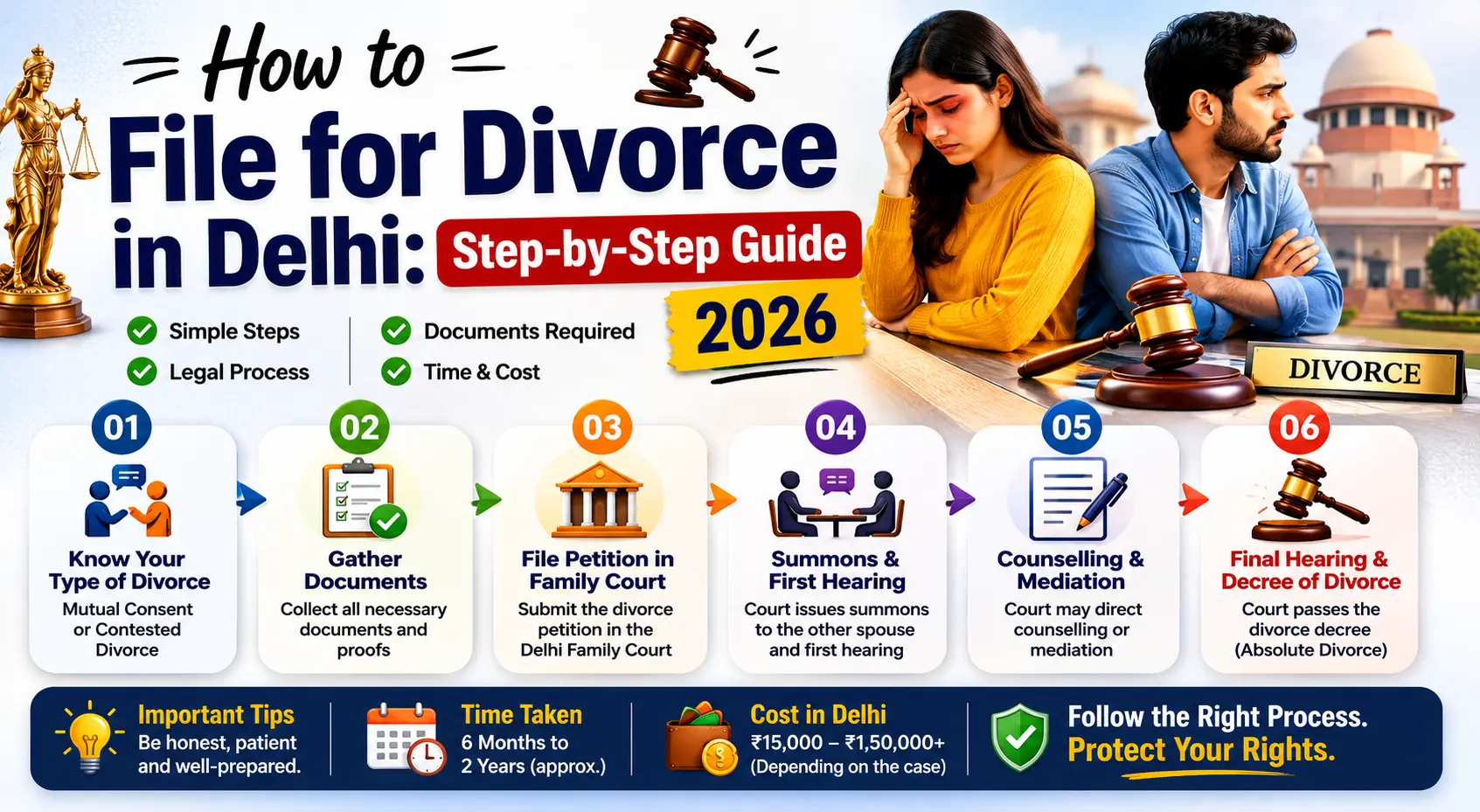
How Do You File for Divorce in Delhi?
To file for divorce in Delhi, first identify which personal law governs your marriage. Select the correct local family court based on your residential address or where the marriage was solemnised. Prepare your official documents and submit your divorce petition to the court clerk. You can file for mutual consent divorce if both spouses agree, or a contested divorce if you have specific legal grounds. A skilled family lawyer simplifies this entire process for you.
Walk into any family court in Delhi without the correct paperwork and the clerk will reject your case immediately. Filing in the wrong district or missing vital details can delay your hearings for months or years. In our experience, verifying your local court jurisdiction first prevents significant delays. This practical guide walks you through every step required to obtain your final divorce decree.
What Are the Two Types of Divorce in Delhi?
- Mutual Consent Divorce — Both spouses agree to end the marriage and have already settled terms on maintenance, custody, and property. Faster, less expensive, less adversarial.
- Contested Divorce — One spouse files on specific legal grounds (cruelty, desertion, adultery, etc.) without the other’s agreement. Longer, more complex, requires stronger evidence.
What Are the Legal Grounds for Divorce in India?
Cruelty, desertion, and adultery are the primary legal grounds. Under the Hindu Marriage Act, 1955, you may file for divorce if your spouse subjects you to cruelty or deserts you for a continuous period of two years. For a mutual consent divorce, you do not need to prove these grounds — both spouses need only have lived separately for one year and mutually agree to dissolve the marriage.
Grounds for divorce under the Hindu Marriage Act, 1955 (Section 13):
- Cruelty — Physical or mental cruelty by the spouse (most commonly cited ground in Delhi)
- Desertion — Spouse has deserted you for a continuous period of at least two years
- Adultery — Spouse has had voluntary sexual intercourse with another person
- Conversion — Spouse has converted to a non-Hindu religion
- Mental disorder — Spouse suffers from incurable unsoundness of mind
- Communicable disease — Spouse suffers from venereal disease in a communicable form
- Renunciation — Spouse has renounced the world by entering a religious order
- Presumption of death — Spouse has not been heard of or known to be alive for seven years
Note: Muslim, Christian, and Parsi personal laws have their own grounds for divorce. The Special Marriage Act, 1954 applies to inter-faith and registered civil marriages. Always confirm which law governs your marriage before filing.
What Documents Are Required to File for Divorce in Delhi?
Marriage certificate, address proof, and passport-size photographs are the core requirements. Submit the original marriage certificate or a certified copy, along with identity documents for both spouses. Mutual consent divorce cases require a joint petition clearly setting out agreed terms on maintenance, child custody, and property division.
- ✅ Original marriage certificate (or certified copy from Registrar)
- ✅ Address proof of both parties — Aadhaar card, passport, or voter ID
- ✅ Passport-size photographs of both parties
- ✅ Proof of separate residence for at least one year (for mutual consent divorce)
- ✅ Income and financial documents (salary slips, ITR, bank statements) — for maintenance claims
- ✅ Evidence of grounds cited — in contested divorce (medical records, police complaints, witness statements, photographs, call records, etc.)
- ✅ Birth certificates of children — if child custody is involved
- ✅ Property documents — if matrimonial property division is part of the case
- ✅ Joint petition and settlement terms — for mutual consent divorce
How to File for Mutual Consent Divorce in Delhi – Step by Step
The process takes from 6 to 18 months. You must file a joint petition under Section 13B of the Hindu Marriage Act. Both spouses must have lived separately for at least one full year before filing. You will attend two court hearings separated by a mandatory six-month cooling-off period.
- Consult a divorce lawyer — Understand your rights, draft the settlement terms, and verify all documents
- Prepare the joint petition — Both spouses sign a petition stating their agreement to divorce and the settled terms (maintenance, custody, property)
- File the petition in family court — The correct family court is typically determined by where the couple last resided together
- First motion hearing — The court records the statements of both parties and admits the petition; the six-month cooling-off period begins
- Cooling-off period (6 months) — The court may waive this period where the marriage has irretrievably broken down; otherwise, both parties wait out the full six months
- Second motion hearing — Both parties reaffirm their consent; the court is satisfied the divorce is voluntary and the terms are fair
- Divorce decree passed — The court grants the decree of divorce; the marriage is legally dissolved
Important: The Supreme Court of India has held that the six-month cooling-off period can be waived if the court is satisfied that the marriage has irretrievably broken down. Your advocate can file an application for waiver at the time of the first motion hearing.
How to File for Contested Divorce in Delhi – Step by Step
One spouse must file a contested divorce on specific legal grounds under the applicable personal law. These cases often drag on for 2 to 5 years because court dockets in Delhi remain heavily overloaded.
- Consult a divorce lawyer — Assess your grounds, gather evidence, and understand your realistic prospects
- File the divorce petition — Your advocate drafts and files the petition in the appropriate Delhi family court
- Court issues summons — The court sends summons to your spouse to appear and file a written response
- Spouse files written statement — The respondent files a written statement, admitting or denying the allegations
- Interim applications — Either party may apply for interim maintenance, child custody, or residence orders while the case is pending
- Evidence stage — Both parties submit documentary evidence and witness affidavits; cross-examination takes place
- Arguments — Advocates for both sides present oral and written arguments before the judge
- Judgment — The court passes a judgment either granting or dismissing the divorce petition
- Decree and appeal — If divorce is granted, a decree is issued; either party may appeal to the Delhi High Court within 90 days
Which Family Court in Delhi Should You File Your Divorce In?
You must select the correct family court based on your residential address. Under the applicable law, you must file in the court with jurisdiction over the place where the marriage was solemnised, where the couple last resided together, or where the wife currently resides. Filing in the wrong court results in your petition being returned or transferred, causing significant delays.
| Area of Delhi | Family Court |
|---|---|
| North, North-West Delhi | Tis Hazari Courts |
| South Delhi | Saket District Court |
| Rohini, Outer Delhi | Rohini District Court |
| Central, New Delhi | Patiala House Courts |
| East Delhi | Karkardooma District Court |
| South-West Delhi | Dwarka District Court |
How Long Does a Divorce Take in Delhi?
A mutual consent divorce in Delhi typically falls within the 6 to 18-month timeframe, including the mandatory six-month cooling-off window. A contested divorce takes substantially longer — generally 2 to 5 years in district family courts. An appeal to the Delhi High Court extends the case further. You can reduce these timelines by submitting complete, accurate documents and attending every scheduled hearing.
| Type of Divorce | Typical Timeline |
|---|---|
| Mutual consent (with cooling-off) | 6 – 18 months |
| Mutual consent (cooling-off waived) | 3 – 9 months |
| Contested divorce (district court) | 2 – 5 years |
| Contested divorce (with HC appeal) | 5 – 10+ years |
How Much Does a Divorce Cost in Delhi?
The final divorce cost depends mostly on the type of divorce you pursue. Mutual consent divorces are always the most affordable option. Contested divorce cases involve substantially more legal work, with base expenses starting at ₹50,000 and potentially reaching several lakhs. Actual court filing fees are nominal, costing just a few hundred rupees.
- Mutual consent divorce (simple): ₹10,000 – ₹30,000
- Mutual consent divorce (complex terms): ₹30,000 – ₹75,000
- Contested divorce (no property dispute): ₹50,000 – ₹1,50,000+
- Contested divorce (property + custody): ₹1,50,000 – ₹5,00,000+
- Court filing fee: ₹200 – ₹1,000 (nominal)
- Miscellaneous (photocopies, notarisation, etc.): ₹2,000 – ₹5,000
What Are the Common Mistakes to Avoid When Filing for Divorce in Delhi?
Common mistakes when filing for divorce in Delhi include filing in the wrong court, submitting incomplete documents, agreeing to unfair consent terms without independent legal advice, not applying for interim maintenance, and delaying the filing of an injunction when assets are at risk.
- ❌ Filing without a lawyer — Procedural errors are common and difficult to reverse
- ❌ Signing consent terms drafted only by the other side’s advocate — Always obtain independent review
- ❌ Not applying for interim maintenance — You are entitled to support during the proceedings; many people do not claim it
- ❌ Ignoring child custody terms — Vague custody arrangements lead to future disputes; insist on specific, detailed terms
- ❌ Hiding or omitting assets — Courts can reopen settlements if material non-disclosure is proved later
- ❌ Missing court dates — Repeated absence can result in ex-parte orders against you
FAQ: Filing for Divorce in Delhi
Can I file for divorce without a lawyer in Delhi? Technically yes — Indian courts permit self-representation. However, we strongly advise against it, even in mutual consent cases. A divorce in Delhi involves legally binding decisions about maintenance, child custody, and property that affect your life for years. At minimum, have an independent advocate review all documents before signing.
What is the minimum separation period required for divorce in Delhi? For mutual consent divorce under Section 13B of the Hindu Marriage Act, you and your spouse must have lived separately for at least one year before filing. For contested divorce, there is no minimum separation period — you can file immediately if the legal grounds (such as cruelty or adultery) are established.
Can the six-month cooling-off period be waived in Delhi? Yes. The Supreme Court has held that family courts may waive the cooling-off period entirely if the marriage has irretrievably broken down and both parties consent to all terms. Your advocate can submit a formal waiver application at the first motion hearing.
What happens to children during a divorce case in Delhi? The court may pass an interim custody order at the outset to ensure the child’s stability while the case is pending. In the final decree, the court decides custody based on the child’s best interests. Both parents retain visitation rights unless the court restricts them for the child’s safety.
Can a wife file for divorce if her husband is living abroad? Yes. A wife residing in Delhi can file her divorce petition in the appropriate Delhi family court immediately. The court will serve notice on the husband abroad through Indian embassies or by substituted service if he cannot be located.
What is an ex-parte divorce decree? An ex-parte divorce decree is one passed by the court in the absence of the respondent spouse — typically when the respondent fails to appear despite being properly served with summons. The absent spouse may subsequently apply to have the ex-parte order set aside by demonstrating sufficient cause for non-appearance.
Is a divorce granted in Delhi valid across India? Yes. A divorce decree granted by a competent Delhi family court is valid and enforceable throughout India. Many foreign countries recognise Indian divorce decrees, though the process and requirements vary by jurisdiction. NRIs should consult a lawyer about the specific recognition requirements of the relevant country.
Conclusion: How to Start Your Divorce Process in Delhi
Filing for divorce in Delhi is a structured legal process — but it does not have to be overwhelming. Whether you are considering a mutual consent divorce or need to file on contested grounds, understanding the steps, documents, timelines, and costs helps you approach the process with clarity and confidence. The most important first step is getting the right legal advice before you file anything.
Next steps:
- Gather your marriage certificate, address proof, and any relevant documents
- Contact Delhi Legal Expert for a confidential consultation — online or in person
- Get an honest assessment of your case, your rights, and the best path forward
Contact Delhi Legal Expert at delhilegalexpert.com — experienced, affordable, and accessible divorce lawyers in Delhi. We guide you through every step, in plain language.