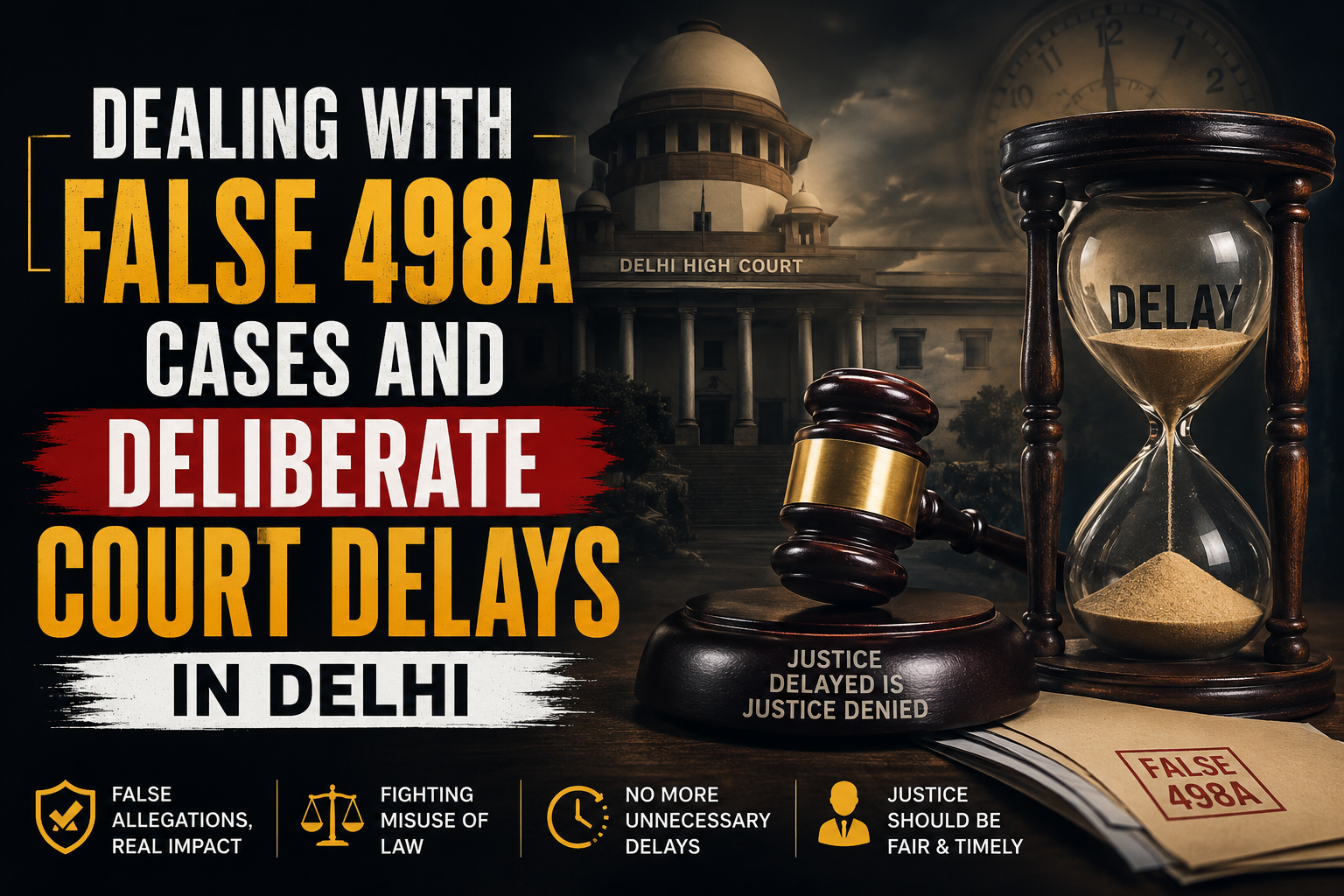
Dealing with False 498A Cases and Deliberate Court Delays in Delhi
A strategic guide for litigants facing bad-faith tactics in Delhi Family Courts
When Divorce Becomes a Weapon: Fighting Legal Harassment
Some spouses go to court for justice. Others go to cause pain. When a divorce turns into a personal vendetta, the law becomes a weapon.
From my observations of legal proceedings, I have noticed a lot of “calculated moves”. This includes the bogus 498A cases and time bound domestic violence complaints. Some people even skip hearings on purpose. These moves are not accidents. Their aim is to drain you of all your money and your morale.
If you are a litigant in Delhi and you’re in such a situation, you must understand the game. You probably have four situations going:
- The divorce petition.
- A Section 498A criminal case.
- A Domestic Violence (DV) application.
- A maintenance petition.
The hearings and paper work are separate to each case. Being hit by all of them at once is draining on the emotions.
What Makes Divorce Litigation in India a Tool for Harassment?
Matrimonial laws have been enacted in India for the protection of the unprotected. They were meant to stop abuse. All laws can be misapplied, however, if one is protected by a law, it can be misapplied.
The penalty it attracts is quite harsh under the Act of 498A and the DV Act. They can lead to arrest and social stigma. These are used for a divorce for the sake of a divorce. They take the other side by storm.
The defendants suddenly had to retain numerous attorneys. The financial toll is huge. The legal system moves slowly, and the “harasser” uses that speed to their advantage.
Recognizing Common Delay Tactics in Divorce Proceedings
The first step to winning is to identify delay tactics in divorce. These tactics follow a pattern. Once you see them, your advocate can stop them.
Common tactics include:
- Filing “Rejoinders” late: This pushes the next hearing date back by months.
- Changing Advocates: This is a classic trick to ask the Judge for “more time to study the file.”
- Missing Mediation: Claiming illness or travel to avoid sitting across the table.
TACTIC 1 — False Case Filings
False 498A case filing and domestic violence applications timed to coincide with divorce proceedings are among the most common and damaging delay tactics in divorce India. Their effect is twofold: they increase the legal burden on the other side, and they give courts reason to pause proceedings in one forum while another is pending.
A skilled advocate on the opposing side will use these parallel proceedings to argue for stays, adjournments, and delays in the main divorce trial. The result: your case stalls indefinitely while your opponent adds to their arsenal.
TACTIC 2 — The No-Show Game
Repeated non-appearance at hearings — by the opposing party or their witnesses — is a classic stalling mechanism. Each no-show results in an adjournment of 4 to 8 weeks. Over two years, that translates to 12 to 20 wasted hearings — years of your life sacrificed to procedural theater.
Courts do have provisions to address this. Under the Code of Civil Procedure, a party that repeatedly fails to appear can be proceeded against ex-parte. However, getting a court to exercise this power requires persistent, documented applications by your counsel — not a one-time ask.
TACTIC 3 — The Endless Cross-Examination
Cross examination delay in contested divorce cases can stretch for years when opposing counsel is instructed to drag it out. A witness is examined for one hour, then the matter is adjourned to the next date — two months away. This repeats, hearing after hearing, year after year.
Section 21B of the HMA and the Delhi High Court’s supervisory jurisdiction exist precisely to address this. If cross examination delay has persisted for more than a year without conclusion, your advocate can petition the High Court for a direction to complete it within a fixed number of sittings.
The Psychology of the Personal Vendetta Litigant
In many divorces, one party is not going to battle for the cash. They aren’t really concerned with property or alimony. Rather, they strive to maintain contact with you via the court system. They wish to continue the struggle. To them, each court date is a means of maintaining control over you.
You may be able to make a very reasonable offer. They will still reject it. This is NOT because money is cheap. It is because if you settle, then you are done with the fight. They are more afraid of the end of the conflict than anything else.
My Expert View: Logic cannot put an end to a personal vendetta. If someone wants to keep fighting, you aren’t going to be able to negotiate with them. There’s only one way to complete the case: You must go to court. You must be patient and strategic. You need a team that knows how to handle this mindset.
Building a Fierce Legal Team for Your Defense
When your opponent acts in bad faith, a good Divorce lawyer is a must. In case of false 498A or Domestic Violence (DV), having a strong team is essential. A top legal team will do the following for you:
- Plan Ahead: They predict what the other side will do. They build a paper trail before new charges are filed. This way, your defense is ready the moment an FIR is made.
- Fight the Charges: They will file a quash petition if it is obvious the case is false. It is carried out in Delhi High Court on the basis of Section 482 of CrPC (Criminal Procedure Code). With a well drafted petition, a criminal threat can be stopped in a matter of a few months.
- Track Every Delay: They write down every time the other side misses a hearing. They document long cross-examinations and fake excuses for delays. This is the record that is relied upon to try to compel the High Court to intervene.
- Move Faster: If the other side does not show up, your team asks for ex-parte proceedings. They do not just wait for the next date.
- Request a Speedy Trial: They apply for an expedited trial under Section 21B HMA. This happens when the delays go on for too long.
Waiting for the other side to make the next move in a vendetta-driven case is a losing strategy. A fierce legal battle, documented and escalated at every stage, is the only effective counter.
Protecting Your Mental Health During Matrimonial Litigation
Long legal battles do more than drain your bank account. This stress makes you sick, unproductive, and unhappy. Often the other party will exploit this stress. They want you to feel tired so you give up.
To survive a false 498A case defense or a contested divorce, your mental health is an asset to your case and needs to be used accordingly. The following steps are strategic needs:
- Set information boundaries: Do not look at cases every hour! Do not get involved in details of the domestic violence case when it is being discussed by your Divorce lawyer in Delhi. Only inform you of major changes. The more focus given to each filing the more matrimonial litigation stress.
- Seek professional therapy: Legal trauma is real. A therapist helps you stay calm. A calm mind makes better choices during a trial. This clarity is vital when you need to make big decisions.
- Build a parallel life: Do not let the case become your whole world. Keep up with your hobbies and routines. Your life must exist outside of the courtroom.
- Track the timeline: Be aware of your milestones. See the progress in a simple chart. Do not get frustrated if a hearing appears to be slow, remember the bigger picture. This gives you a sense of control.
You did not start this fight. However, you have to determine how to endure it. Keep your mind safe as well as your money.
Conclusion: Don’t Let Your Case Drag On Forever
Winning a false 498A case defense is about more than just a court order. It is about taking your life back. You need a clear documented counter-strategy. There has to be tools such as 498A quashing Delhi High Court petitions as well.
Do not wait for the other side to move. Take advantage of trial expediting apps and stop the delay. In law, inaction is your biggest enemy. Own it and break the vicious cycle of stress.
Contact Delhi Legal Expert today for a strategic defense consultation. Whether you’re facing false criminal cases, endless cross-examination, or calculated adjournment games, we have the experience to fight back — and to win.
📞 Book a confidential consultation with our matrimonial defense team today.
Frequently Asked Questions
Targeting Google’s People Also Ask (PAA) boxes
Q1. What is a false 498A case and how is it used in divorce proceedings?
A false 498A case is a criminal complaint in accordance with Section 498A IPC. It is an exaggeration or fabrication of the husband’s or his family’s part as the one who is being cruel. Many times, it is done by a spouse as a tool when the other spouse is seeking divorce.
This makes the case harder and very costly. It pressures the family of the husband socially. As an advocate, I suggest building a false 498A case defense strategy early. This is the best way to stop legal damage before it grows.
Q2. Can a false 498A case be quashed by the Delhi High Court?
Yes. These cases can be barred by the Delhi High Court under Section 482 of the CrPC. This is referred to as “quashing”. If it is a fake case or there is no proof, the court will do so. It also happens if the case is just a “counter-blast” to a divorce petition.
For success in quashing Delhi High Court petitions, strong documents are required. The court must have proof of a bad motive to file the case. An experienced advocate is key to winning this petition.
Q3. What can I do if cross-examination in my divorce case has been going on for over a year?
If your case is stuck, use the law to speed it up. An application can be made in accordance with Section 21B of the Hindu Marriage Act. This law calls for hearings every day.
Another option is to approach Delhi High Court via Article 227 as well. The High Court can order the trial court to finish the cross examination in a set number of days. Always have a record of all dates the other side has requested an adjournment. This list is the best proof of delay.
Q4. What are the most common delay tactics used in Indian divorce cases?
In my experience, many people use delay tactics in divorce India to tire out the other side. Common tricks include:
- Filing fake 498A or DV (Domestic Violence) cases.
- Missing court dates on purpose.
- Dragging out the cross examination for years.
- Filing useless “interim” applications.
- Appealing every small order to a higher court.
These tactics aim to increase your legal fees and exhaust you.
Q5. Is it possible to get ex-parte proceedings if the other side keeps missing hearings?
Yes. Ex-parte proceedings are possible under the Code of Civil Procedure. This happens if the other side misses court dates without a good reason.
Ex-parte: The judge will decide the case alone, based on your evidence. Your attorney should request this from your court at all times when the other party is not present. It is very important to keep a record of each missed appointment for the judge.