Tired of Prolonged Proceedings? How to Expedite Your Divorce in Delhi
Published by Delhi Legal Expert | Family Law | Delhi High Court & Saket District Court
Indian divorce proceedings are not fast. A legal process of negotiation can become a long and protracted emotional, financial and legal nightmare. If you’re stuck in a Delhi matrimonial case that is dragging on with no clear end in sight, you’re not alone – and, more importantly, you’re not powerless.
Here’s how to use the most successful strategies for quick divorce in Delhi: from leveraging mutual divorce under Section 13B of the Hindu Marriage Act, to asking the Delhi High Court to expedite the trial process, to facilitating structured mediation and applying pressure to resolve the case. Even if your partner is unwilling to cooperate, the law can help you find a way out – it all starts with knowledge of your options.
1. Why Indian Divorce Cases Drag On for Years — And the Toll It Takes
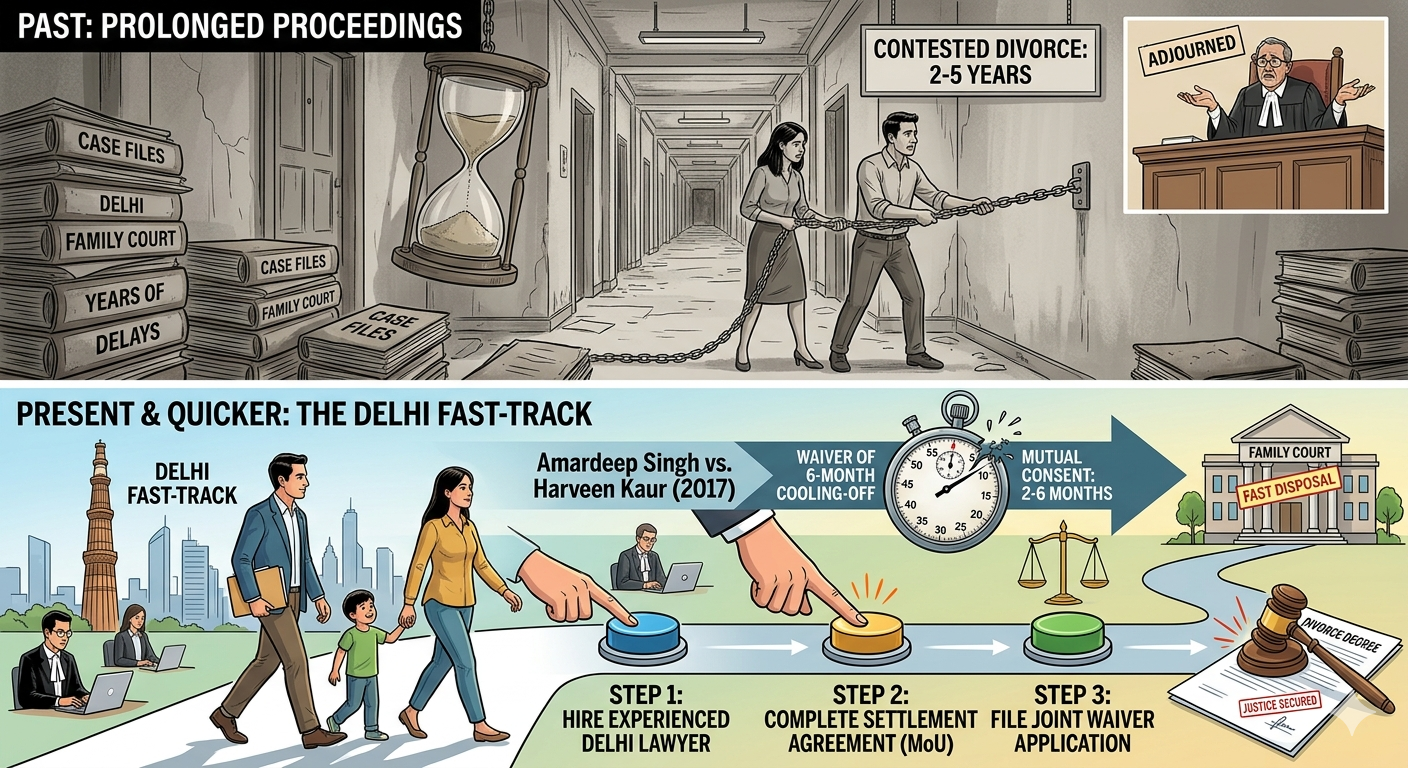
Indian divorce cases tend to be lengthy. The Family Courts in Delhi, be it at Saket District Court, Rohini, or Dwarka, are backed up with thousands of family cases. It’s not uncommon for an opposed divorce to take between three to seven years, or even more, to reach a final decree.
Several structural reasons drive this delay:
- Overcrowded Family Courts: Delhi’s Family Courts are dealing with a significant backlog of cases – petitions for maintenance and custody, settlements of matrimonial cases, petitions for domestic violence and petitions for divorce.
- Tactical adjournments: Often, one party strategically requests adjournments to delay the proceedings, in an attempt to exhaust the other party into accepting an unfavourable compromise or withdrawing the case.
- Incomplete documentation: Divorce petitions that are improperly drafted, lack critical annexures or are not accompanied by proper summons result in multiple procedural delays at the stage of admission and evidence.
- Multi-layered litigation: Applications for interim maintenance under Section 24 HMA, petitions for child custody, domestic violence and even criminal complaints – can be initiated and each follow a different process, adding to the complexity of the legal battles.
The impact of the delays on people’s lives is devastating. Those involved report extreme anxiety and depression, financial devastation and the inability to re-start their lives. Children of the warring parents are traumatised. Some abandon petitions and relinquish their rights to get out of the process.
But there is a better way.
2. The Quickest Remedy: Mutual Divorce Under Section 13B HMA
The fastest way to end a matrimonial dispute, according to lawyers, senior advocates and even internet forums, is mutual divorce. Where both parties agree that the marriage is beyond repair, litigating a contested divorce is a waste of time, money and effort.
What Is mutual divorce under Section 13B of the Hindu Marriage Act?
Divorce by mutual consent is provided under Section 13B of the Hindu Marriage Act, 1955 (HMA). This Section provides for a mutual petition for divorce by the spouses, where they state that they have been separated for a period of one year or more, and that they have mutually decided to divorce.
The Section 13B HMA process has two motions:
- First Motion: Husband and wife appear in the Family Court and present a joint petition. Statements are recorded.
- Second Motion: A waiting period (required by law) elapses, and both parties confirm their consent to divorce, on which the court grants the divorce decree.
Historically, the period between the First and Second Motion has been six months, the “cooling-off” period. But this delay is a significant cause of unnecessary delay when reconciliation between the parties is not the desired outcome.
Waiving the 6-Month Cooling-Off Period in Delhi
The Supreme Court of India in the case of Amardeep Singh v. Harveen Kaur (2017), ruled that the six-month cooling-off period under Section 13B HMA is not mandatory, and can be waived by the court if:
- The parties have been separated for more than 18 months from the date of filing of the petition.
- All other issues like alimony, custody and division of property have been resolved.
- The cooling-off period will only add to their misery with no chance of reconciliation.
In Delhi, Family Courts (such as Saket Family Court) regularly grant an application for waiving the cooling-off period when these requirements are met. When waived, a mutual divorce in Delhi is finalised in just three to six weeks from the date of the application, and is the quickest way to obtain a decree of divorce.
Why Mutual Divorce Makes Strategic and Financial Sense
- Privacy: There are no disputed allegations, no airing of personal inadequacies, and no cross-examination.
- Lower legal costs: A mutual divorce in Delhi is much cheaper than a contested divorce that drags on for years with numerous court hearings.
- Finality: A mutual decree is nearly impossible to appeal, and offers finality to the parties.
- Control: Parties decide on their own terms of maintenance, custody, property settlement – rather than having the court dictate terms after a protracted battle.
If your spouse is reluctant, see the sections below on mediation and influence for ways to sway them.
3. High Court Intervention: Using Delhi High Court to End the Delay
When mutual divorce is not feasible (due to the spouse’s unwillingness to cooperate or due to the contested case already being in the pipeline), Delhi High Court intervention is the best way to hasten the divorce process.
How the Delhi High Court Can Set Timelines for Family Courts
Article 227 of the Constitution of India gives the Delhi High Court “supervisory and control jurisdiction” over all courts in the state, including Family Courts. This allows the High Court to supervise the subordinate courts to ensure their efficient functioning and not to delay cases.
In family law cases, parties can petition the Delhi High CourtDelhi High Court for a direction to the Family Court to:
- Hear the case on a day-to-day basis until the stage of evidence is over.
- Examine and cross-examine witnesses within a specified time period.
- Make final orders at a certain time, usually six to 12 months.
Such directions have been passed by the courts in cases where there has been undue delay, unreasonable obstruction by one of the parties, or a case has been unduly pending.
Section 21B HMA: The Dedicated Fast-Track Provision
Section 21B of the Hindu Marriage Act (HMA), is an often overlooked section for litigants, and sometimes even lawyers. It states that:
- Matrimonial proceedings under the HMA should be conducted in camera (in private).
- Courts should, as far as possible, proceed with the case from day to day rather than granting long adjournments.
- There should be a continuous hearing until the matter is concluded.
This is a provision of the trial court but also offers an important statutory hook to take the matter to the Delhi High Court under Article 227 to ensure that this rule is being complied with. An application citing Section 21B HMA along with the provisions of Article 227 can lead to the High Court setting a timeframe for the Family Court to complete the case.
What to Expect When You File in the Delhi High Court
Filing a petition before the Delhi High Court to expedite divorce proceedings typically involves:
- Drafting a petition that documents the history of delays, adjournments, and their reasons in the Family Court below.
- Establishing that the delay is leading to irreparable loss – financial, mental, and of custody and children.
- Citing the applicable precedents where the Delhi High Court has intervened and set timelines in matrimonial cases.
- Seeking specific relief: an order for day-to-day hearing, the culmination of evidence in a certain number of months and final submissions and judgment at a pre-set date.
Very often, the mere filing of the High Court petition and notice to the respondent is sufficient to encourage the counter party to re-think their delaying strategies and open discussions.
4. Strategic Settlements: Mediation, External Influence, and Breaking the Deadlock
Even if a case is under litigation, the best and least traumatic outcomes in matrimonial litigation stem from settlements. When your spouse is uncooperative, the strategic use of pressure and mediation can make all the difference.
The Role of Court-Annexed Mediation in Delhi
Delhi’s Family Courts have Mediation and Conciliation Centres which are staffed with trained mediators, typically former judges or senior barristers, to help parties negotiate a settlement. Courts in Delhi increasingly refer cases for mediation, and encourage it prior to the submission of contentious evidence.
An effective mediator can:
- Uncover underlying interests and motivations.
- Identify the real interests behind each party’s stated positions.
- Explore creative solutions on alimony, child custody arrangements, and property division that a court judgment could never provide.
- Provide a safe environment for parties to voice their emotions that lead to conflict and non-cooperation, and de-escalate them.
Experience and research consistently demonstrate that settlement in matrimonial cases achieved through mediation leads to greater compliance, and lower recourse to court to enforce compliance.
Using External Influence and Family Elders Constructively
In India, friends, family elders and other community members can be quite helpful in convincing an unwilling spouse to accept a settlement. This can be a sensitive matter to navigate, but it’s entirely appropriate and can be very effective.
Practical strategies include:
- Engaging trusted family elders from both sides to facilitate a structured conversation about settlement terms in a private, respectful setting.
- Bringing in religious or community leaders who have moral authority with the resistant spouse, and who can explain the benefits of a peaceful settlement.
- Enlisting the help of close friends who know both spouses’ circumstances to explain the financial and emotional toll of litigation.
The goal is that this pressure comes from outside to encourage a fair, voluntary resolution – not through coercion or blackmail. Pressure and bullying can result in legal and negligence claims, or even invalidate a settlement.
Financial Reality as a Persuasion Tool
Sometimes the best persuasion is an objective financial analysis. An itemized statement of what the cost of contested divorce proceedings will be for the husband and wife over the next three to five years, in terms of legal fees, court appearances, lost income and well-being, can lead an unwilling spouse to change his or her mind. Matrimonial case settlement today is nearly always more economically sensible than five years from now.
5. Conclusion: Moving from Litigation to Liberation
You don’t have to live by your protracted divorce case in Delhi. There are many strategies possible under the law and the right one will depend on your marriage – whether or not your spouse is willing to negotiate, whether you have children and how long the process has taken.
To summarise the fast-track strategy:
- If your spouse is willing, file for mutual divorce under Section 13B HMA immediately and apply for a waiver of the cooling-off period to conclude proceedings in weeks, not years.
- If the Family Court proceedings are being deliberately delayed, approach the Delhi High Court under Article 227 of the Constitution or invoke Section 21B HMA to compel a day-to-day hearing schedule and a fixed timeline for judgment.
- In parallel, pursue court-annexed mediation and engage trusted family elders and friends to explore whether an amicable matrimonial case settlement is achievable, even at an advanced stage of litigation.
The goal is not just a final divorce decree — it is the freedom to rebuild your life on your own terms, without the shadow of endless court dates and compounding legal costs.
Consult a Delhi Legal Expert Today
Every matrimonial case in Delhi is unique, and the right strategy requires an accurate assessment of where your case stands and what leverage is available to you. If you are considering approaching the Delhi High Court for a direction to expedite your divorce proceedings, or if you want to evaluate whether a mutual divorce settlement is achievable in your situation, consult an experienced divorce lawyer at Saket Court or the Delhi High Court who can map the fastest and most strategic route to your resolution.
📞 Book a confidential consultation with our Delhi matrimonial law team today.
Frequently Asked Questions (FAQ)
Q1. What is the fastest way to get a divorce in Delhi?
Mutual divorce under Section 13B of the Hindu Marriage Act is the quickest way. The 6-month waiting period can be waived in the Family Court in Delhi, provided both parties consent and all other issues, including alimony and custody are settled. A mutual divorce in Delhi can be finalised in 3-6 weeks.
Q2. Can the Delhi High Court force a Family Court to speed up a divorce case?
Yes. The Delhi High Court has the power to direct Family Courts to follow a day-to-day calendar of hearings and dispose of the proceedings within a certain time period, under Article 227 of the Constitution of India. This is an effective method of speeding up divorce cases in Delhi.
Q3. What is Section 21B of the Hindu Marriage Act?
This Section of HMA provides that proceedings under the Act should be heard in camera and should be heard as far as possible, without substantial interruptions. It establishes the grounds to approach the Delhi High Court for directions, if a Family Court is taking frequent and unreasonable adjournments.
Q4. How long does a mutual divorce take in Delhi after waiving the cooling-off period?
Once the waiver of the six-month cooling-off period is obtained (which requires a period of at least 18 months of separation and full settlement on alimony, custody and property), the Second Motion can be heard and the divorce decree can be obtained in three to eight weeks, depending on the schedule of the court.
Q5. What role does mediation play in expediting a divorce case in Delhi?
Court-annexed mediation at Delhi’s Family Courts allows both parties to negotiate a confidential settlement with the help of a trained mediator. A successful matrimonial case settlement through mediation is faster, cheaper, and more durable than a contested court judgment, and courts actively encourage it before proceeding to the evidence stage.